How much does suspension repair cost in Virginia?
There is no single Virginia price, and no official source publishes a dated one, so treat any flat figure with caution. The cost depends on which parts have failed, whether they are replaced in pairs, the vehicle and whether an alignment follows. In Virginia you can request a written estimate, and the shop cannot bill more than 10 percent above it without your approval.
Free to ask. Local shops send quotes, and you pay only when you book one.
By Kasra Taheri, Founder, LoclisPublished
Researched and drafted with AI, then checked claim by claim against the sources listed below before it was published. Prices and rules change; the dates beside each source say when it was last checked.
This is a job for a licensed pro in Virginia
This page explains what the work involves, the permits, what a licensed pro does and what drives the cost. It does not give step-by-step instructions, because this work needs a licence, a permit or both, and doing it wrong can injure someone. Before you hire, check the licence on Virginia's DPOR record.
Suspension repair costs whatever the shop quotes for your vehicle, and the number can be small or large depending on what has worn out. We found no dated, primary-source Virginia price list for suspension work, so this guide does not quote a figure. It explains what drives the price, what Virginia's inspection rules say about suspension parts and how to compare estimates fairly.
What "suspension repair" can mean
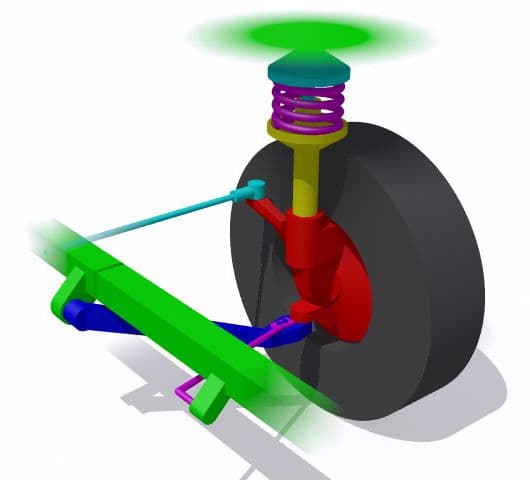
The suspension is a group of parts that carry the weight of the car, keep the tires on the road and let the wheels move over bumps. A quote might cover one part or several:
- Shocks or struts. The dampers that control bounce. On many cars the strut also holds the coil spring and part of the steering geometry.
- Springs. Coil or leaf springs, or air springs on some vehicles.
- Control arms, bushings and ball joints. The links and pivots that hold each wheel in place.
- Stabilizer bar links. Small rods that reduce body roll and are a common source of clunks.
- Alignment. Setting the wheel angles after parts are replaced.
Two shops quoting "suspension repair" may be pricing very different lists. Ask for the scope in writing before you compare totals.
What drives the cost
Which parts have failed. A worn stabilizer link is a much smaller job than a pair of struts, and both are smaller than a set of control arms with new ball joints. Virginia's inspection rules show how many parts count: they direct the inspector to reject a vehicle if a spring is broken, sagging or misaligned, or if air bags are collapsed or the air suspension system leaks or is deflated.[1] The same rules reject shock absorbers or cross stabilizer links that are disconnected, broken, bent, loose, or do not function properly,[1] and a MacPherson strut that is broken, bent, loose or does not function properly.[1]
One part or a pair. Dampers and springs on an axle wear together, so shops often quote both sides. Ask why, and whether the other side was inspected, not assumed.
Bushings and joints. A control arm may be sold with its bushings and ball joint attached, or as separate parts. The inspection rules reject any control arm or suspension positioning part that uses bushings if the bushing is missing, or worn to the extent that the component can be moved by hand along its axis.[1] Ask whether the quote replaces the whole arm or only the worn piece, and what that does to the price.
Vehicle type. Trucks, SUVs, performance cars and vehicles with adaptive or air suspension use more expensive parts and take longer to repair. Air suspension is a particular cost driver, because the same rules reject a vehicle when the system leaks or is deflated.[1]
Parts quality. Dampers and arms come as original-equipment, aftermarket and economy grades. Ask for the brand or grade on each line.
Alignment and related work. Replacing many suspension parts changes the wheel angles, so an alignment is often part of the job. Ask whether it is in the quote or billed separately, and whether the tires show uneven wear that suggests something else is wrong.
Rust and seized parts. Older, corroded vehicles can have bolts that will not come free. That adds labor, and a good shop will tell you before it happens.
Leaks and the inspection rule
A damp shock is not an automatic failure, and it is not an automatic sale either. The same rules say not to reject a shock absorber or MacPherson strut unless there is evidence of leakage that causes the device not to function properly.[1] If a shop tells you a shock is leaking, ask where, and whether it affects how the part works.
The rules are firm about the rest. Rear suspension parts, including control arms, ball joints, radius or torque arms, stabilizer bars and trailing arms, must not have any damage or noticeable play when checked with hand pressure.[1] A shop that finds play should be able to show it to you. For other repairs priced the same way, see how much a brake job costs in Virginia and how much exhaust repair costs.
Getting a quote you can compare
Virginia's Automobile Repair Facilities Act applies to any person who for profit diagnoses or corrects malfunctions of, or damage to, a motor vehicle.[2] On request, before any repair work for which you may be charged more than $25, the shop must give you a written statement of the estimated labor, the estimated parts, a description of the problem or work and the estimated completion time.[3]
Limits on the final bill: the shop cannot charge more than 10 percent over the written estimate, or 20 percent for a vehicle at least 25 model years old, unless you authorize the extra work or time.[3] A shop may charge a reasonable fee for the estimate and related diagnostic work, but must disclose the condition when you ask, in writing or on a sign posted at the entrance.[3] Ask about that fee before you hand over the keys.
When the work is done, you must get a written invoice that shows the work performed and the charges for parts and labor, separately stated, and identifies warranty parts and any used, rebuilt or reconditioned parts.[4]
Ask each shop for the same things:
- the vehicle, axle and parts named on the estimate, with brand or grade
- parts and labor on separate lines, with the alignment shown
- what was measured or seen to justify each part, and a chance to see it on the car
- the warranty on parts and labor, in writing
- a call for your approval before any work beyond the estimate
Two or three estimates for the same described symptom is enough. If one is far lower, the line items will usually show a smaller scope, a lower-grade part or a missing alignment.
When to call a licensed pro
For the suspension work itself. Suspension parts hold a car's wheels in place, and the work involves lifting the vehicle, compressing or releasing spring force and judging wear against the manufacturer's specifications, so a mistake is a safety problem and an inspection failure. Take the car to a qualified repair shop, and stop driving it if the steering feels loose, the car pulls hard to one side, a wheel wobbles or you hear metal knocking from a corner. Your protection is the estimate: a written, itemized scope and your approval of any change, backed by Virginia's Automobile Repair Facilities Act, including the estimate rules at law.lis.virginia.gov.
Loclis lists Virginia businesses by trade and area. Browse automotive repair services or read more automotive repair answers.
To get prices for your own car, describe the job once.
Common questions
- Why can't this page give a dollar figure?
- Because no Virginia government source publishes a dated price for suspension work, and the cost swings with the vehicle, the parts and the shop. A flat number would be a guess. What you can do is understand the line items and compare itemized written estimates.
- Do shocks and struts have to be replaced in pairs?
- Usually shops recommend replacing them in pairs on the same axle so the car handles evenly, but ask the shop to explain why for your vehicle. A worn part on one side does not always mean the other is bad, so ask to see the evidence for each.
- Will a leaking shock fail the Virginia safety inspection?
- Not by itself. The inspection rules say not to reject a shock absorber or MacPherson strut unless there is evidence of leakage that causes the device not to function properly. A shock that is broken, bent, loose or disconnected is a rejection item.
- Can a shop charge more than its estimate?
- Not by much. If you requested a written estimate, Virginia law bars a charge more than 10 percent above it, or 20 percent for a vehicle at least 25 model years old, unless you authorize the additional work or time.
- Do I have to pay for an estimate?
- Possibly. A shop may charge a reasonable fee for the written estimate and related diagnostic work, but it must disclose that condition when you ask, in writing or on a sign at the entrance. Ask about the fee first.
Sources
- [1] 19VAC30-70-110, Steering and suspension, Virginia Administrative Code, Department of State Police. Checked October 27, 2026.
- [2] Va. Code § 59.1-207.2, Definitions, Code of Virginia, Virginia General Assembly. Checked October 27, 2026.
- [3] Va. Code § 59.1-207.3, Written estimate for repair work required upon request, Code of Virginia, Virginia General Assembly. Checked October 27, 2026.
- [4] Va. Code § 59.1-207.5, Written invoice required upon completion of repair work, Code of Virginia, Virginia General Assembly. Checked October 27, 2026.
Want a pro to handle it?
Describe the job once. Licensed local businesses send quotes, and you pay only when you book one.
Get a quote for Automotive