How often should smoke detectors be replaced?
Replace the whole smoke alarm every 10 years, counted from the manufacture date, according to the U.S. Fire Administration. For a hardwired alarm, also replace the backup battery at least once a year and test the alarm monthly. Alarms that fail a test, chirp for end of life or are older than 10 years should be replaced sooner.
Free to ask. Local shops send quotes, and you pay only when you book one.
By Kasra Taheri, Founder, LoclisPublished
Researched and drafted with AI, then checked claim by claim against the sources listed below before it was published. Prices and rules change; the dates beside each source say when it was last checked.
This is a job for a licensed pro in Virginia
This page explains what the work involves, the permits, what a licensed pro does and what drives the cost. It does not give step-by-step instructions, because this work needs a licence, a permit or both, and doing it wrong can injure someone. Before you hire, check the licence on Virginia's DPOR record.
The short rule: replace the entire smoke alarm every 10 years. The U.S. Fire Administration puts it as a simple fact about age: alarms "need to be replaced 10 years from the manufacture date."[1] That applies to hardwired alarms as much as battery ones, so a house wired in 2012 may be due now even if every unit still tests fine.
The three timelines to keep
For a smoke alarm that is hardwired into the home's electrical system, the agency's advice reads: "Test the alarm monthly. Replace the backup battery at least once every year. Replace the entire smoke alarm every 10 years."[1]
Manufacturers' wording varies, so read yours. First Alert's hardwired manual asks for a test once a week ("Test this Smoke Alarm once a week.") and says "Replace Alarm 10 years after installation."[2] The two counts start from different dates, so use the earlier one: the U.S. Fire Administration counts from the manufacture date printed on the alarm, and First Alert counts from installation.
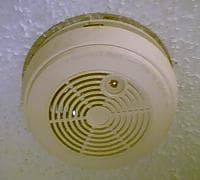
Signs an alarm is due sooner
Many alarms tell you. First Alert's manual says the alarm will also provide an audible End-of-Life Signal approximately 10 years after installation to remind you to replace the unit,[2] and its table lists the pattern as 5 chirps every minute.[2] Kidde sealed-battery models chirp every 30 seconds to indicate it is time to replace the alarm.[3] Patterns differ by brand; why a hardwired detector chirps explains how to read them.
An alarm that fails its test should not wait for its birthday: First Alert says the unit "should be replaced immediately if it is not operating properly."[2] If you have an alarm that is chirping at end of life, First Alert warns: "Do not unplug or deactivate the Alarm until you get replacement."[2]
Keeping track
An old house often has alarms of mixed ages, because one was added when the kitchen was remodelled and another was swapped after a nuisance alarm. A simple habit works: write the install year and the replace-by year on a note kept with your home records, and list every alarm by room, including the basement and any hall outside bedrooms. An electrician doing a visit can read the manufacture date off each unit.
Replace the set together where you can, so the alarms are one brand and one age and sound together when one detects smoke. First Alert's manual says to "Connect this unit ONLY to other compatible units," so mixing brands can be a problem.[2] See what replacing hardwired smoke detectors involves.
When to call a licensed pro
For the replacement itself. The U.S. Fire Administration says only qualified electricians should install hardwired smoke alarms.[1] In Virginia, no individual shall engage in, or offer to engage in, work as a tradesman unless he has been licensed,[4] and the Code defines a tradesman as someone doing work for the general public for compensation in the trades of electrical, plumbing and heating, ventilation and air conditioning.[5] Ask to see the electrician's licence and check it with DPOR before work starts.
For what a replacement costs, read what installing hardwired smoke detectors costs in Virginia, and for what the code asks of your house, what smoke alarms Virginia requires.
Loclis lists licensed electrical businesses with their licence details: browse electrical repair services or read more electrical repair answers.
To get a quote for your own house, describe the alarms you have and licensed local electricians reply.
Common questions
- Do hardwired smoke detectors last longer than battery ones?
- No. The U.S. Fire Administration gives the same 10-year replacement interval for a hardwired alarm as for one powered by a 9-volt battery. Wiring changes where the power comes from, not how long the sensor lasts. A sealed 10-year battery model is replaced as a whole unit according to its manufacturer's instructions.
- How do I find the age of my smoke detector?
- Look for the manufacture date on the back or side of the alarm. The U.S. Fire Administration counts the 10 years from that date, not from when it was installed. A hardwired alarm is fixed to the ceiling, so ask an electrician to read it if you cannot do so safely.
- Should I replace smoke detectors if they still pass the test?
- If they are past 10 years from manufacture, yes. The U.S. Fire Administration's 10-year rule is based on age, not on whether the alarm still passes a test.
- Do I replace all the alarms at once?
- Usually yes, when they are interconnected. First Alert's manual says to "Connect this unit ONLY to other compatible units," so mixing brands can be a problem.[^firstalert] Ask for matching, interconnected alarms in a written quote.
- Does the replacement need a permit in Virginia?
- Ask your local building department, and see our guide to what replacing hardwired smoke detectors involves.
Sources
- [1] Smoke Alarms, U.S. Fire Administration, FEMA. Checked October 27, 2026.
- [2] User's Manual, Smoke Alarm AC Powered Dual Sensor with Battery Backup, Model SM300-AC, First Alert (BRK Brands). Checked October 27, 2026.
- [3] What Causes Consistent Chirping?, Kidde. Checked October 27, 2026.
- [4] Va. Code § 54.1-1129, Necessity for licensure, Code of Virginia, Virginia General Assembly. Checked October 27, 2026.
- [5] Va. Code § 54.1-1128, Definitions (Tradesmen), Code of Virginia, Virginia General Assembly. Checked October 27, 2026.
Want a pro to handle it?
Describe the job once. Licensed local businesses send quotes, and you pay only when you book one.
Get a quote for Electrical Repair