What does replacing hardwired smoke detectors involve?
A licensed electrician finds every hardwired alarm, checks how old each one is, replaces them with matching interconnected alarms, and tests the whole set. The U.S. Fire Administration says only qualified electricians should install hardwired smoke alarms, and alarms should be replaced every 10 years. Ask whether your locality wants a permit for the swap.
Free to ask. Local shops send quotes, and you pay only when you book one.
By Kasra Taheri, Founder, LoclisPublished
Researched and drafted with AI, then checked claim by claim against the sources listed below before it was published. Prices and rules change; the dates beside each source say when it was last checked.
This is a job for a licensed pro in Virginia
This page explains what the work involves, the permits, what a licensed pro does and what drives the cost. It does not give step-by-step instructions, because this work needs a licence, a permit or both, and doing it wrong can injure someone. Before you hire, check the licence on Virginia's DPOR record.
Replacing hardwired smoke alarms is a job for a licensed electrician. A typical visit means finding every alarm, checking how old each one is, replacing them with matching alarms that sound together, and testing the whole set. The U.S. Fire Administration is direct about who does it: "Only qualified electricians should install hardwired smoke alarms."[1]
Why hardwired alarms get replaced
Age is the usual reason. The U.S. Fire Administration says to replace the entire smoke alarm every 10 years, and says hardwired alarms "usually have a backup battery that will need to be replaced once a year."[1] The agency counts the 10 years from the manufacture date,[1] so check the date on each alarm.
Other reasons are a unit that chirps or fails its test, an old set made up of mismatched brands that no longer sound together, or a remodel that changes where alarms need to be. Mention any chirping when you book.
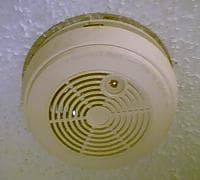
What an electrician does on a replacement visit
The exact steps depend on your wiring, but a visit usually covers these things:
- Finding and dating every alarm. Most homes have more than you remember: hallways, bedrooms, the basement and sometimes the attic stair.
- Matching the alarms to each other. The U.S. Fire Administration says to choose interconnected smoke alarms so that when one sounds, they all sound.[1] Alarms from different makers often do not talk to each other, so an electrician commonly replaces the whole set with one brand.
- Choosing the sensor type. The agency recommends that every home have both ionization and photoelectric smoke alarms, or dual-sensor smoke alarms.[1]
- Checking placement. The agency recommends alarms in every bedroom, outside each separate sleeping area and on every level of the home.[1] If one is missing from a level, the electrician can tell you what adding it involves.
- Testing. The whole set is tested together, so you know a push on one button sounds all of them.
The wiring work itself is why this is not a homeowner job.
Permits
Virginia's Uniform Statewide Building Code requires a permit application before installations or alterations involving electric wiring.[2] The code's list of ordinary repairs that need no permit names replacing switches, receptacles, luminaires and ceiling fans; smoke alarms are not on it.[2] The same list includes other repair work deemed by the building official to be minor and ordinary,[2] so whether a like-for-like swap needs a permit is, in practice, the local building official's call.
Phone your county or city building department before the work, or ask the electrician what that locality expects. If the job adds alarms or new wiring, say so when you call, because the permit answer may differ.
What to do while you wait
Do not disable an alarm that is sounding. The U.S. Fire Administration says never to take the battery out of your smoke alarm while cooking.[1] If a nuisance alarm keeps going off, ask the electrician about relocating that unit instead.
When to call a licensed pro
For the whole job. The Code of Virginia says no individual shall engage in, or offer to engage in, work as a tradesman unless he has been licensed,[3] and it defines a tradesman as anyone who does work for the general public for compensation in the trades of electrical, plumbing and heating, ventilation and air conditioning.[4] The Board for Contractors adds that if the work is valued at $1,000 or more, a valid Virginia Contractor's License is required.[5] Ask the electrician whether your job is above or below that figure.
Check the licence before work starts with how to check if a contractor is licensed in Virginia. Wondering about money first? See what installing hardwired smoke detectors costs in Virginia, and for what the code asks of your house, what smoke alarms Virginia requires.
Loclis lists licensed electrical businesses with their licence details. Browse electrical repair services or read more electrical repair answers.
To get a quote for your own house, describe the job once and licensed local electricians reply.
Common questions
- Can I replace a hardwired smoke alarm myself?
- The U.S. Fire Administration says only qualified electricians should install hardwired smoke alarms. A plug-in or battery-only alarm is a different product, but a hardwired unit connects to your home's wiring and belongs with a licensed electrician.
- How often do hardwired smoke alarms need replacing?
- The U.S. Fire Administration says to replace the entire smoke alarm every 10 years, and to replace the backup battery at least once a year. The agency counts the 10 years from the manufacture date.
- Do I need a permit to replace smoke alarms in Virginia?
- It depends on the job and the locality. The Uniform Statewide Building Code lists installations or alterations involving electric wiring among the work that needs a permit application, and smoke alarms are not among the listed exempt repairs. Ask your local building department, and ask the electrician who is pulling any permit.
- Should the new alarms be interconnected?
- Yes where you can. The U.S. Fire Administration recommends interconnected alarms so that when one sounds, they all sound, in every bedroom, outside each sleeping area and on every level.
- Can I take the battery out when the alarm goes off while cooking?
- No. The U.S. Fire Administration says never to take the battery out of your smoke alarm while cooking, and warns that disabling an alarm or removing the battery can be a deadly mistake. Its advice for a cooking alarm is to open a window or door and press the hush button.
Sources
- [1] Smoke Alarms, U.S. Fire Administration, FEMA. Checked October 27, 2026.
- [2] 13VAC5-63-80. Section 108 Application for permit (Virginia Uniform Statewide Building Code), Virginia Administrative Code, Virginia General Assembly. Checked October 27, 2026.
- [3] Va. Code § 54.1-1129, Necessity for licensure, Code of Virginia, Virginia General Assembly. Checked October 27, 2026.
- [4] Va. Code § 54.1-1128, Definitions (Tradesmen), Code of Virginia, Virginia General Assembly. Checked October 27, 2026.
- [5] What You Should Know Before You Hire a Contractor, Virginia Board for Contractors, DPOR. Checked October 27, 2026.
Want a pro to handle it?
Describe the job once. Licensed local businesses send quotes, and you pay only when you book one.
Get a quote for Electrical Repair