Why is my hardwired smoke detector chirping?
A chirp is a warning, usually from the backup battery or from age. Manufacturers use different patterns: First Alert's hardwired model chirps once a minute for a weak battery and five times a minute at end of life, and Kidde's low-battery chirp comes every 30 to 40 seconds. Check your model's manual, and use an electrician if the chirp persists.
Free to ask. Local shops send quotes, and you pay only when you book one.
By Kasra Taheri, Founder, LoclisPublished
Researched and drafted with AI, then checked claim by claim against the sources listed below before it was published. Prices and rules change; the dates beside each source say when it was last checked.
This is a job for a licensed pro in Virginia
This page explains what the work involves, the permits, what a licensed pro does and what drives the cost. It does not give step-by-step instructions, because this work needs a licence, a permit or both, and doing it wrong can injure someone. Before you hire, check the licence on Virginia's DPOR record.
A chirping hardwired smoke detector is telling you something needs attention, and it will not stop on its own. Most often the cause is the backup battery or the age of the alarm. Because the unit is wired into your home's electrical system, the fix belongs with a licensed electrician, and the chirp is a good reason to book one.
What the chirp pattern usually means
There is no universal code; each manufacturer sets its own, and the pattern is in your alarm's manual. Two examples show how much they differ.
First Alert's hardwired dual-sensor model signals a low battery with a horn that "Chirps 1x every minute," a malfunction with "3 chirps every minute" and the end of the alarm's life with "5 chirps every minute."[1] Its manual's advice: "If you hear 3 or 5 chirps every minute or so, replace the Smoke Alarm."[1]
Kidde describes a low battery differently. The alarm will chirp every 30-40 seconds (every 60 seconds for some alarms) for a minimum of seven days.[2] Kidde also says a malfunctioning alarm will chirp between flashes of the red LED, that a hush condition makes the alarm chirp every 30-40 seconds for approximately seven minutes while the Hush feature is activated, and that sealed-battery models chirp every 30 seconds to indicate it is time to replace the alarm.[2]
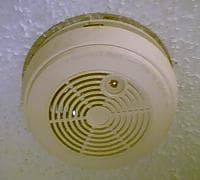
So a chirp every 30 seconds is a low battery on one brand and an end-of-life signal on another. Look for the model number on the alarm and read its pattern table before guessing.
The usual causes
A weak backup battery. Hardwired alarms usually have a backup battery that will need to be replaced once a year.[4] A tired battery is the most common source of chirping.
An alarm that has aged out. The U.S. Fire Administration says alarms need to be replaced 10 years from the manufacture date.[4] An old unit may chirp no matter what battery it has. See how often smoke detectors should be replaced.
A malfunction or a loose connection. Kidde says that an intermittent chirp usually means the battery is starting to lose charge, and rarely it could be due to the white wire becoming loose in the wire nut.[3] A loose wire inside a ceiling box is not something to check yourself.
A power interruption or a hushed alarm. First Alert's table lists the same "Chirps 1x every minute" when AC power is removed,[1] and Kidde says a hushed alarm chirps for approximately seven minutes.[2] Noting how long and how often it chirps helps tell these apart from a real fault.
What not to do
Do not silence it and forget it. First Alert's manual states that the silence features are for your convenience only and will not correct a problem,[1] and the low-battery chirp resumes after 8 hours.
Do not cut power to stop the noise. The same manual says: "Never disconnect the power from an AC powered unit to stop an unwanted Alarm."[1] The U.S. Fire Administration is blunt about the stakes: "Disabling a smoke alarm or removing the battery can be a deadly mistake."[4]
If you can tell which alarm is chirping, note its location and model number. If you cannot, say so; an electrician can trace it.
When to call a licensed pro
Call one when the chirp persists, when you cannot tell which unit it is, or when the alarms are 10 years old or more. The U.S. Fire Administration says only qualified electricians should install hardwired smoke alarms,[4] and First Alert's manual says wiring and installation must be performed by a licensed electrician.[1] In Virginia, no individual shall engage in, or offer to engage in, work as a tradesman unless he has been licensed,[5] and the Code defines a tradesman as someone doing work for the general public for compensation in the trades of electrical, plumbing and heating, ventilation and air conditioning.[6]
When you book, say which alarm chirps, how often, and what the alarm's date label says. For what a replacement visit includes, read what replacing hardwired smoke detectors involves, and for cost, what installing hardwired smoke detectors costs in Virginia. The code side is in what smoke alarms Virginia requires.
Loclis lists licensed electrical businesses with their licence details: browse electrical repair services or read more electrical repair answers.
To get a quote for your own house, describe the chirping alarm and licensed local electricians reply.
Common questions
- Why does my smoke detector chirp at night?
- The chirp is the same all day, but a quiet house makes it noticeable. It is a warning, not a false alarm: Kidde says a low-battery alarm will chirp every 30-40 seconds (every 60 seconds for some alarms) for a minimum of seven days.
- Can I just silence the chirp?
- Only temporarily. First Alert's manual says its silence features are for your convenience only and will not correct a problem, and the low-battery chirp resumes after 8 hours. Silencing buys time to book an electrician; it does not fix the alarm.
- Is it safe to disconnect the alarm to stop the noise?
- No. First Alert's manual says never to disconnect the power from an AC-powered unit to stop an unwanted alarm, and the U.S. Fire Administration warns that disabling a smoke alarm or removing the battery can be a deadly mistake.
- Why is the chirp still there after a new battery?
- That points to something other than a weak battery: an alarm at the end of its life, a malfunction, or, rarely, a loose connection. Kidde says a chirp between flashes of the red LED means a defective battery or other failure if the test button does not sound the alarm. An electrician can sort out which.
- Why are all my alarms chirping or going off together?
- Hardwired alarms are usually interconnected, so one unit's signal can be heard from several. It is often hard to tell which one is the source. An electrician can find the unit and check the others while on site.
Sources
- [1] User's Manual, Smoke Alarm AC Powered Dual Sensor with Battery Backup, Model SM300-AC, First Alert (BRK Brands). Checked October 27, 2026.
- [2] What Causes Consistent Chirping?, Kidde. Checked October 27, 2026.
- [3] What is Causing My Smoke Alarm to Sound, Beep, or Chirp?, Kidde. Checked October 27, 2026.
- [4] Smoke Alarms, U.S. Fire Administration, FEMA. Checked October 27, 2026.
- [5] Va. Code § 54.1-1129, Necessity for licensure, Code of Virginia, Virginia General Assembly. Checked October 27, 2026.
- [6] Va. Code § 54.1-1128, Definitions (Tradesmen), Code of Virginia, Virginia General Assembly. Checked October 27, 2026.
Want a pro to handle it?
Describe the job once. Licensed local businesses send quotes, and you pay only when you book one.
Get a quote for Electrical Repair