How much does it cost to install hardwired smoke detectors in Virginia?
No public source gives a Virginia labor price for hardwired alarms, so get written quotes. The alarms themselves are cheap: when we checked on October 27, 2026, the U.S. Fire Administration listed basic alarms from $6 and dual-sensor alarms from $24. Labor, new wiring, the number of floors and any permit make up the rest of the bill.
Free to ask. Local shops send quotes, and you pay only when you book one.
By Kasra Taheri, Founder, LoclisPublished
Researched and drafted with AI, then checked claim by claim against the sources listed below before it was published. Prices and rules change; the dates beside each source say when it was last checked.
This is a job for a licensed pro in Virginia
This page explains what the work involves, the permits, what a licensed pro does and what drives the cost. It does not give step-by-step instructions, because this work needs a licence, a permit or both, and doing it wrong can injure someone. Before you hire, check the licence on Virginia's DPOR record.
There is no public Virginia price list for installing hardwired smoke alarms, so the honest answer is to get written quotes. The alarms themselves are the cheap part: when we checked on October 27, 2026, the U.S. Fire Administration listed basic alarms from $6 and dual-sensor alarms from $24.[1] The rest of the bill is an electrician's time, any new wiring, and a possible permit.
What the alarms cost
The U.S. Fire Administration's smoke alarm page, checked on October 27, 2026, lists these starting prices:
- ionization and photoelectric alarms at $6 and up[1]
- dual-sensor alarms at $24 and up[1]
- alarms with a microprocessor at $30 and up[1]
- wireless alarms at $40 and up[1]
Those are prices for the devices, not for a hardwired installation. Some fire departments offer reduced-price, or even free, smoke alarms,[1] but that help is for the alarms, and the agency is clear on the wiring: "Only qualified electricians should install hardwired smoke alarms."[1]
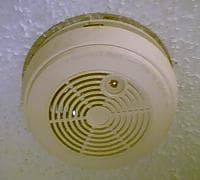
What drives the labor cost
Without a dated price from a Virginia source, the useful thing is to know what moves the number. Ask each electrician to price these separately.
Replacing versus adding. Swapping old alarms for new ones in the same spots is quicker than adding alarms to rooms or floors that had none, which needs new cable, new ceiling openings and repairs afterward. A house with no hardwired system at all is the largest job.
How many alarms. The U.S. Fire Administration recommends interconnected alarms in every bedroom, outside each sleeping area and on every level,[1] so a three-bedroom house with a basement needs more units than most people count.
Access. A finished ceiling, a plaster wall, a vaulted ceiling or an attic that is hard to reach all add time.
The alarms you choose. Dual-sensor and wireless units cost more than basic ones, and the electrician's markup on parts differs.
Drywall repair. Adding wiring can open the ceiling. Ask whether patching and painting are in the quote or left to you.
Minimum charges. Many electricians have a minimum visit fee, so a one-alarm job costs more per alarm than a six-alarm job.
Permit fees
Whether a given swap needs a permit is a local call. The Virginia Uniform Statewide Building Code lists installations or alterations involving electric wiring among the work that needs a permit application,[3] and fees are set by each locality; one example follows. On its fee schedule, checked on October 26, 2026, Montgomery County lists an electrical trade permit for residential and non-residential work, including accessory structures, at $0.03 per square foot with a minimum of $45, plus a Virginia State Levy of 2% of each fee and a technology fee of 2% with a minimum of $10.[2] Your county or city will charge differently. Ask the electrician whether the permit is in the quote and who pulls it. What replacing hardwired alarms involves explains when a permit question comes up.
Getting quotes you can compare
The Board for Contractors advises getting at least three written bids or estimates using identical plans and specifications.[4] For smoke alarms that means each electrician quotes the same number of alarms, the same type (interconnected, dual-sensor or wireless), the same locations and the same finish work. Ask for:
- the make and model of the alarms and whether the set is interconnected
- parts, labor and permit on separate lines
- whether drywall patching and paint are included
- what happens if the electrician finds old or damaged wiring
For payment, DPOR suggests an initial deposit of no more than 10% of the total price or $1,000, whichever is less.[4]
When to call a licensed pro
For the install. The Code of Virginia says no individual shall engage in, or offer to engage in, work as a tradesman unless he has been licensed,[5] and electrical work for the public is within that. Use how to check if a contractor is licensed in Virginia before you pay anyone. For hourly rates, see what electricians charge per hour in Virginia, and for what the code asks of your home, read what smoke alarms Virginia requires in a house.
Browse electrical services or read more electrical repair answers.
To get a price for your own house, describe the job once and licensed local electricians quote it.
Common questions
- How much does a hardwired smoke alarm itself cost?
- When we checked on October 27, 2026, the U.S. Fire Administration listed ionization and photoelectric alarms at $6 and up, dual-sensor alarms at $24 and up, and wireless alarms at $40 and up. Hardwired units vary by maker and features, so the electrician's parts line is the number to compare.
- Is labor or the alarm the bigger cost?
- Usually labor. The alarms are inexpensive, while the electrician's time, any new wiring, the number of floors and the access to each ceiling set the price. Ask each quote to separate parts, labor and permit.
- Does a smoke alarm installation need a permit?
- Adding alarms or wiring can. The Uniform Statewide Building Code lists installations or alterations involving electric wiring among the work that needs a permit application, and fees are set by each locality. Ask the electrician or your building department.
- Can my fire department help with the cost?
- Possibly with the alarms. The U.S. Fire Administration says some fire departments offer reduced-price, or even free, smoke alarms. Call your local non-emergency number. Hardwired alarms still need an electrician.
- How big a deposit is reasonable?
- The Board for Contractors suggests an initial deposit of no more than 10% of the total price or $1,000, whichever is less, with a higher deposit possible only for custom or special-order items.
Sources
- [1] Smoke Alarms, U.S. Fire Administration, FEMA. Checked October 27, 2026.
- [2] Permit & Inspection Fees, Montgomery County, Virginia, Building Permits and Inspections. Checked October 26, 2026.
- [3] 13VAC5-63-80. Section 108 Application for permit (Virginia Uniform Statewide Building Code), Virginia Administrative Code, Virginia General Assembly. Checked October 27, 2026.
- [4] What You Should Know Before You Hire a Contractor, Virginia Board for Contractors, DPOR. Checked October 27, 2026.
- [5] Va. Code § 54.1-1129, Necessity for licensure, Code of Virginia, Virginia General Assembly. Checked October 27, 2026.
Want a pro to handle it?
Describe the job once. Licensed local businesses send quotes, and you pay only when you book one.
Get a quote for Electrical Repair