How can I check my roof for damage from the ground?
Walk around the house with binoculars after big storms and in spring and fall, looking for cracked, curled, lifted or missing shingles, bare patches where granules have worn off, loose flashing at chimneys and vents, a sagging roofline and branches on the roof. Then check the attic with a flashlight for stains or wet spots. Stay off the roof; anything up close is a roofer's job.
Free to ask. Local shops send quotes, and you pay only when you book one.
By Kasra Taheri, Founder, LoclisUpdated
Researched and drafted with AI, then checked claim by claim against the sources listed below before it was published. Prices and rules change; the dates beside each source say when it was last checked.
This is a job for a licensed pro in Virginia
This page explains what the work involves, the permits, what a licensed pro does and what drives the cost. It does not give step-by-step instructions, because this work needs a licence, a permit or both, and doing it wrong can injure someone. Before you hire, check the licence on Virginia's DPOR record.
You can spot most roof damage without leaving the ground. The safe way is to walk around the house with binoculars and look for cracked, curled or missing shingles and loss of the protective mineral granules, then check the attic from inside. What you should not do is climb up: walking on a roof is dangerous and can damage it. Here is when to look, what each sign means, and when to call a roofer.
When to look
Make it a habit twice a year and after storms. A spring check leaves time for repairs in the warmer months, and a fall check comes before winter weather. A Forest Service roofing guide adds that flashings should be checked twice a year, when the roof is inspected and the gutters are cleaned.[1] Your own walk-around in those same months tells you whether that professional visit is needed.
Look again after any storm with high wind, hail or falling limbs. Small damage spreads: missing or torn shingles leave the roof open to water damage and rot, and nearby shingles are then easily ripped off or blown away.[1] Wait until the weather has cleared and the roof is dry, and stay well back from the house if branches are still hanging.
What to look for from the ground
Walk all four sides, and cross the street or step back in the yard to see the upper slopes. Binoculars, or a phone camera zoomed in, show far more than the naked eye.
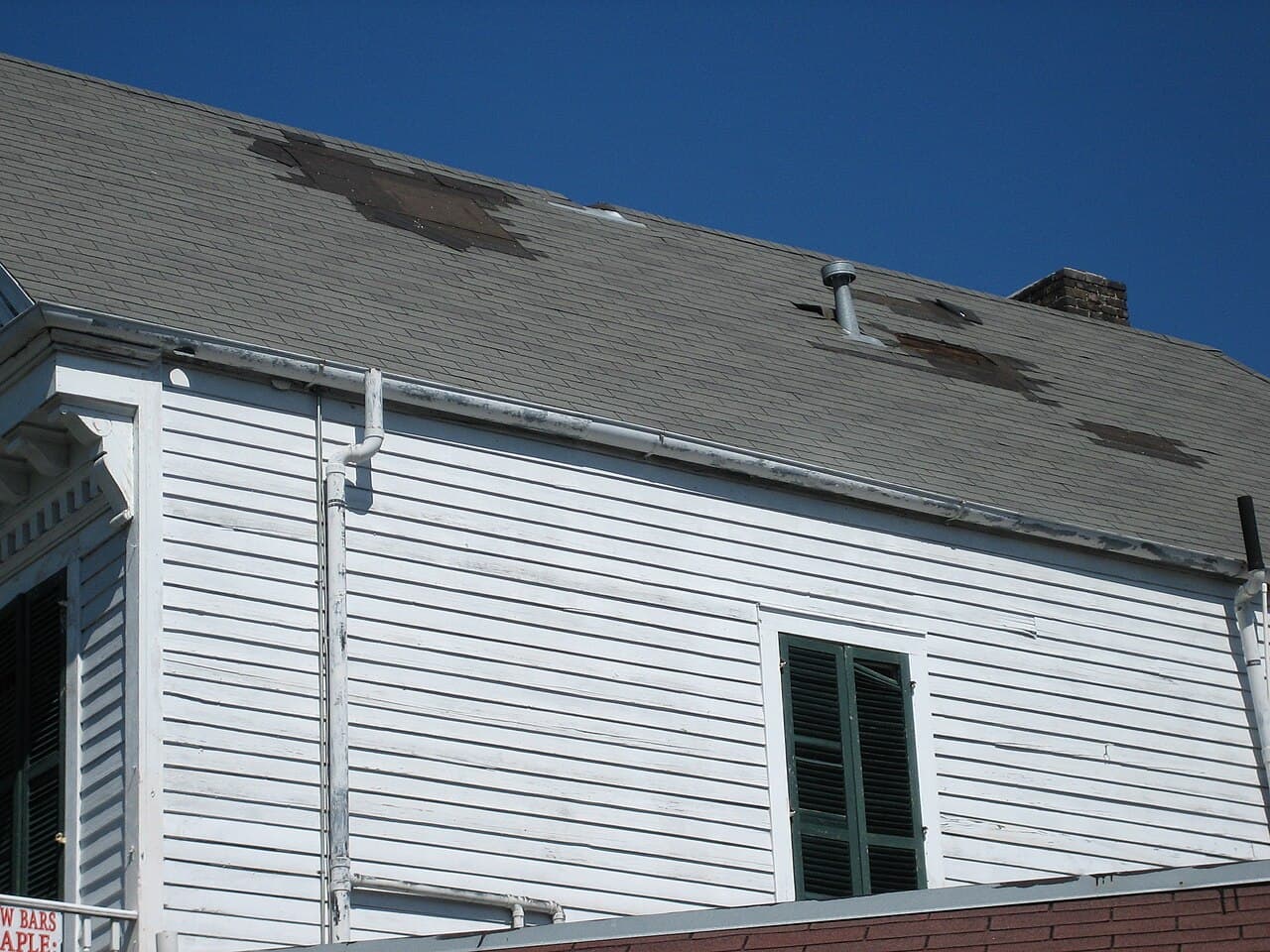
Missing or lifted shingles. Bare patches like those above are obvious. Lifted ones are harder to see: look for tabs that sit at a different angle or cast a shadow. High winds can lift shingle edges and force water and debris underneath,[1] and a lifted shingle can leak long before it blows off.
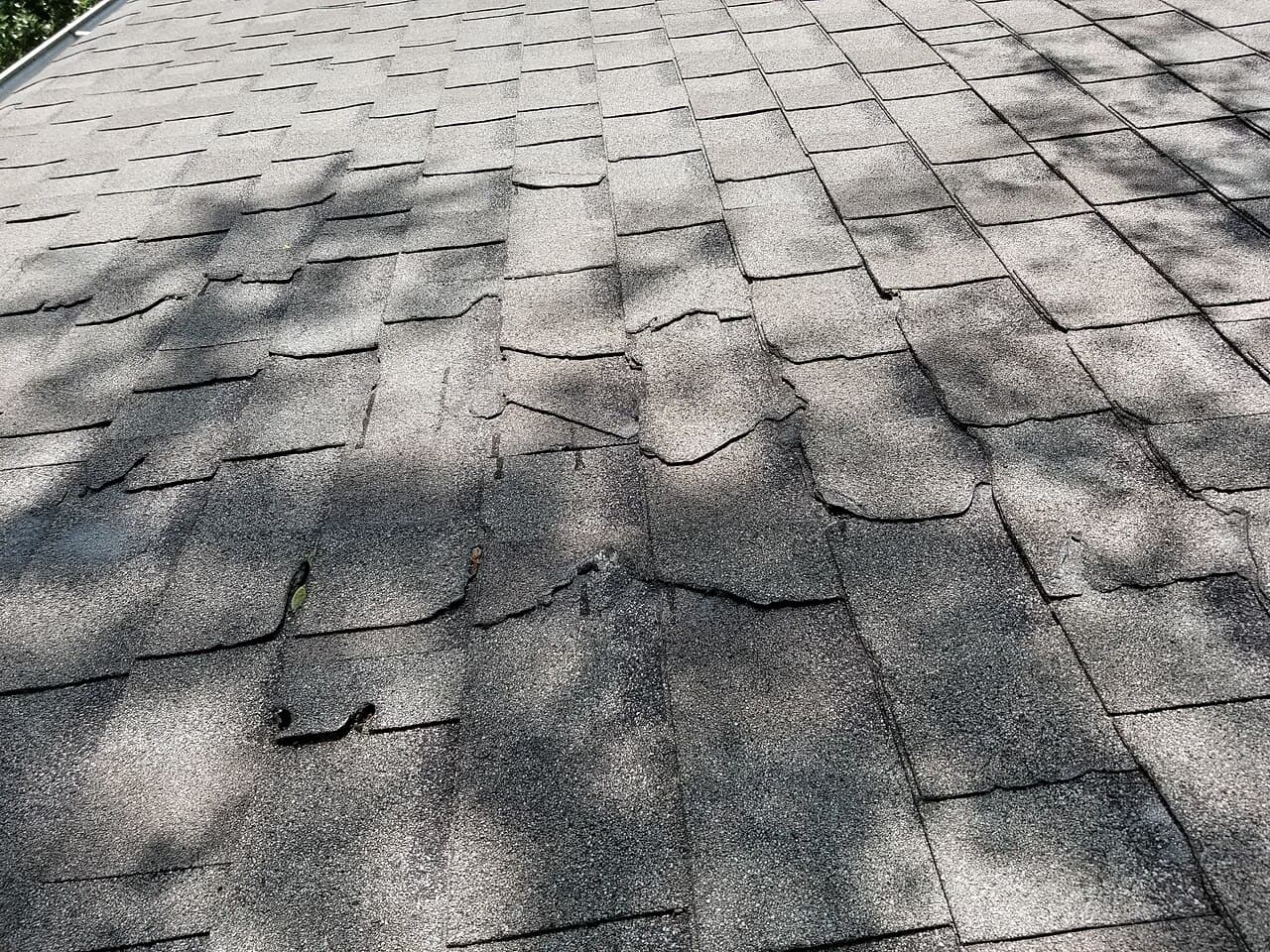
Cracks, creases and torn tabs. Up close these look like the photo below. From the ground, look for lines across shingles or a ragged edge on a row.
Granule loss. Granules are the colored crushed rock on the surface of the shingle. Worn areas show up as darker, smoother patches, and the grit collects in gutters and at downspout outlets.
Curling and splitting. When shingles become old and worn out, they curl, split and lose their waterproofing effectiveness.[1] Curling over most of the roof is a sign of age more than storm damage.
Flashing. Many apparent roof leaks are really flashing leaks,[1] so look hard at the metal around chimneys, vents, skylights and the joints where the roof meets a wall.[1] Bent, lifted or rusted pieces, or gaps where the metal meets masonry, are worth reporting.
The roofline. Sight along the ridge and the edges. A dip or sway is a structural warning, and a reason to have a roofer or structural engineer look at it.
Trees, debris and stains. Branches that touch the roof scratch and gouge it as they move in the wind, falling branches can puncture shingles, and leaves left on the roof hold moisture.[1] Algae grows in damp, shaded areas on asphalt-shingle roofs and leaves a black-green stain that can hold moisture.[1] Streaks alone are not a leak, but they show where the roof stays wet.
Gutters. Leaves in the gutters block drainage,[1] and overflowing water can soak the roof edge and fascia. See why gutters overflow.
Then check from inside
The attic tells you whether water is already getting in. Look at the underside of the roof deck and rafters with a flashlight for stains or wet spots that show water getting in, paying most attention below chimneys, vents and valleys. Also check ceilings on the top floor and the tops of exterior walls for new stains.
ENERGY STAR's attic checklist suggests a flashlight or headlamp, a hard hat or cap against sharp roofing nails, and safety glasses, gloves and a dust mask.[2] Walk on joists or truss chords, not on the ceiling drywall or insulation, so you don't fall through.[2] And one warning: Some attics have vermiculite insulation, a lightweight, pea-size, flaky gray mineral that may contain asbestos; do not disturb it unless it has been tested by an approved lab.[2] If the attic is hard to reach, leave it to the roofer.
Keep a record
Photos make every later step easier. Ready.gov's advice after a storm is simple: "Document any property damage with photographs."[4] Virginia's Bureau of Insurance likewise advises that you take photographs before cleaning or repairing anything and keep receipts.[3] Date your pictures and take the same shots each spring and fall, so a roofer, an insurer or a future buyer can see how the roof has changed.
Simple upkeep between checks
Gutters free of leaves, branches kept off the roof and sound caulk at joints all help a roof last. "Trees and shrubs should be trimmed away from the house to eliminate damp, shaded areas."[1] Hire out anything that needs a tall ladder or a chainsaw near the roof, and see how often to clean gutters.
When to call a licensed pro
Call a roofer when you see missing or lifted shingles, damaged flashing, a sagging line, or stains in the attic, and for the spring and fall inspection if the roof is getting old. Anything on the roof is their job.
After a storm, choose the roofer yourself. DPOR warns: "Be wary of door-to-door solicitations promising repairs at a discounted price."[6] In Virginia, work valued at $1,000 or more needs a valid Virginia contractor's licence, and for roofing-only work you may want a contractor licensed in that specialty.[5] Check any roofer using DPOR's License Lookup or by calling (804) 367-8511.[6] Read how to avoid roofing scams after a storm, when a roof can be repaired instead of replaced, or browse all exterior answers and roof inspection businesses.
Describe what you saw and add your photos, and licensed local roofers quote or offer to come and look.
Common questions
- How often should I look at my roof from the ground?
- In spring and fall, and after any storm with high wind, hail or falling branches. Those twice-a-year checks match when roofing groups suggest a professional inspection, so you can book one if you spot anything.
- What do granules in the gutter mean?
- Granules are the colored crushed rock on the shingle surface that protects the asphalt. A few are common. Heavy, steady loss on an older roof, with dark bare patches on the shingles, usually means they are wearing out.
- Can I use a drone or a ladder to get a closer look?
- A drone or a camera with a long zoom keeps you on the ground, which is the safe way to look. Climbing onto the roof is not: the shingle makers warn that walking on a roof is dangerous and can damage it.
- Is a dark streak on the roof damage?
- Usually it is algae, which grows in damp, shaded spots and leaves a black-green stain. It is not a leak, but it can hold moisture, so trim back overhanging branches and mention it to a roofer at the next inspection.
- What should I do if I find damage after a storm?
- Photograph it from the ground before anything is moved or fixed, keep receipts for any emergency work, and call your insurer if the damage is large. Then have a licensed roofer you contacted yourself look at it.
Sources
- [1] Overview of Roofing Materials for Forest Service Facilities (Tech Tip 0071-2314-MTDC, March 2000), USDA Forest Service, Missoula Technology and Development Center. Checked October 26, 2026.
- [2] DIY Checks and Inspections, ENERGY STAR (U.S. EPA and DOE). Checked October 26, 2026.
- [3] Disaster Strikes: Insured Homeowners Loss, Virginia State Corporation Commission, Bureau of Insurance. Checked October 26, 2026.
- [4] Hurricanes, Ready.gov (FEMA). Checked October 26, 2026.
- [5] What You Should Know Before You Hire a Contractor, Virginia Board for Contractors, DPOR. Checked October 26, 2026.
- [6] Disaster Recovery: Avoiding Fraud, Virginia Department of Professional and Occupational Regulation. Checked October 26, 2026.
Want a pro to handle it?
Describe the job once. Licensed local businesses send quotes, and you pay only when you book one.
Get a quote for Roofing