Why does my roof leak only when it rains hard?
A leak that shows up only in heavy or wind-driven rain usually means water is being pushed sideways or backing up, not dripping through an open hole. The usual causes are worn flashing at a chimney, vent or wall, shingle edges lifted by wind, a section pitched too low for shingles, and gutters or roof edges that overflow. A roofer can trace which from where the stain appears.
Free to ask. Local shops send quotes, and you pay only when you book one.
By Kasra Taheri, Founder, LoclisUpdated
Researched and drafted with AI, then checked claim by claim against the sources listed below before it was published. Prices and rules change; the dates beside each source say when it was last checked.
This is a job for a licensed pro in Virginia
This page explains what the work involves, the permits, what a licensed pro does and what drives the cost. It does not give step-by-step instructions, because this work needs a licence, a permit or both, and doing it wrong can injure someone. Before you hire, check the licence on Virginia's DPOR record.
A roof that stays dry in a steady shower but leaks in a downpour or a windy storm usually has a weak joint, not an open hole. Shingles are meant to shed water, but it is when rain is heavy or blown sideways that water finds the places where the roof system has a gap. These are the usual suspects, roughly in the order roofers find them.
Flashing at chimneys, vents and walls
The single most common cause is flashing. A Forest Service roofing guide puts it bluntly: "Many apparent roof leaks are really flashing leaks."[1] Flashings are pieces of metal or roll roofing that keep water out wherever something meets or passes through the roof: vent pipes, chimneys, walls, dormers and valleys.
These joints shed normal rain well enough. In a hard, wind-driven rain, water is pushed up and sideways into seams, behind a loose counterflashing on a chimney, or through a cracked rubber boot around a vent pipe. The same guide advises that flashings should be checked twice a year, when the roof is inspected and the gutters are cleaned.[1]
A stain near a chimney, on a wall below a dormer, or in a line below a vent pipe points strongly at flashing.
Shingle edges lifted by wind
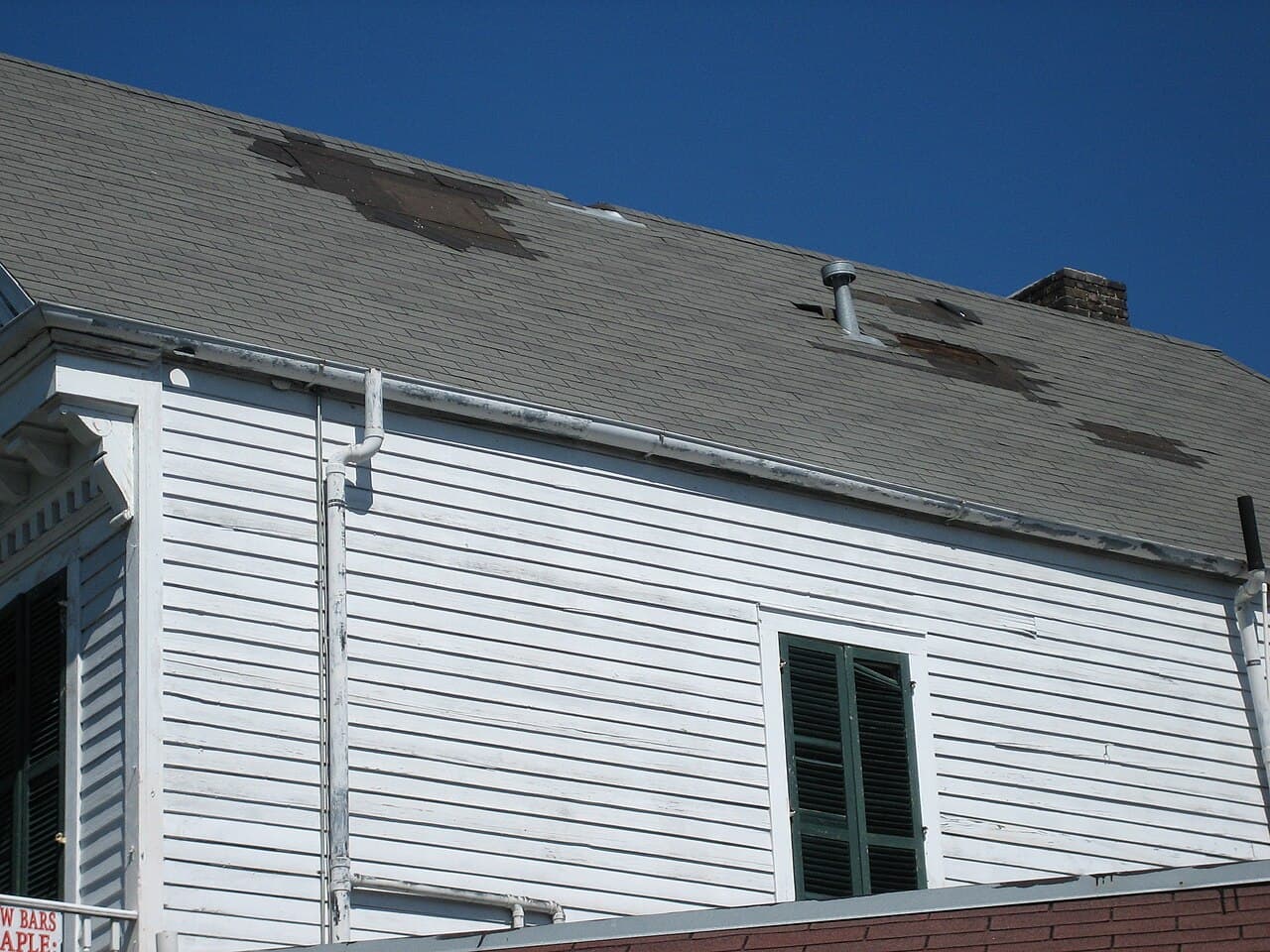
Wind turns small defects into leaks. "High winds can lift edges of shingles or other roofing materials, forcing water and debris underneath them."[1] A shingle whose seal strip has let go may lie flat on a calm day and lift only in a gust, which is why the leak comes and goes with the weather.
Older roofs are more prone to it. When shingles become old and worn out, they curl, split and lose their waterproofing effectiveness.[1] Nails can work loose too. The repairs roofers make here are routine: resealing wind-damaged shingles and fixing nails that have backed out.
A section pitched too low for shingles
Porch roofs, shed dormers and additions are often flatter than the main roof. The Department of Energy's Building America Solution Center says asphalt shingles should only be installed on roof slopes of 2 in 12 or greater, and that from 2 in 12 up to 4 in 12 a double underlayment application is required.[2] Water drains more slowly off a low slope, so a section built without that extra protection can let heavy or wind-driven rain back up under the shingles. Ask a roofer to check the pitch of any low section above a leak, and the transition where it meets a steeper roof.
Valleys and missing underlayment
Shingles are only the first layer. Beneath them sit the underlayment and the roof sheathing, and when shingles are damaged or blown off, the underlayment and sheathing are the only protection against rainwater.[2] Valleys carry the water from two slopes at once, so in a cloudburst they run deepest. Worn shingles in a valley, or a valley built without a good secondary layer, may leak only when the flow is heavy.
Overflowing gutters and roof edges
Sometimes the roof is fine and the water comes over or behind the gutter. Leaves in the gutters block drainage.[1] When a clogged or undersized gutter overflows in a downpour, water can run back behind the roof edge onto the fascia and deck. Stains along an exterior wall or at the top of a wall near the eaves, rather than mid-ceiling, often point here. See why gutters overflow and how often to clean gutters.
When it is not rain at all
If stains show up in cold weather with no rain, the cause may be condensation. Moisture in poorly ventilated attics promotes decay of the wooden roof sheathing and rafters,[1] and frost on the underside of the deck can melt and drip like a leak. A roofer or home inspector can tell the two apart.
What to note before the roofer comes
The more you can tell a roofer, the faster the leak is found. Write down the date of each leak, how hard it rained, which way the wind blew, and exactly where the water appeared. Photograph the stain each time so you can see whether it grows.
If the attic is easy to reach, you can look during or just after a storm: look at the underside of the roof deck and rafters with a flashlight for stains or wet spots. ENERGY STAR's attic safety advice applies: walk on joists or truss chords, not on the ceiling drywall or insulation, so you don't fall through, and watch for roofing nails pointing down from the roof deck.[3] Some attics have vermiculite insulation, a lightweight, pea-size, flaky gray mineral that may contain asbestos; do not disturb it unless it has been tested by an approved lab.[3]
When to call a licensed pro
Call a roofer after the first leak, not the fifth: each storm wets the decking and insulation again. Until then, limit the damage inside. Catch the water with buckets and keep it off ceilings and insulation, and stay off the roof: a wet roof is dangerous to walk on, and every repair is a job for a roofer.
In Virginia, work valued at $1,000 or more needs a valid Virginia contractor's licence, and for roofing-only work you may want a contractor licensed in that specialty.[4] Check any roofer using DPOR's License Lookup or by calling (804) 367-8511.[5] Before agreeing to a quote, read what roof repair costs in Virginia and when a roof can be repaired instead of replaced, or browse all exterior answers and roof leak repair businesses.
Describe when and where the roof leaks, with photos of the stain, and licensed local roofers quote or offer to come and find the source.
Common questions
- Why does the leak show up only when rain comes from one direction?
- Wind pushes water sideways into joints that shed ordinary rain, such as flashing at a chimney or wall, or shingle edges that have lifted. Note the wind direction during each leak; it points the roofer to the side of the roof to look at first.
- Can a leak be far from where the stain is?
- Yes. Water can enter at one spot, run along the deck, a rafter or the top of the insulation, and drip somewhere else. That is why a roofer checks the attic directly above and uphill of the stain, not just the ceiling below.
- My stains appear in winter even without rain. Is that a leak?
- It may be condensation instead. Warm, moist air in a poorly ventilated attic can condense on the underside of the roof deck. Tell the roofer when the stains appear, because the fix is ventilation rather than shingles.
- Is a low-slope porch roof more likely to leak?
- It can be. Shingles need special underlayment on slopes from 2:12 up to less than 4:12 and should never go on slopes below 2:12. Water drains more slowly there, and wind-driven rain gets in more easily.
- Should I go up and caulk the flashing myself?
- No. The asphalt roofing manufacturers recommend that only trained professionals walk, climb or work on a roof. Catch the water inside, note when it leaks, and have a licensed roofer find the source.
Sources
- [1] Overview of Roofing Materials for Forest Service Facilities (Tech Tip 0071-2314-MTDC, March 2000), USDA Forest Service, Missoula Technology and Development Center. Checked October 26, 2026.
- [2] Asphalt Shingle Roofs, Building America Solution Center, Pacific Northwest National Laboratory for the U.S. Department of Energy. Checked October 27, 2026.
- [3] DIY Checks and Inspections, ENERGY STAR (U.S. EPA and DOE). Checked October 26, 2026.
- [4] What You Should Know Before You Hire a Contractor, Virginia Board for Contractors, DPOR. Checked October 26, 2026.
- [5] Disaster Recovery: Avoiding Fraud, Virginia Department of Professional and Occupational Regulation. Checked October 26, 2026.
Want a pro to handle it?
Describe the job once. Licensed local businesses send quotes, and you pay only when you book one.
Get a quote for Roofing