When can a roof be repaired instead of replaced?
A roof can usually be repaired when the damage sits in one area and the rest of the roof is sound: a few wind-lifted or punctured shingles, a leaking flashing, or nails that have backed out. Replacement is the honest answer when the decking is rotted, the roof sags, the shingles are too distorted to lie flat, or the wear is spread across the whole surface.
Free to ask. Local shops send quotes, and you pay only when you book one.
By Kasra Taheri, Founder, LoclisUpdated
Researched and drafted with AI, then checked claim by claim against the sources listed below before it was published. Prices and rules change; the dates beside each source say when it was last checked.
This is a job for a licensed pro in Virginia
This page explains what the work involves, the permits, what a licensed pro does and what drives the cost. It does not give step-by-step instructions, because this work needs a licence, a permit or both, and doing it wrong can injure someone. Before you hire, check the licence on Virginia's DPOR record.
A roof can usually be repaired when the damage is in one place and the rest of the roof still has life in it. A repair makes sense for a few damaged shingles, a leaking flashing or nails that have backed out, because the work stays in one area. It stops making sense when the problem is the roof as a whole: rotted decking, a sagging structure, too many layers, or shingles worn out everywhere.
Damage that is usually repairable
Typical jobs a roofer can do in a short visit are replacing shingles torn or punctured by windborne debris, resealing or re-nailing shingles lifted by wind, re-securing nails that have backed out, and fixing or replacing flashing around a vent pipe, chimney or skylight.
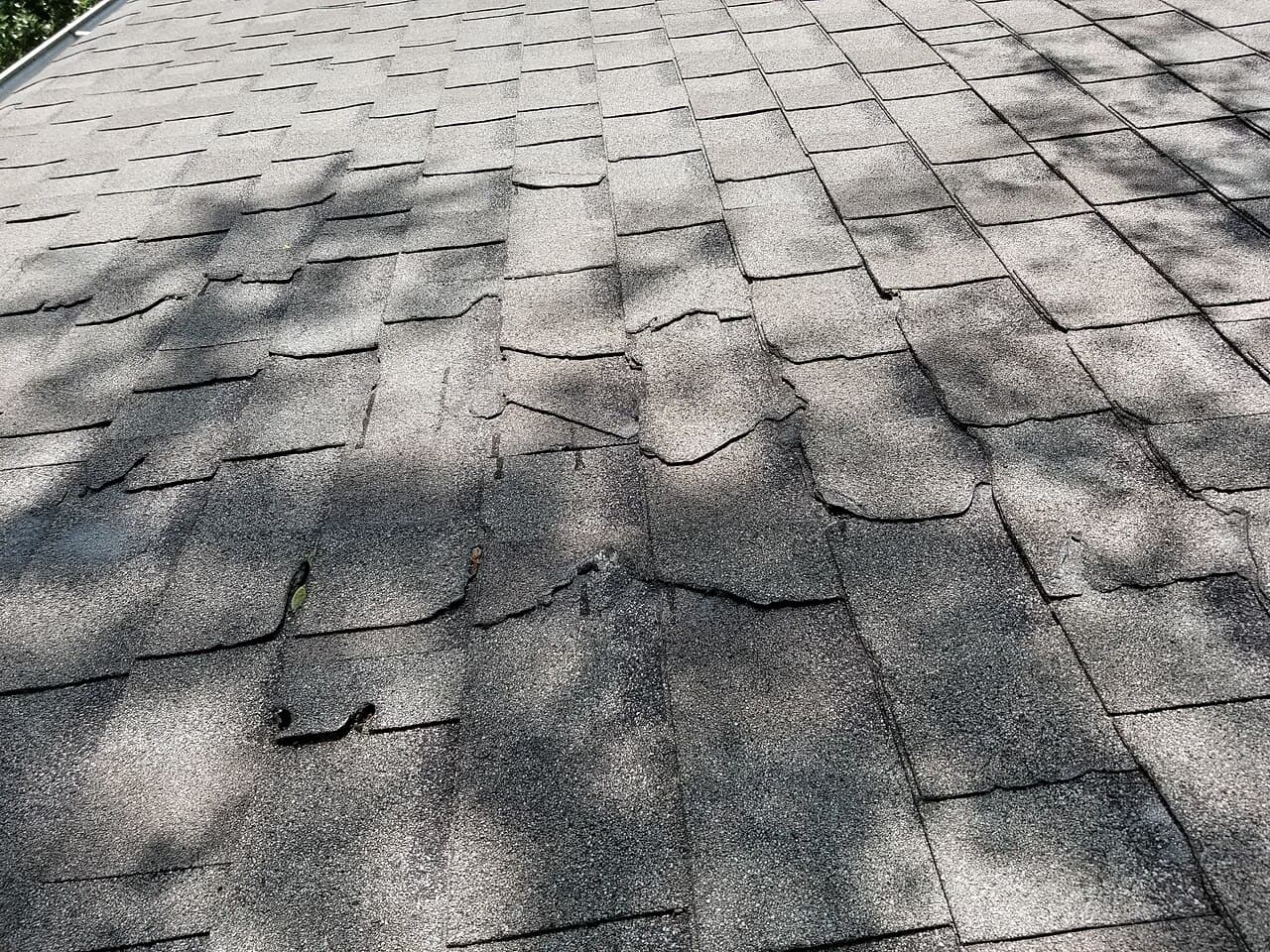
Damage like the patch above, a cluster of cracked and lifted tabs on an otherwise flat, intact roof, is the classic repair job.
Leaks around a chimney, vent pipe, skylight or wall are another common repair. As a Forest Service roofing guide puts it, "Many apparent roof leaks are really flashing leaks."[1] Resealing or replacing the flashing at one spot often fixes the leak without touching the shingles around it.
Timing matters. On a sound roof, missing or torn shingles leave the roof open to water damage and rot, and the problem tends to spread because nearby shingles are easily ripped off or blown away.[1] The same guide's advice is blunt: "Repair missing or torn shingles as soon as possible."[1] A repair done in the first weeks is small; the same damage left for a season can turn into decking work.
Signs the roof needs replacing instead
Some conditions mean the old shingles have to come off, which turns a repair into a replacement:
- rotted or warped wood, or large gaps between deck boards, under the shingles;
- sagging along the ridge or between rafters, which is a structural problem to have looked at by a roofer or a structural engineer;
- shingles so uneven and distorted that new ones could not be made to lie flat;
- several layers of shingles already on the roof.
Age and spread matter as much as any single defect. When shingles become old and worn out, they curl, split and lose their waterproofing effectiveness.[1] The same guide gives 3-tab fiberglass shingles a life of 15 to 25 years and architectural shingles 20 to 30,[1] so a roof near the end of that range is a poor candidate for repeated patching. If you see curling and splitting across every slope, patching one spot leaves the rest still failing. "A deteriorating roof only gets worse with time."[1]
Questions that tip the decision
Can the shingles be matched? Contractors often leave spare shingles from the original job. Without them, knowing the shingle's color name and the year the roof went on helps a roofer find a close commercial match. Even then, new shingles can look different at first because they have not weathered like the rest of the roof. A repair on a back slope matters less than one facing the street.
What is under the shingles? When water gets underneath the roofing, it can work its way to the deck and rot the roof structure.[1] Ask the roofer to show you photos of the decking at the damaged spot. Soft or dark wood there is the line between a repair and a larger job.
How many layers are there? Ask the roofer how many layers yours has before anyone proposes shingling over the old roof, and ask your building department whether another layer is allowed.
Is a permit involved? Virginia's building code treats small roof repairs as ordinary repairs. Under the Uniform Statewide Building Code, replacing 100 square feet or less of roof covering needs no permit in any wind zone.[2] Beyond that, an unlimited amount of roof covering can be replaced without a permit on most houses (Groups R-3, R-4 and R-5) where the nominal design wind speed is not greater than 100 miles per hour,[2] and replacing 256 square feet or less of roof decking on those houses is exempt too, unless the decking had to be fire-retardant-treated or otherwise protected when the house was built.[2] The building official may also require a permit for replacement roofing in a historic district a locality has designated, and for exempt work in a special flood hazard area,[2] so check with your building department. For the full rules, see whether you need a permit to replace a roof.
Temporary fixes are not repairs
After a storm, the first job is limiting water damage inside. Virginia's Bureau of Insurance says insurers expect homeowners to protect their property from further damage and will pay the reasonable costs associated with protecting the property, and that placing tarps on the roof is a way of protecting your property from further damage.[3] Put buckets under drips and move belongings out of the way, and leave the tarp to a roofer; it means working on the roof.
Be clear about what you are paying for. A roofer may make a temporary repair to stop water while proper materials arrive, and that is not the same as a repair. Ask in writing which one you are getting, and what the permanent fix will be.
When to call a licensed pro
Any work on the roof itself belongs to a roofer. Ask the roofer to say in writing whether they recommend repair or replacement and why, with photos of the damage and of the decking if they can see it.
In Virginia, licensing depends on the size of the job. Work valued at $1,000 or more needs a valid Virginia contractor's licence, and for roofing-only work you may want a contractor licensed in that specialty.[4] Under the Code of Virginia, a Class C contractor can take a single job over $1,000 but less than $30,000.[6] Check any roofer using DPOR's License Lookup or by calling (804) 367-8511,[5] or follow how to check a contractor's licence.
If the answer turns out to be a new roof, see how to tell if you need a new roof, what a new roof costs in Virginia and what roof repair costs. Browse all exterior answers, find roof repair businesses, or see exterior contractors in Blacksburg.
Describe the damage and add photos from the ground, and licensed local roofers quote or offer to come and look.
Common questions
- Can a roofer just patch the leak on an old roof?
- Often, yes, if the leak comes from one spot such as a flashing or a few damaged shingles. On a roof with curling or splitting shingles all over, a patch may only buy time, so ask the roofer to say in writing how much life the rest of the roof has left.
- Will repaired shingles match the rest of my roof?
- Usually close, not exact. Spare shingles left from the original job match best. Otherwise the color name and the year the roof went on help a roofer find a near match, and new shingles tend to blend in as they weather.
- Do I need a permit for a roof repair in Virginia?
- Usually not for a small repair. The building code exempts replacing 100 square feet or less of roof covering in any wind zone, and replacing 256 square feet or less of decking on most houses. Larger jobs depend on your area's design wind speed, so ask your local building department.
- Is roofing cement a real repair?
- Roofing cement over a puncture can hold water out for a while, but treat it as a stopgap. Ask the roofer to say in writing whether the fix is temporary, and what permanent repair they recommend.
- Can new shingles go over the old ones instead of a tear-off?
- Sometimes, but not if the decking is rotted or the old shingles are badly distorted. Ask the roofer how many layers are on your roof now and whether the building department allows another.
Sources
- [1] Overview of Roofing Materials for Forest Service Facilities (Tech Tip 0071-2314-MTDC, March 2000), USDA Forest Service, Missoula Technology and Development Center. Checked October 26, 2026.
- [2] 13VAC5-63-80, Virginia Uniform Statewide Building Code, Section 108 Application for permit, Virginia Department of Housing and Community Development (Virginia Administrative Code). Checked October 26, 2026.
- [3] Disaster Strikes: Insured Homeowners Loss, Virginia State Corporation Commission, Bureau of Insurance. Checked October 26, 2026.
- [4] What You Should Know Before You Hire a Contractor, Virginia Board for Contractors, DPOR. Checked October 26, 2026.
- [5] Disaster Recovery: Avoiding Fraud, Virginia Department of Professional and Occupational Regulation. Checked October 26, 2026.
- [6] § 54.1-1100. Definitions (contractor classes), Code of Virginia. Checked October 26, 2026.
Want a pro to handle it?
Describe the job once. Licensed local businesses send quotes, and you pay only when you book one.
Get a quote for Roofing