How do I check my sprinkler coverage so the lawn waters evenly?
Run a catch-can test. Set at least five wide-mouthed containers across a zone, run it for a timed period, and measure the water in each. Similar depths mean even coverage. Low cans show where a head is turned, tilted, blocked or too far from the next one, so adjust and retest.
Free to ask. Local shops send quotes, and you pay only when you book one.
By Kasra Taheri, Founder, LoclisPublished
Researched and drafted with AI, then checked claim by claim against the sources listed below before it was published. Prices and rules change; the dates beside each source say when it was last checked.
Step by step
Read when to stop and call a pro, further down this page, before you start.
Step 1: Run one zone
Start a single zone from the controller's manual watering function and watch each head's pattern.[4]
Step 2: Fix visible problems
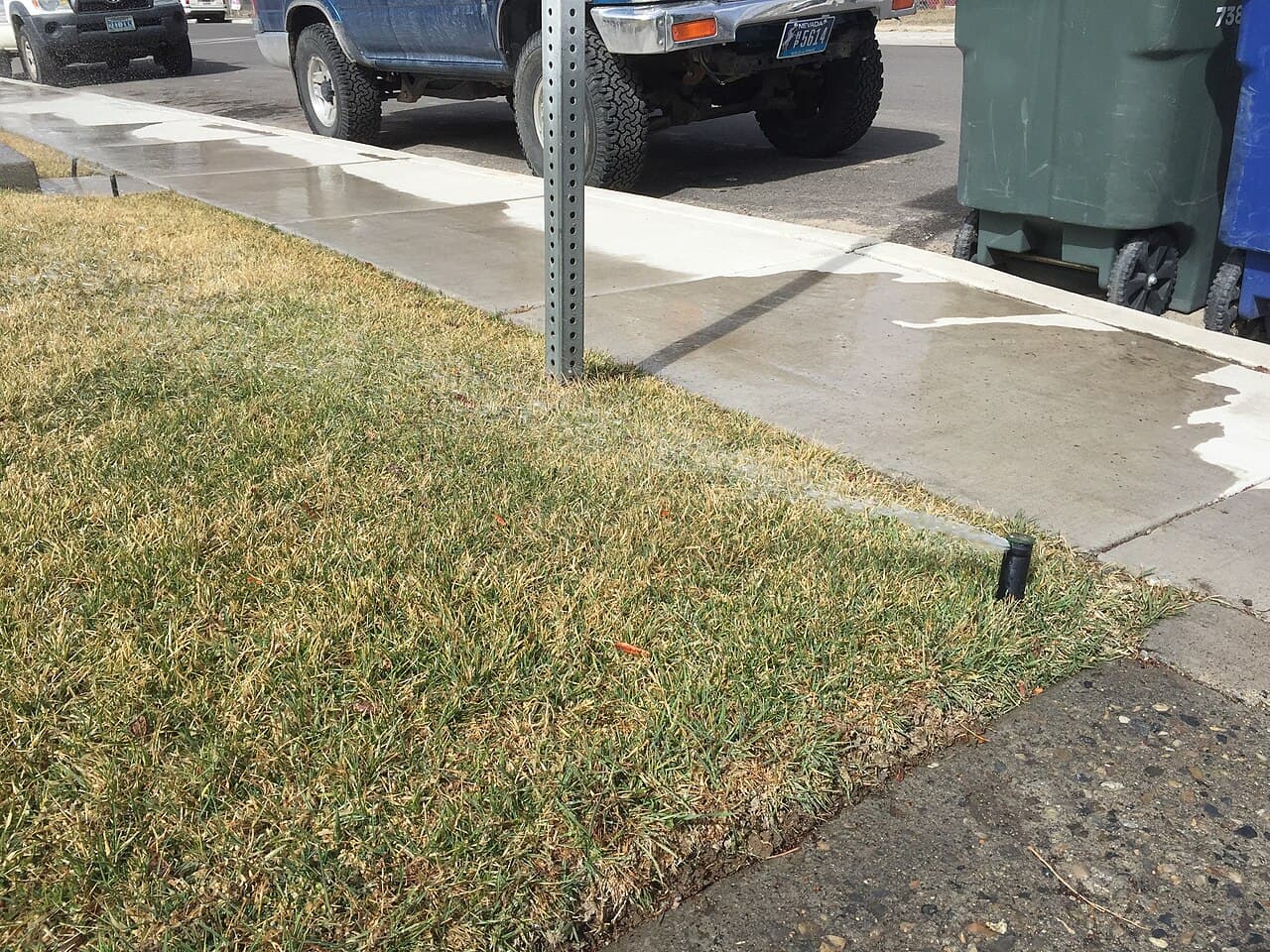
Straighten tilted heads and turn any spray hitting driveways, sidewalks or walls back toward the lawn.[2]
Step 3: Set out the cans
Place at least five wide-mouthed containers across the zone at about 20, 40, 60, 80 and 100 percent of the sprinkler's throw.[1]
Step 4: Run the zone and time it
Run the zone for a set period, such as 15 minutes, and write the time down.[1]
Step 5: Measure each can
Hold a ruler inside each can and record the depth, then average them.[1]
Step 6: Find the low cans
Note which cans are much lower than the average; those spots are watering unevenly.
Step 7: Adjust the heads
Use a small flat blade screwdriver to set spray direction and distance, or replace a worn nozzle.[4]
Step 8: Retest and set run times
Run the cans again, then use the average depth to set how long each zone runs.[1]
A catch-can test shows where your sprinklers water unevenly. Set out at least five wide-mouthed containers across a zone, run it for a timed period, then measure the water in each. Similar depths mean the lawn waters evenly; big differences show where heads need adjusting.
Before the test, walk the zone
Fix what you can see first. Start one zone or program at a time on your controller, using its manual watering function.[4] Then watch each head's spray distance and pattern, and check that the spray falls in droplets rather than misting, which wastes water.[4]
Look for heads that do not pop up fully or are tilted,[2] and for any sprinkler spraying onto driveways, sidewalks or walls. WaterSense says those should be turned towards the landscape, and a sprinkler can be adjusted to as wide or as narrow as necessary.[2]
The catch-can test
Virginia Cooperative Extension describes a basic irrigation system audit: check for uniform water distribution and overlap of any irrigation system by placing at least five broad, wide-mouthed containers at distances of approximately 20, 40, 60, 80, and 100 percent of the maximum throw of the sprinkler(s).[1] Straight-sided cans or plastic cups work if they are all the same size.
Run the zone for a set time, such as 15 minutes, and write it down. Then collect the output and note how long you ran the system and the average depth of water collected in the containers.[1] A ruler held against the inside of each can gives the depth.
Reading the results
Extension says this test will help to diagnose and prevent either dry or saturated areas that can lead to an unhealthy turf.[1] Compare the cans:
- Close to equal: coverage is good. Use the average to set run times.
- One or two cans low: the spot is too far from a head, the arc is wrong, or the head is blocked or tilted.
- Cans near the head much fuller than the far cans: the heads may not overlap enough. WaterSense says each sprinkler should be able to reach the sprinkler head next to it, known as head-to-head coverage.[2]
- Everything low and misty: pressure may be too high. WaterSense advises you to avoid overspraying or misting due to high pressure.[2]
Fix what the cans show
For spray heads, Rain Bird says to adjust spray action on the top of the sprinkler with a small flat blade screwdriver: twist the stem to align with desired spray direction, and turn +/- to adjust distance.[4] If a nozzle is broken, leaking around the head or not covering the desired area, replace it: pull up the stem, remove the old nozzle and filter screen, then fit a new filter screen and a nozzle with the proper pattern and throw distance.[4] Run the zone and test again.
Use the average depth to set your timing. Extension gives an example: if you need to run your system for 60 minutes to deliver 1 inch of water, but the lawn puddles at about 30 minutes, run it for no more than 30 minutes at a time and schedule two events a week.[1] How long to run your sprinklers walks through the arithmetic. If patches stay dry anyway, see why a lawn has dry spots even with sprinklers.
How often to recheck
WaterSense says a sprinkler spruce-up is not just for spring: regularly check your irrigation system to ensure no water is being wasted.[2] A good habit is one walk-through at the start of the watering season and another after any mower, trimmer or vehicle damage. Test with cans again after you change nozzles, heads or the layout.
Stop and call a pro if
- Water pools on the surface between cycles. WaterSense says it could be a sign of an underground leak.[2]
- Valves do not close fully. If the valves are not able to close completely, your system could slowly seep water even when it is turned off.[2]
- Coverage stays uneven after you adjust the heads. The zone may need a redesign. WaterSense notes that an irrigation professional certified by a WaterSense labeled program can install, maintain, or audit your irrigation system.[3]
- You are unsure about a repair. WaterSense says you may be able to fix broken heads yourself, but if you are unsure, go with a pro.[2]
Getting help in Virginia
Weighing a system against hand watering? Read whether you need a sprinkler system in Virginia. Loclis lists local contractors under lawn and landscaping, and there are more lawn and landscaping answers.
When you are ready, describe your sprinkler problem once and local contractors can quote it.
Common questions
- How many cans do I need for a sprinkler coverage test?
- Extension says at least five broad, wide-mouthed containers, set at about 20, 40, 60, 80 and 100 percent of the sprinkler's maximum throw. Use more if the zone is large or has several heads.
- How long should I run the zone during the test?
- Any set period works as long as you write it down, for example 15 minutes. Divide the average depth by the minutes to learn how much the zone applies per minute.
- What counts as uneven coverage?
- Cans that differ a lot from the average. A low can points to a gap in coverage, such as a turned, tilted or blocked head, or too little overlap with the next head.
- Can I do the test with a rain sensor or smart controller?
- Yes. The test measures what the sprinklers apply, not when the controller runs them. Run the zone manually, then compare cans.
- How often should I check my sprinkler coverage?
- WaterSense says to regularly check your irrigation system. At the start of the watering season and after any damage or head change is a sensible rhythm.
Sources
- [1] Summer Lawn Management: Watering the Lawn (430-010), Virginia Cooperative Extension, Virginia Tech. Checked October 27, 2026.
- [2] Sprinkler Spruce-Up, U.S. Environmental Protection Agency, WaterSense. Checked October 27, 2026.
- [3] Outdoors, U.S. Environmental Protection Agency, WaterSense. Checked October 27, 2026.
- [4] 3 Simple Repairs and Upgrades for Your Pop-Up Sprinklers This Spring, Rain Bird Corporation (manufacturer). Checked October 27, 2026.
Want a pro to handle it?
Describe the job once. Licensed local businesses send quotes, and you pay only when you book one.
Get a quote from a local pro