How long should I run my sprinklers to water the lawn?
Aim for about 1 inch of water a week in warm weather, counting rain, applied in one or two deep early-morning waterings. How many minutes that takes depends on your sprinklers, so set out a few empty cans, time how long they take to collect half an inch, and stop sooner if water puddles or runs off.
Free to ask. Local shops send quotes, and you pay only when you book one.
By Kasra Taheri, Founder, LoclisPublished
Researched and drafted with AI, then checked claim by claim against the sources listed below before it was published. Prices and rules change; the dates beside each source say when it was last checked.
Step by step
Read when to stop and call a pro, further down this page, before you start.
Step 1: List your zones
Find the controller and note which zone waters which part of the lawn, so you can time each one separately.
Step 2: Set out catch cans
Place at least five wide-mouthed containers across the zone, at about 20, 40, 60, 80 and 100 percent of the sprinkler's throw.[1]
Step 3: Run the zone for a timed test
Run just that zone for a set number of minutes and write the time down.
Step 4: Measure the depth
Measure the water in each can with a ruler and average them to learn how much the zone applies per minute.[1]
Step 5: Work out minutes for half an inch
Divide half an inch by the depth per minute. Half an inch twice a week meets the target of about 1 inch a week.[1]
Step 6: Shorten the run if water puddles
If water pools or runs off before the time is up, run it for shorter periods instead.[1]
Step 7: Schedule it for early morning
Set the controller to start around sunrise, a few days apart, and avoid night watering.[1]
Step 8: Skip cycles after rain
Check a rain gauge and the soil, and pause the schedule when rain has done the job.[1]
Run each sprinkler zone long enough to put down about half an inch of water, twice a week, and skip a cycle when it has rained. That adds up to the 1 inch a week most lawns want in warm weather. How many minutes that takes depends on your sprinklers, so measure it once instead of guessing.
Virginia Cooperative Extension puts the target this way: most turfgrasses require approximately 1 inch of water per week — whether from rainfall or supplemental irrigation — to sustain growth during warmer conditions.[1] Rain counts toward the total, so in a wet week the answer can be zero minutes.
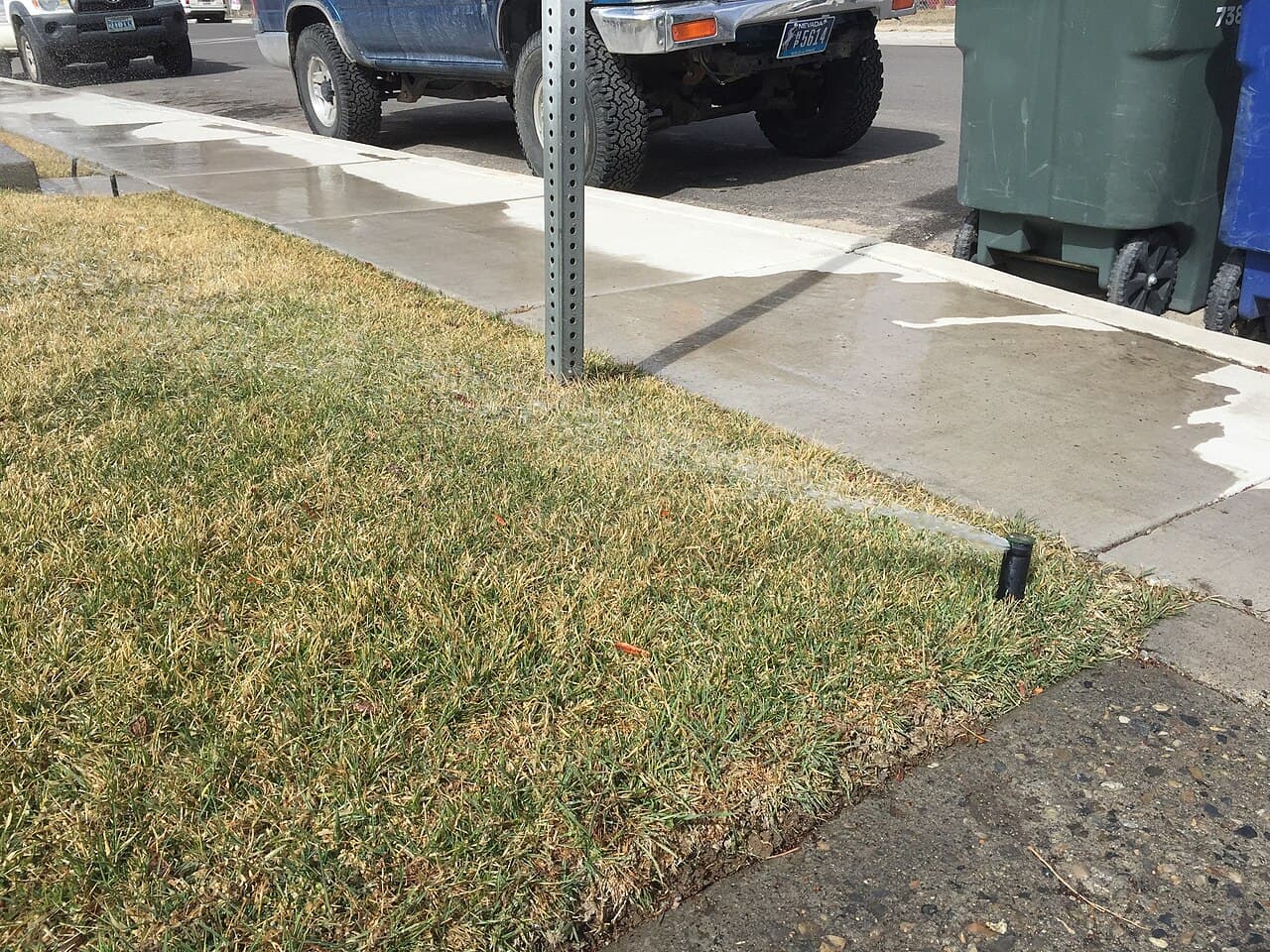
Why not just run it every day
Short daily runs feel gentle, but they work against the lawn. Deep and infrequent watering that thoroughly soaks the rootzone to a 4-inch depth maintains a healthy root system and reduces weed infestation, as opposed to light and frequent irrigation, which promotes shallow roots and germination of weed seeds.[1]
The opposite mistake is trying to put the whole inch down in one go. Effectively applying 1 inch of water is likely impossible to do in a single watering given the slow infiltration rate of most Virginia soils.[1] Extension's answer is to split it: smaller amounts of water applied every three to four days may be required to allow water to enter the soil without causing runoff.[1]
Measure your own minutes
Sprinkler heads differ enormously in how fast they apply water, so a neighbour's 20 minutes tells you nothing. The standard check is a catch-can test. Extension describes it as placing at least five broad, wide-mouthed containers at distances of approximately 20, 40, 60, 80, and 100 percent of the maximum throw of the sprinkler(s).[1] Straight-sided tuna cans or small plastic tubs work. Run one zone for a timed period, then measure the depth in each container and average them.
Then do the arithmetic. Extension's worked example: if you need to run your system for 60 minutes to deliver 1 inch of water,[1] but the lawn starts puddling around the 30-minute mark, you can develop a responsible irrigation program in which you run your sprinklers for no longer than 30 minutes per irrigation event in order to avoid puddling.[1] This will provide one-half inch of water, and you can now schedule two irrigation events during the week.[1]
Your own numbers will differ, but the method is the same. Test each zone, because shaded, sloped or clay-heavy zones often need different times than a sunny flat one.
When in the day to water
Early morning wins. Water is best applied early in the morning,[1] a few hours before or just after sunrise, when evaporation loss and wind are lowest. Afternoon watering is acceptable, but wind may affect uniformity, and evaporation loss is greater.[1] Night watering is to be avoided unless it is the ONLY time possible because it greatly increases the chances of fungal diseases by keeping the leaf blades wet for hours.[1]
Adjust for rain, grass and age
Take the schedule as a starting point. Remember that if nature provides water by rainfall, irrigation may not be needed.[1] Use a rain gauge to keep track of rainfall[1] and look at the soil before every run. A rain sensor on an automatic system does this for you: rain sensors optimize water use efficiency and should be a part of any installed irrigation system.[1]
Grass type matters. Warm-season grasses (bermudagrass, zoysiagrass, centipedegrass, and St. Augustinegrass) are much more efficient water users than are cool-season grasses,[1] so a zoysia lawn needs less than a tall fescue lawn. New lawns are the exception to everything above: newly sodded or seeded lawns require more frequent watering (for the first three to four weeks) than do well-established lawns.[1] For those, see how often to water new sod and new grass seed.
Signs you are over or under watering
Too much water is a real problem, not a safe error. Overwatered lawns frequently lead to excess blade growth, summer fungal diseases, and more frequent mowing.[1] Too little shows up as footprinting: the grass blades will not spring back if you walk across the lawn, and your footprints will be visible.[1]
If you choose to let a lawn go brown in a dry stretch, that is survivable. Lawns that receive little to no water from irrigation or rainfall during summer months will go dormant, and most lawns will recover when water returns.[1]
Stop and call a pro if
- A zone stays soggy or a patch is always wet with the schedule off. That points to a leaking buried pipe or a valve that is not closing.
- Water pours from a head or the ground after the zone shuts off, or a zone will not shut off from the controller.
- Heads do not pop up, spray in one direction only, or the pressure drops across every zone after you have cleaned the nozzles.
- Your water bill jumps with no change in the schedule. On landscape irrigation, EPA's WaterSense program says: Experts estimate that as much as 50 percent of this water is wasted due to overwatering caused by inefficiencies in irrigation methods and systems,[2] so a system that runs but wastes water is worth an audit.
- The fix means digging or touching the controller's wiring. Landscape irrigation contracting is the Board for Contractors' specialty for the installation, repair, improvement, or removal of irrigation sprinkler systems or outdoor sprinkler systems.[3]
Getting help in Virginia
Once the run times are right, keep the grass itself healthy with how often to mow. If you are weighing a system, see whether you need a sprinkler system at all. Browse more lawn and landscaping answers or lawn and landscaping businesses.
When a leak, a stuck valve or a dead controller needs a licensed person, describe the sprinkler problem once and local pros can quote it.
Common questions
- How many minutes should I run each sprinkler zone?
- It depends on the sprinkler type, so test it. Set out at least five wide-mouthed containers across the zone, run it for a timed period and measure the depth. Then run it long enough to apply about half an inch, and stop sooner if the water puddles or runs off.
- How much water does a lawn need per week in Virginia?
- Virginia Cooperative Extension's rule of thumb is about 1 inch per week in warm weather, counting rainfall. Cool-season lawns such as tall fescue need more than warm-season grasses such as zoysia.
- Is it better to water the lawn every day or a few times a week?
- A few deeper waterings. Deep and infrequent watering builds deeper roots and discourages weeds, while light daily watering keeps roots shallow.
- What is the best time of day to run sprinklers?
- Early morning, a few hours before or just after sunrise. Evaporation and wind are lowest, and the leaf blades dry during the day. Avoid watering at night.
- Should I run the sprinklers when it is raining?
- No. Rain counts toward the weekly inch. A rain gauge in the yard, or a rain sensor on an automatic system, tells you when to skip.
Sources
- [1] Summer Lawn Management: Watering the Lawn (430-010), Virginia Cooperative Extension, Virginia Tech. Checked October 27, 2026.
- [2] WaterSense Labeled Controllers, U.S. Environmental Protection Agency, WaterSense. Checked October 27, 2026.
- [3] 18VAC50-22-30, Definitions of specialty services (Board for Contractors Regulations), Virginia Administrative Code, Virginia General Assembly. Checked October 27, 2026.
Want a pro to handle it?
Describe the job once. Licensed local businesses send quotes, and you pay only when you book one.
Get a quote from a local pro