Why are there dry spots in my lawn even with sprinklers?
Dry spots usually mean a head is not reaching them: it is turned, tilted, broken, clogged or blocked by a plant. Watch each zone run and check head-to-head coverage. If coverage looks right, water may be running off compacted soil, so use shorter cycles and aerate.
Free to ask. Local shops send quotes, and you pay only when you book one.
By Kasra Taheri, Founder, LoclisPublished
Researched and drafted with AI, then checked claim by claim against the sources listed below before it was published. Prices and rules change; the dates beside each source say when it was last checked.
Step by step
Read when to stop and call a pro, further down this page, before you start.
Step 1: Run one zone at a time
Start a single zone from the controller's manual watering function and watch it from the dry spot.[3]
Step 2: Flag the dry spots
Mark each dry patch and any broken or tilted head with a flag so you can work on it later.[2]
Step 3: Check head-to-head coverage
Each sprinkler should reach the head next to it; note any gaps in the pattern.[2]
Step 4: Adjust or replace the head
Point the spray and set its distance with a small flat blade screwdriver, or replace a broken head or nozzle.[3]
Step 5: Look for misting
If the spray mists instead of falling in droplets, the pressure is too high.[2]
Step 6: Test with catch cans
Set out five or more wide-mouthed containers across the zone, with one in the dry spot, and compare the depth collected.[1]
Step 7: Break up long runs
If water runs off, use shorter cycles with soak breaks in between.[2]
Step 8: Aerate compacted ground
Core aeration can loosen compacted soil so water soaks in deeper.[1]
Dry spots under a sprinkler system almost always come from one of four things: water that never reaches the spot, water that reaches it but runs off, soil that will not take the water in, or a problem that is not about water at all. Walk the lawn while each zone runs and you can usually tell which within a couple of cycles.
Watch each zone run
Start one zone at a time from your controller. Most controllers have a manual watering function, and app-based controllers let you do it from your phone.[3] Then go outside and watch each head's spray distance and pattern. Walk around and note how the sprinklers are watering and if they are covering the desired areas.[3]
Missing or broken sprinkler heads can be hard to find because most irrigation systems run overnight or early in the morning.[2] A cycle run in daylight, with you standing next to the dry patch, shows you what is happening there.
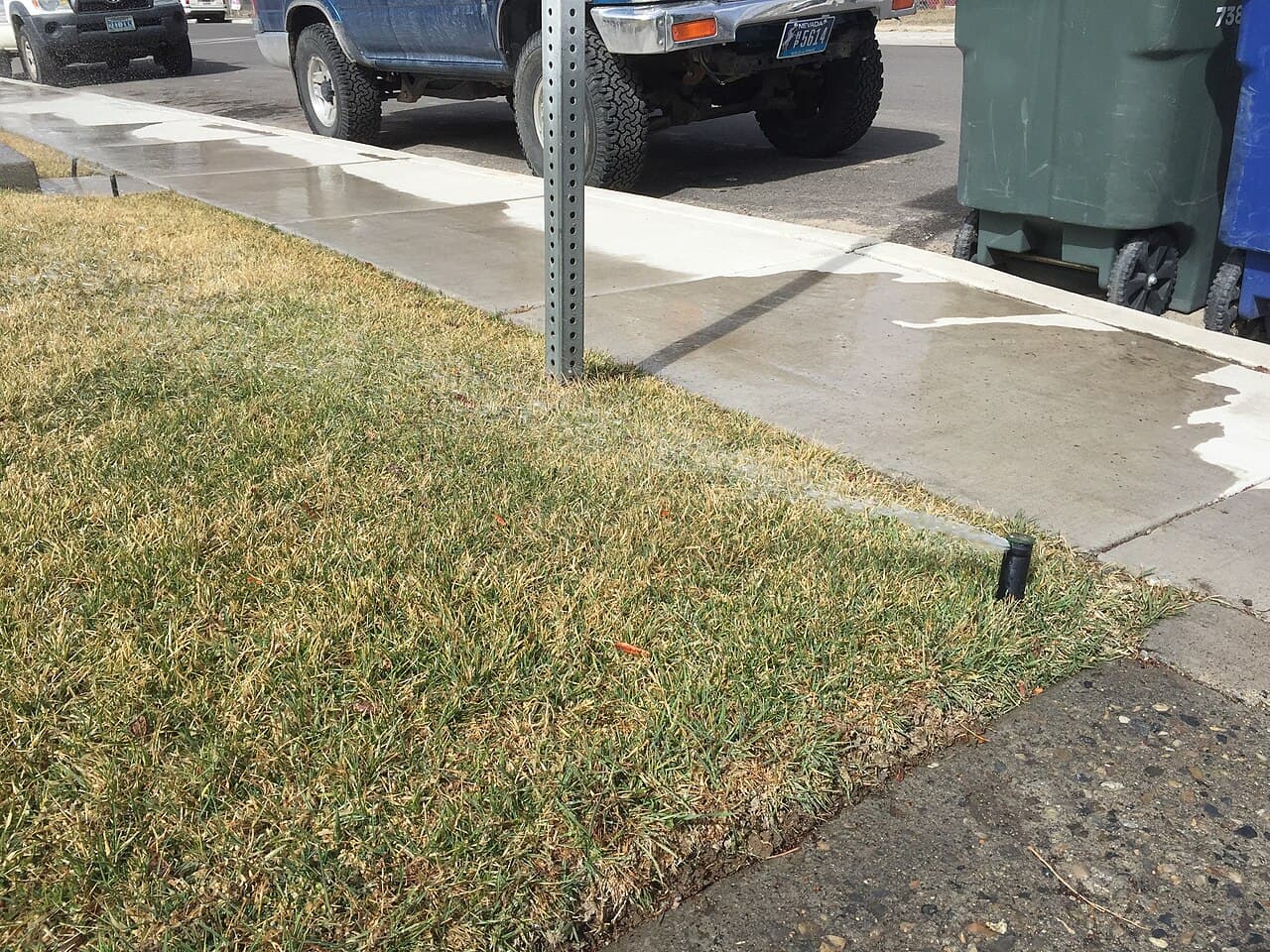
The usual causes, in order of likelihood
A head that does not cover the spot. The EPA's WaterSense program says each sprinkler should be able to reach the sprinkler head next to it, known as head-to-head coverage, and that you should properly direct sprinkler for uniform coverage to avoid dry spots in the landscape.[2] A head turned a few degrees, a nozzle set to a short throw, or a shrub that has grown up in front of the spray all leave a gap. Rain Bird says to adjust spray action on the top of the sprinkler with a small flat blade screwdriver: twist the stem to align with desired spray direction, and turn +/- to adjust distance.[3]
A broken, tilted or clogged head. WaterSense tells homeowners to look for heads that do not pop up fully or are tilted, because they can unexpectedly spray to the wrong areas.[2] A mower hit, a kinked stem or grit in the nozzle screen can turn a good head into a dry spot. If you find a broken head, WaterSense suggests placing a flag next to it so you can work on it later.[2]
Misting from high pressure. WaterSense advises you to avoid overspraying or misting due to high pressure.[2] A fine mist drifts and evaporates, so the grass at the edge of the pattern gets less than the grass near the head. Rain Bird makes the same point: check that the spray is uniform with water droplets rather than misting, which wastes water.[3]
Water that runs off before it soaks in. Compacted or slopey ground sheds water. Virginia Cooperative Extension notes that effectively applying 1 inch of water is likely impossible to do in a single watering given the slow infiltration rate of most Virginia soils.[1] If a zone puddles and runs onto the pavement while a patch uphill stays dry, the schedule is the problem, not the heads. WaterSense recommends breaking up the irrigation into smaller intervals when runoff occurs, with breaks in between so the water can seep in, a method it calls cycle-and-soak.[2]
Compacted soil. Extension says annual core aeration can loosen compacted soil and allow water to infiltrate deeper into the ground.[1] Compaction under a footpath or where a vehicle has parked often shows up as a dry strip that sprinklers alone never fix.
Find the pattern with a catch-can test
If the walk-around does not settle it, measure. Virginia Cooperative Extension describes a basic irrigation system audit: check for uniform water distribution and overlap of any irrigation system by placing at least five broad, wide-mouthed containers at distances of approximately 20, 40, 60, 80, and 100 percent of the maximum throw of the sprinkler(s).[1] The method is covered step by step in how to check your sprinkler coverage. Put one or two cans right in the dry spot. If they collect much less than the others, the cause is the head or its pressure. If they collect the same amount and the grass is still dry, the water is running off or not soaking in.
Is it really a water problem?
Check the grass before you change the system. A thirsty lawn first shows "footprinting": the grass blades will not spring back if you walk across the lawn, and your footprints will be visible.[1] Lawns that receive little to no water from irrigation or rainfall during summer months will go dormant.[1] If the patch springs back when you step on it, look for something other than water, such as shade, tree roots, a pet or a grub problem. Why a lawn has bare patches covers those.
Tall fescue is drought tolerant when its roots are deep, but Extension adds that this advantage is lost if grown on shallow or extremely compacted soils.[1]
Fix it in this order
- Flag every dry spot while the zone runs.
- Straighten, clear or replace the head that should cover it.
- Adjust arc and distance so the spray reaches the next head.
- If water runs off, switch to shorter cycles with a soak break. How long to run your sprinklers covers timing.
- Aerate compacted ground, then retest with cans.
Stop and call a pro if
- Water pools between cycles. WaterSense says that between irrigation cycles, looking for areas of the landscape with water pooling on the surface could show a sign of an underground leak.[2] Digging into pipe is a job for an irrigation contractor.
- Heads leak at the joints. Leaking joints can also be a sign of too much water pressure or particles in the water.[2]
- A zone will not shut off, or valves will not close. The valve is underground and needs diagnosing.
- You are unsure. WaterSense says you may be able to fix broken heads yourself, but if you are unsure, go with a pro.[2]
- The same dry spots return after you fix the heads. The layout may need redesigning. Read whether you need a sprinkler system in Virginia for what a contractor does.
Getting help in Virginia
Loclis lists licensed contractors who handle irrigation repair. Browse lawn and landscaping help or more lawn and landscaping answers.
When you are ready, describe the dry spots and your system once and local contractors can quote the repair.
Common questions
- Why does one part of my lawn stay dry when the sprinklers run?
- Most often a head is not reaching it: it is turned, tilted, broken, clogged or blocked by a plant. Watch the zone run from the dry spot, then adjust the head or replace it.
- How do I know if the dry spot is a sprinkler problem or something else?
- Step on it. If the blades do not spring back and your footprints show, the grass is thirsty. If it springs back, look at shade, roots, pets or grubs.
- Can I fix a sprinkler head myself?
- Often, yes. WaterSense says you may be able to fix broken heads yourself, but if you are unsure, go with a pro. Pooling water or leaking joints usually mean a call to a contractor.
- Will running the sprinklers longer fix the dry spot?
- Not if the problem is coverage or runoff. Longer runs puddle and run off on compacted soil. Fix the head first, then use shorter cycles with soak breaks.
- Could compacted soil be the cause?
- Yes. Extension says annual core aeration can loosen compacted soil and let water soak deeper.
Sources
- [1] Summer Lawn Management: Watering the Lawn (430-010), Virginia Cooperative Extension, Virginia Tech. Checked October 27, 2026.
- [2] Sprinkler Spruce-Up, U.S. Environmental Protection Agency, WaterSense. Checked October 27, 2026.
- [3] 3 Simple Repairs and Upgrades for Your Pop-Up Sprinklers This Spring, Rain Bird Corporation (manufacturer). Checked October 27, 2026.
Want a pro to handle it?
Describe the job once. Licensed local businesses send quotes, and you pay only when you book one.
Get a quote from a local pro