How do I clean air vents and return grilles?
Turn the system off, vacuum the face of each supply register and return grille with a brush attachment, then take the covers off, wash them in warm soapy water, dry them fully and refit them. Wipe only the lip of the duct you can reach and keep water out of the ductwork. A dusty return grille is normal; dust blowing out of supply vents is a job for a pro.
Free to ask. Local shops send quotes, and you pay only when you book one.
By Kasra Taheri, Founder, LoclisPublished
Researched and drafted with AI, then checked claim by claim against the sources listed below before it was published. Prices and rules change; the dates beside each source say when it was last checked.
Step by step
Read when to stop and call a pro, further down this page, before you start.
Step 1: Turn the system off
Set the thermostat to off, with the fan on auto, so the fan is not blowing dust around or pulling it into an open return while you work.
Step 2: Vacuum the face
Run a vacuum brush attachment over each supply register and return grille, working along the slats and louvers.
Step 3: Take the cover off
Undo the screws, or lift a floor register straight out of its opening, and keep the screws in a cup.
Step 4: Deal with the filter
If the return grille holds a filter, slide it out, note its size and airflow arrow, and replace it if it is dirty.[2]
Step 5: Wash the cover
Soak metal or plastic covers in warm water with a little dish soap and scrub the slats with a soft brush.
Step 6: Go gently on old paint
On painted covers in a house built before 1978, skip steel wool, scouring pads and abrasive cleaners.[5]
Step 7: Wipe the duct opening
Vacuum the lip of the duct you can reach and wipe it with a well-wrung cloth; keep water out of the ductwork.[1]
Step 8: Look at the boot
With the cover off, check for gaps where the duct boot meets the floor, wall or ceiling, a common place for leaks.[3]
Step 9: Dry everything
Let each cover dry completely on a towel before it goes back, so no water drips into the duct.
Step 10: Refit firmly
Set or screw each cover back so it sits tight against the surface, then reopen the louvers on supply registers.
Step 11: Turn the system back on
Reset the thermostat and hold a hand near each supply register to confirm air is flowing from it.
Step 12: Keep the vents clear
Move rugs, furniture and long curtains off registers and returns so air can move freely.[7]
Most vent and grille cleaning is a vacuum-and-wash job you can do with a screwdriver and a sink: vacuum the face of each cover, take it off, wash it in warm soapy water, let it dry and put it back. A grey film on a return grille does not mean the ducts are dirty. EPA says it is normal for the return registers to get dusty as dust-laden air is pulled through the grate,[1] and that the registers can be easily vacuumed or removed and cleaned.[1]
Supply registers and return grilles
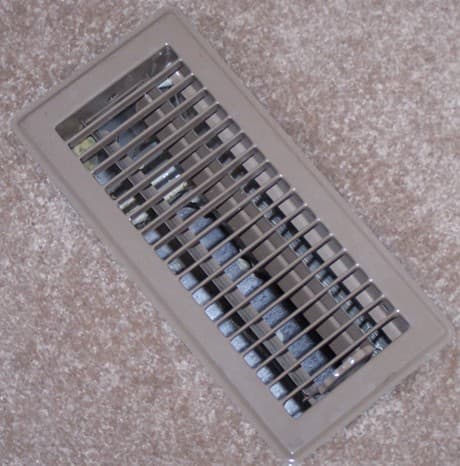
Supply registers are the covers air blows out of, usually with louvers you can open and close. Return grilles are the covers where air is pulled back to the furnace or air handler; they are often larger, with fixed slats, and they collect dust faster because they face the incoming air.
Some return grilles hold the system's filter behind a hinged face. ENERGY STAR notes that, depending on the system, your filter may be located in the duct system versus the heating and cooling equipment itself.[2] If yours is, cleaning the grille and changing the filter are one job.
What you need
- A vacuum with a brush attachment. EPA suggests a high efficiency vacuum (HEPA) cleaner or the highest efficiency filter bags your vacuum cleaner can take,[1] and warns that Vacuuming can increase the amount of dust in the air during and after vacuuming as well as in your ducts.[1] Turning the system off first keeps that dust out of the return.
- A screwdriver that fits the cover screws, and a cup to keep them in.
- Dish soap, a soft brush (an old toothbrush works on narrow slats) and a couple of towels.
- A damp cloth for the duct lip and the wall or floor around the vent. Dampening the cloth helps keep settled dust from going back into the air.[4]
- A new filter of the right size, if a return grille holds one.
Before you start in an older house
Two materials call for a lighter touch.
Paint. If your home was built before 1978, it is more likely to have lead-based paint.[5] Treat any old paint in the house as possibly lead, including the paint on old metal registers. EPA's advice for cleaning in a home that may have lead paint is not to use steel wool, scouring pads or abrasive cleaners,[5] so wash painted covers gently and never sand or scrape them to make them look new.
Insulation around the boot. EPA tells duct cleaners to check that there are no asbestos-containing materials (e.g., insulation, register boots, etc.)[1] before they start. If the boot behind a cover is wrapped in old, crumbling insulation, leave it alone. If you suspect material contains asbestos, don't touch it.[6]
How far into the duct to go
Clean the cover and the lip of the duct you can reach by hand, and stop there. A household vacuum cannot clean a duct run; professional duct cleaning uses specialized tools to dislodge dirt and other debris in ducts, then vacuum them out with a high-powered vacuum cleaner.[1]
Keep water out of the ductwork. EPA is plain about it: Steam cleaning and other methods involving moisture should not be used on any kind of duct work.[1] Wring the cloth out well, and let washed covers dry completely before they go back. Skip disinfectant sprays as well: No chemical biocides are currently registered by EPA for use in internally-insulated air duct systems.[1]
While the cover is off, look at the joint where the metal duct boot meets the floor, wall or ceiling. ENERGY STAR says these connections should be well sealed, and adds: These are common locations to find leaks and disconnected ductwork.[3] At a return grille, a gap there lets the system pull dusty air from inside the wall or floor. ENERGY STAR's do-it-yourself approach is sealing air leaks using mastic sealant or metal tape,[3] with one rule: Never use duct tape, as it is not long-lasting.[3] If the boot has come loose from the duct, that is a repair rather than a cleaning job.
Keeping vents clean longer
- Mind the filter. ENERGY STAR's guidance is to Check your filter every month,[2] especially in heavy heating and cooling months, and to Change your filter if it's dirty—or at least every three months.[2] Our guide to filter ratings covers which one to buy.
- Check the fit. Make sure air cannot bypass filters through gaps around the filter holder.[1] Dust that slips past the filter ends up on the registers and in the ducts.
- Protect vents during projects. During sanding, drywall work or other dusty renovation, EPA says to seal off supply and return registers and do not operate the heating and cooling system until after cleaning up the dust.[1]
- Leave them open to the room. EPA's general advice is to be careful not to block air vents or grilles,[7] which also keeps furniture from trapping dust against them.
Stop and call a pro if
- Dust or debris blows out of the supply registers when the system starts. That is one of the situations where EPA suggests duct cleaning: when particles are actually released into the home from your supply registers.[1]
- You see growth or smell mustiness inside the duct. EPA's other reasons to clean include substantial visible mold growth inside hard surface (e.g., sheet metal) ducts,[1] and it warns that if the insulation gets wet or moldy it cannot be effectively cleaned and should be removed and replaced.[1]
- There are droppings, nests or insects. Ducts are infested with vermin[1] is the third of EPA's reasons, and the entry point needs sealing too.
- The insulation around a boot is damaged and might contain asbestos.
- The duct is loose, crushed or disconnected behind the register.
- The marks are black and greasy rather than grey and you heat with a fuel-burning furnace. Read why black dust shows up around vents, and have a licensed HVAC technician look at the furnace. EPA recommends that a fuel burning furnace, stove or fireplace be inspected for proper functioning and serviced before each heating season to protect against carbon monoxide poisoning.[1]
Related answers
If you are weighing a whole-system cleaning, start with whether air duct cleaning is worth it and how often ducts need cleaning, and learn the warning signs of a duct cleaning scam. Loclis lists DPOR-licensed businesses with their licence number and class: browse duct cleaning services, HVAC businesses in Blacksburg, or all heating and cooling answers.
If a vent has turned out to need more than a wash, describe the job once and local businesses quote it.
Common questions
- Is it normal for the return grille to get dusty so fast?
- Yes. EPA says it is normal for return registers to get dusty as dust-laden air is pulled through the grate, and that this does not mean the ducts behind it are heavily contaminated. Vacuum it when you see a film, and check the filter at the same time.
- Do I need to clean inside the ducts as well?
- Usually not. Wipe the lip of the duct you can reach and leave the duct runs alone. Cleaning the ducts themselves takes specialised brushes and a high-powered vacuum. EPA lists the times to consider it: substantial visible mold in hard-surface ducts, ducts infested with vermin, or ducts clogged with excessive dust and debris or releasing particles from the supply registers. It also says properly done cleaning has not been shown to be harmful, so an occasional cleaning is a choice, not a mistake.
- Can I spray disinfectant or wash the ducts with water?
- No. EPA says steam cleaning and other methods involving moisture should not be used on any kind of duct work, and that no chemical biocides are registered by EPA for use in internally insulated duct systems. Clean the covers in the sink and keep the ducts dry.
- The vent cover screws are painted over. What should I do?
- In a house built before 1978, assume the paint could contain lead and do not sand, scrape or chip it. If the screw will not turn with steady pressure from a well-fitting screwdriver, leave that cover in place and clean its face with the vacuum brush and a damp cloth instead. If a little paint flakes off anyway, wipe it up with a damp paper towel and throw the towel away.
- Will clean vents make my house less dusty?
- A little, at the vents themselves. Dirty ducts are only one of many sources of dust in a home, and EPA notes that pollutants from outdoors and from everyday activities such as cooking and cleaning can cause greater exposure than dirty ducts. The filter, the fit of the filter and how you dust and vacuum usually matter more. See why a house stays dusty even with clean ducts.
Sources
- [1] Should You Have the Air Ducts in Your Home Cleaned? (EPA 402-K-97-002), U.S. Environmental Protection Agency. Checked October 26, 2026.
- [2] A Guide to Energy-Efficient Heating and Cooling, ENERGY STAR (U.S. EPA). Checked October 26, 2026.
- [3] Duct Sealing, ENERGY STAR (U.S. EPA). Checked October 26, 2026.
- [4] Sources of Indoor Particulate Matter (PM), U.S. Environmental Protection Agency. Checked October 26, 2026.
- [5] Reduce the Risk of Lead Exposure at Home, U.S. Environmental Protection Agency. Checked October 26, 2026.
- [6] Protect Your Family from Exposures to Asbestos, U.S. Environmental Protection Agency. Checked October 26, 2026.
- [7] Care for Your Air: A Guide to Indoor Air Quality, U.S. Environmental Protection Agency. Checked October 26, 2026.
Want a pro to handle it?
Describe the job once. Licensed local businesses send quotes, and you pay only when you book one.
Get a quote for HVAC Repair