How do I clean and reseal stamped concrete?
Wash the surface thoroughly, let it dry completely, then apply one thin, even coat of a sealer that is compatible with the one already on it, at the label's coverage rate, in shade and mild weather. Reseal when water stops beading or the color looks flat, not on a fixed schedule, because extra coats build up and fail.
Free to ask. Local shops send quotes, and you pay only when you book one.
By Kasra Taheri, Founder, LoclisUpdated
Researched and drafted with AI, then checked claim by claim against the sources listed below before it was published. Prices and rules change; the dates beside each source say when it was last checked.
Step by step
Read when to stop and call a pro, further down this page, before you start.
Step 1: Check that it needs sealer
Sprinkle water on a few spots; if it soaks in and darkens the concrete instead of beading, or the color looks flat and dull, the sealer is probably worn and a reseal is due.
Step 2: Find out what sealer is on it
Ask the installer or check old receipts for the product, because the old coating decides what can go on top: one professional solvent-based sealer, for example, should not go over other curing compounds, and old water-based sealers must be removed before it goes on.[1]
Step 3: Choose a product made for homeowners
Buy a sealer sold for homeowner use that is compatible with the old one, and read its label and safety data sheet before you open it.[2]
Step 4: Pick the right day
Choose a dry spell with the slab and air well above 40 °F and no rain due for at least 12 hours, and plan to seal in the evening or in shade, since hot sun on the slab can cause bubbling.[1]
Step 5: Clear and protect the area
Move furniture and planters, cover nearby plants, and tape paper over siding, door thresholds and anything the sealer should not touch.
Step 6: Scrub and rinse the surface
Wash with a mild detergent, a stiff brush and plenty of water, working into the grout lines, then rinse until no soap or grit is left.[1]
Step 7: Treat stains separately
Use a concrete degreaser on oil and a cleaner made for efflorescence on white haze, following its label, wearing rubber gloves and eye protection for an acid cleaner, and trying it on a small hidden area first.[5]
Step 9: Work out how much sealer you need
Measure the area and divide by the coverage rate on the label so you buy, and apply, the right amount and no more.[1]
Step 10: Put on protective gear
Wear chemical-resistant gloves, safety glasses with side shields or goggles, and clothing that covers your skin, and keep every flame, spark and cigarette away from a solvent-based product.[4]
Step 11: Try a test patch
Seal a small, out-of-the-way area and let it dry to check that it bonds, dries clear and gives the look you want.[2]
Step 13: Add grip if it gets slippery
If the patio is slick when wet, stir a slip-resistant additive made for your type of sealer into the final coat only, as its label directs.[6]
Step 14: Keep off until it cures
Keep feet, pets and furniture off for the time on the label, usually several hours for foot traffic and longer for cars.[1]
Wash the stamped concrete thoroughly, let it dry for about a day, then roll or spray on one thin, even coat of a sealer that is compatible with the one already there, at the coverage rate on the label, in shade and mild weather. The hard part is not the sealing. It is the cleaning, the drying and resisting the urge to put on too much.
When stamped concrete needs resealing
Reseal when the surface needs it, not after a set number of years. One manufacturer's water-based sealer calls for a light maintenance coat every 1 to 2 years depending on the concrete's exposure to traffic, abrasion and weathering,[2] which is a range, not a schedule. Resealing too often does harm: the same maker warns that too many successive coats, or multiple coats over time can cause bubbling, whitening, peeling, and ultimate failure of the product,[1] and says a buildup of sealer applied numerous times over the years traps moisture under the film.[3]
Two quick checks tell you where you stand. Sprinkle water on a few spots: on well-sealed concrete it usually beads, and on worn sealer it soaks in and darkens the surface. Then look at the color in daylight. If it looks chalky or flat but deepens when wet, the sealer is probably wearing thin.
As a rough guide, the surface of one professional solvent-based acrylic sealer typically begins to dull after 3 to 4 years of use,[1] while a water-based version from the same maker calls for a light maintenance coat every 1 to 2 years.[2] Sun, foot traffic, cars and winter salt all shorten that.
Choose products made for the job, and for you
Many of the sealers, cleaners and grit additives decorative contractors use are professional products. Three named on this page as examples, Increte Clear Seal, Euco R&E Cleaner and Increte Shur-Grip, are each labelled "For professional use only."[1][5][6] They show the kind of rules a sealer label sets. For your own reseal, buy a product sold for homeowner use, and follow its label rather than the figures here.
Solvent-based sealers need the most care. Clear Seal, a solvent-based acrylic, carries the signal word "Danger" and is classed as a flammable liquid.[4] Its hazard statements include "Harmful if inhaled", "May cause cancer", "May cause genetic defects" and "May be fatal if swallowed and enters airways".[4] Its precautions call for protective gloves and clothing, eye or face protection such as safety glasses with side shields or goggles, and a suitable respirator if ventilation is inadequate.[4] They also call for not breathing its vapor or spray, using it only outdoors or somewhere well ventilated, and keeping it away from heat, sparks, open flames and other ignition sources, with no smoking.[4]
In practice that means no grill, cigarette or running engine nearby, windows on the house side closed, and children and pets kept indoors until it dries. If the solvent odor is objectionable, the maker's advice is to switch to a water-based, low-odor product.[1] A water-based sealer has its own safety data sheet, to be read before use.[2]
Find out what is on it now
Before you buy anything, find out what sealer the installer used. The original sealer's manufacturer or a local supplier can tell you what is compatible with it. Some products have strict rules: Clear Seal, for example, should not go over other curing compounds, and old water-based sealers must be removed before it goes on.[1] If nobody knows what is on the slab, a test patch is not optional. If the only compatible sealer turns out to be a solvent-based professional product, that is a good point to hand the job to a decorative concrete contractor.
Cleaning comes first
For routine care, clean as needed with mild soap or detergent and water, then rinse.[1] Before a reseal, the job has to be more thorough. One solvent-based sealer's label says the surface must be clean and free of puddled or standing water,[1] and a water-based one calls for concrete free of dust, dirt, laitance, efflorescence, curing compounds, paint, oil, grease and other contaminants.[2] Older concrete should be cleaned with a cleaner/degreaser specifically designed for concrete and paver surfaces.[2] Scrub with detergent and a stiff brush, work into the grout lines, and rinse until the water runs clear.
A pressure washer is optional. Held too close it can etch the surface or strip the darker accent color from the grout lines, so the brush-and-hose method is slower but safer if you have not run one before.
Oil and white haze need their own treatment. Many efflorescence cleaners are acids. Euco R&E Cleaner, a professional example, removes primary and secondary efflorescence and is safe on integrally colored concrete,[5] but it contains phosphoric acid and calls for rubber gloves and eye protection.[5] Whatever you use, follow the label exactly and rinse well.
Then dry the slab properly: use a leaf blower to clear standing water from the slab and the joints, and give it time before sealing. Sealer over trapped water is a common reason a fresh coat turns white.[3]
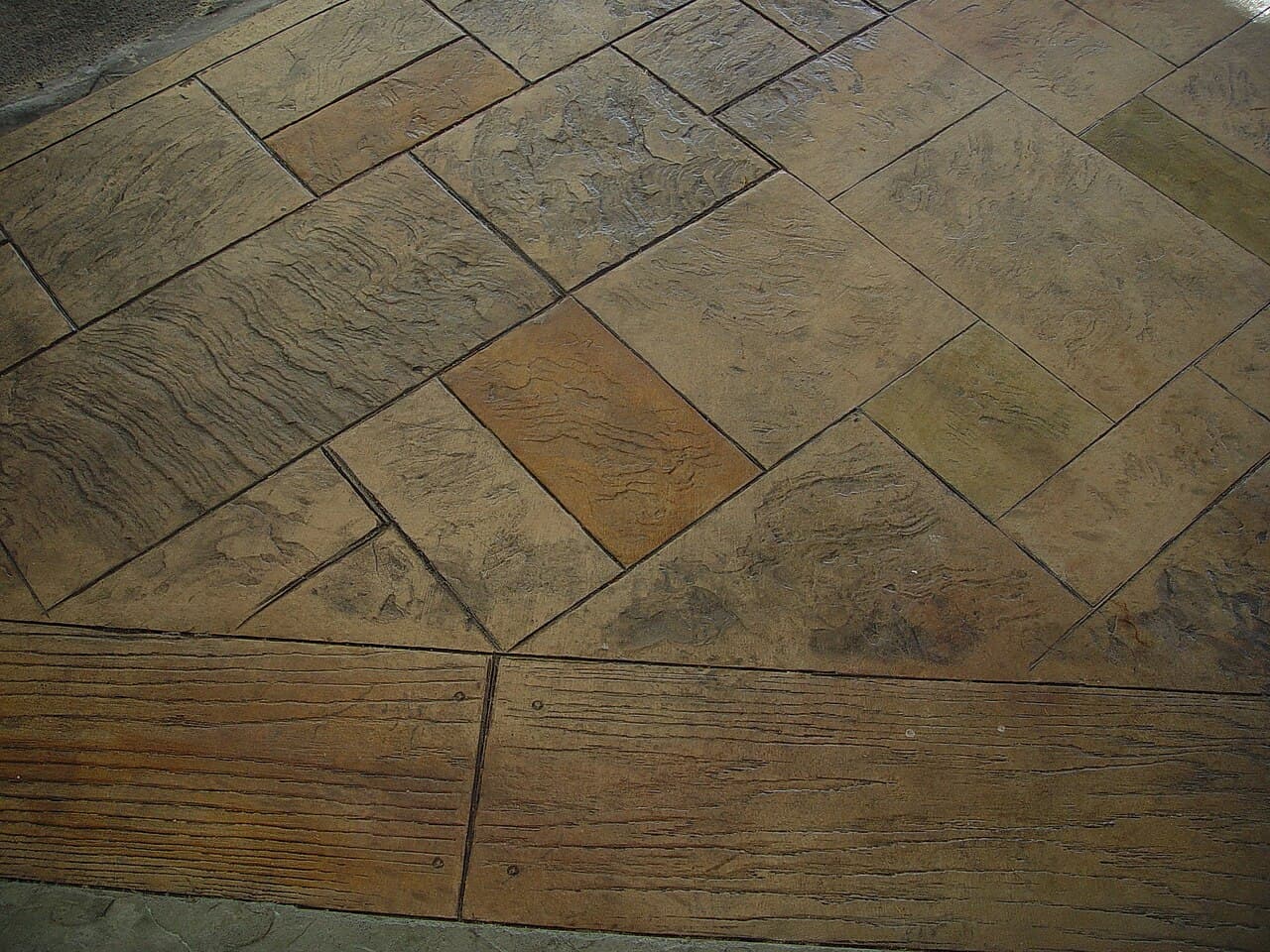
Pick the weather and the time of day
Read the temperature limits on your product. Clear Seal, for example, is not to be applied when the concrete or air is below 40 °F, or if rain is expected within 12 hours, and hot, direct sunlight or temperatures above 95 °F can cause bubbling.[1] Its water-based counterpart lists an application range of 45 to 95 °F and no rain or heavy fog for 8 to 12 hours.[2]
In a Virginia summer, sun on the slab is often the bigger problem. Seal in the evening or in shade rather than with the sun on the slab. Spring and fall days with dry air are often easier.
Applying the sealer
Thin is the goal. Coverage rates vary by product: the water-based Clear Seal lists 200 to 300 ft² per gallon,[2] and the solvent-based one says to measure the area to be sealed and the corresponding volume of product required based on the coverage rate.[1] Measure the patio, divide by the label's rate, and pour out only what that area should take.
Both Euclid sealers named here can be applied with a sprayer or a roller, and the solvent-based one calls for an industrial, hand-held, pump-up or airless sprayer, or by roller, not a plastic garden-type sprayer.[1] For a more uniform appearance over decorative concrete, the water-based one says it is recommended to backroll the product after spraying:[2] mist the sealer on, then roll it out so it does not pool in the texture. The solvent-based sealer lists a first coat at 300 square feet per gallon and a second at 400,[1] and calls for a short, 3/8-inch nap, solvent-resistant roller.[1] On a reseal, one coat is often enough.
Then keep everyone off it. Clear Seal, for example, lists 4 to 6 hours before foot traffic and 6 to 10 hours before wheel traffic, results developed under laboratory conditions, and low concrete or air temperature or high relative humidity extends its drying time.[1] Your own product's label sets the times to follow.
A Virginia rule to know. In the Northern Virginia, Fredericksburg and Richmond Volatile Organic Compound Emissions Control Areas,[7] state air rules cap the VOC content of architectural coatings by category. The caps include 400 grams per liter for waterproofing concrete and masonry sealers and 350 grams per liter for concrete curing compounds,[8] and a coating labelled or recommended for more than one category is held to the most restrictive of those limits.[8] Clear Seal, which is sold as a curing compound and a cure and seal, lists a VOC content of 681 grams per liter.[1] If you live in one of those areas, check the VOC figure on the label against the limit for every category the product is sold for.
If the old sealer is white, peeling or thick
White, cloudy sealer on a solvent-based acrylic has two main causes: applying it to a wet surface or applying it too thick.[3] A film that simply went on too heavy can sometimes be rescued without adding sealer, but the rescue is solvent work (see the next section). Sealer that is loose, flaking or badly discolored has to come off before resealing: one manufacturer says all old paint, oil, grease and water-based sealers must be removed and sells a coating stripper for it.[1] That is usually a job for a decorative concrete contractor. If the patio is slick when wet, see how to keep stamped concrete from getting slippery before you reseal, and if the color itself is going, see why stamped concrete fades.
Stop and call a pro if
- New sealer went on too thick and turned white or cloudy. On a solvent-based acrylic, the fix is that scrubbing with a solvent such as xylene turns the sealer back into a liquid so the excess can be wiped off, with no new sealer added.[1] That is solvent work across the whole slab, best left to a contractor equipped for it.
- The old sealer is peeling, flaking or white across large areas. Stripping it takes blasting equipment or chemical strippers.
- The only compatible sealer is a solvent-based product labelled for professional use.
- The surface is scaling, spalling or cracked. Sealer will not fix a failing surface, and a repair needs to be planned before any reseal.
- You cannot identify the old sealer and the test patch fails. A contractor can test and strip as needed.
- The color is uneven or washed out and you want it restored, which can mean a tinted sealer or stain that is hard to get even.
- It is a large driveway or a pool deck, where an uneven coat or the wrong additive costs more to fix than to do right.
Getting help in Virginia
Loclis lists DPOR-licensed businesses with their licence number and class. Browse stamped and decorative concrete, look up concrete contractors in Blacksburg, or read more concrete and hardscaping answers, including what stamped concrete costs in Virginia.
Describe the reseal once and licensed local concrete businesses quote it.
Common questions
- How often should stamped concrete be resealed?
- When it needs it, not on a calendar. The usual signs are water soaking in instead of beading and color that looks flat. One professional solvent-based acrylic sealer typically begins to dull after 3 to 4 years; a water-based sealer from the same maker calls for a light maintenance coat every 1 to 2 years. Sealing every year mostly builds up a film that later has to be removed.
- Can I pressure wash stamped concrete before sealing?
- You can, but it is optional. A pressure washer held too close can etch the surface or blast the accent color out of the grout lines. Scrubbing with detergent, a stiff brush and a garden hose is slower but gentler, and the surface must be clean and dry before any sealer goes on. A contractor can do the washing if you would rather not.
- Are solvent-based concrete sealers dangerous to use?
- They need real care. Clear Seal, a professional solvent-based acrylic, carries the signal word "Danger": it is a flammable liquid, harmful if inhaled, and may cause cancer. Its precautions call for gloves, eye protection, good ventilation and no ignition sources nearby. If the solvent odor is objectionable, the maker points to a water-based, low-odor product instead.
- Can I put water-based sealer over solvent-based sealer?
- Sometimes, but do not assume it. Compatibility depends on the products: one professional solvent-based sealer says old water-based sealers must be removed before it goes on. The original manufacturer or a local supplier can tell you what will bond. Always try a small test patch and let it cure before doing the whole patio.
- Why did my new sealer turn white or cloudy?
- Usually because it went onto a damp surface or went on too thick, and cool, damp weather can turn a water-based sealer milky. On a solvent-based acrylic, an over-applied film can often be re-liquefied with a solvent and the excess wiped off, but that is solvent work across the whole slab, so hire a decorative concrete contractor for it. If the film is peeling, it has to be removed before resealing.
- How long before I can walk on resealed stamped concrete?
- Follow the label. Clear Seal, a professional solvent-based acrylic, lists 4 to 6 hours before foot traffic and 6 to 10 hours before wheel traffic, results developed under laboratory conditions. Cool concrete or air, or high humidity, makes it dry more slowly.
- Does Virginia limit which concrete sealers I can buy?
- In the Northern Virginia, Fredericksburg and Richmond VOC emissions control areas, a state rule caps the VOC content of architectural coatings by category: 400 grams per liter for waterproofing concrete and masonry sealers and 350 for concrete curing compounds, with the stricter limit applying to a product labelled for both. Elsewhere in Virginia that rule does not apply. Check the VOC figure on the label if you live in one of those areas.
Sources
- [1] INCRETE CLEAR SEAL technical data sheet, The Euclid Chemical Company. Checked October 26, 2026.
- [2] INCRETE CLEAR SEAL WATER-BASE technical data sheet, The Euclid Chemical Company. Checked October 26, 2026.
- [3] Diagnosing 5 Common Concrete Sealer Problems, The Euclid Chemical Company. Checked October 26, 2026.
- [4] Clear Seal safety data sheet, The Euclid Chemical Company. Checked October 26, 2026.
- [5] EUCO R&E CLEANER technical data sheet, The Euclid Chemical Company. Checked October 26, 2026.
- [6] INCRETE SHUR-GRIP technical data sheet, The Euclid Chemical Company. Checked October 26, 2026.
- [7] 9VAC5-45-520, Applicability (architectural and industrial maintenance coatings), Virginia Administrative Code, State Air Pollution Control Board. Checked October 26, 2026.
- [8] 9VAC5-45-550, Standard for volatile organic compounds, Virginia Administrative Code, State Air Pollution Control Board. Checked October 26, 2026.
Want a pro to handle it?
Describe the job once. Licensed local businesses send quotes, and you pay only when you book one.
Get a quote from a local pro