Why is my stamped concrete fading?
Often because the sealer has worn thin, since sealer is what deepens the color. As a rough check, if the color comes back when you hose it down, worn sealer is the likely cause and a clean and reseal usually helps. Other causes are a sealer turning white, efflorescence, the accent color wearing off the high spots, and surface damage from freeze-thaw and deicing salt.
Free to ask. Local shops send quotes, and you pay only when you book one.
By Kasra Taheri, Founder, LoclisUpdated
Researched and drafted with AI, then checked claim by claim against the sources listed below before it was published. Prices and rules change; the dates beside each source say when it was last checked.
Step by step
Read when to stop and call a pro, further down this page, before you start.
Step 1: Clean a test area
Scrub a few square feet with mild detergent and water and rinse, so you are judging the color and not a film of dirt or mildew.[2]
Step 2: Wet it and compare
Hose the clean area and watch: if the color deepens a lot when wet and goes flat as it dries, the sealer is probably worn, and a reseal will usually bring much of it back.
Step 3: Check whether water beads
If water soaks in and darkens the surface instead of beading, the sealer has stopped repelling water and is due for renewal.
Step 4: Look for a white film
A milky or cloudy layer that sits in the sealer, often in low spots, points to sealer whitening rather than fading color.[1]
Step 5: Look for a white powder
A white, chalky deposit on the concrete that returns after rain is likely efflorescence; an acid efflorescence cleaner can remove it, used as its label directs with rubber gloves and eye protection.[6]
Step 6: Check the grout lines and high spots
If the darker accent color is gone from the raised areas but remains in the joints, wear or harsh cleaning has removed the release color.
Step 7: Look for flaking
Patches where the surface has flaked off and plain gray concrete shows are scaling, which resealing will not fix.
Step 8: Reseal the worn areas
Once you know it is sealer wear, clean and dry the whole surface and apply a thin coat of a compatible sealer, following the label.[3]
Stamped concrete often looks faded because the sealer has worn thin rather than because the color has left the concrete. A rough check: hose a clean patch down, and if the color comes back while it is wet and goes flat as it dries, worn sealer is the likely cause and a clean and reseal usually helps. If it does not come back, look for one of the other causes below.
The usual cause: worn sealer
Sealer is a large part of the color you see on stamped concrete. A sealer will deepen the true color of concrete,[1] and most acrylic sealers darken concrete and leave some gloss, a "wet look".[1] As sun, foot traffic and weather wear the film away, the surface goes back toward the lighter, duller color of the bare concrete. That reads as fading.
When water stops beading and the color looks flat, the sealer is spent. How long that takes depends on the sealer. On one professional solvent-based acrylic, the surface typically begins to dull from use after 3 to 4 years, and another coat restores the original luster;[2] the same maker's water-based sealer calls for a light maintenance coat every 1 to 2 years.[3]
For the reseal itself, see how to clean and reseal stamped concrete.
When the sealer turns white or cloudy
A milky, cloudy look is the sealer failing, not the color fading. With solvent-based sealers, there are two main causes: sealer applied to a wet surface or to fresh concrete with bleed water,[1] and sealer applied too thick, or built up over years of coats, so moisture gets trapped and the film loses its bond.[1] Water-based sealers have their own version: they can dry white or powdery if applied when it is too cold or too humid.[1] Heavy applications, cool weather or long exposure to moisture can give water-based sealer a milky look[3] as well.
On a solvent-based acrylic that is only cloudy, not peeling, the film can often be rescued with solvent rather than more sealer, but that is work for a contractor (see the last section). If the film is flaking or peeling, it needs to be stripped, which is usually contractor work too.
White powder on the surface: efflorescence
A white, chalky deposit on the concrete itself, rather than in the sealer, is usually efflorescence, and it often comes back after wet weather. Acid cleaners made for it can remove it. Euco R&E Cleaner, for example, removes primary and secondary efflorescence, is safe on integrally colored concrete,[6] and calls for a test area first.[6] It also contains phosphoric acid, calls for rubber gloves and eye protection, and is labelled "For professional use only."[6] For a DIY clean, choose an efflorescence cleaner sold for homeowner use and follow its label, protective gear included. Rinse well, let the slab dry and then reseal.
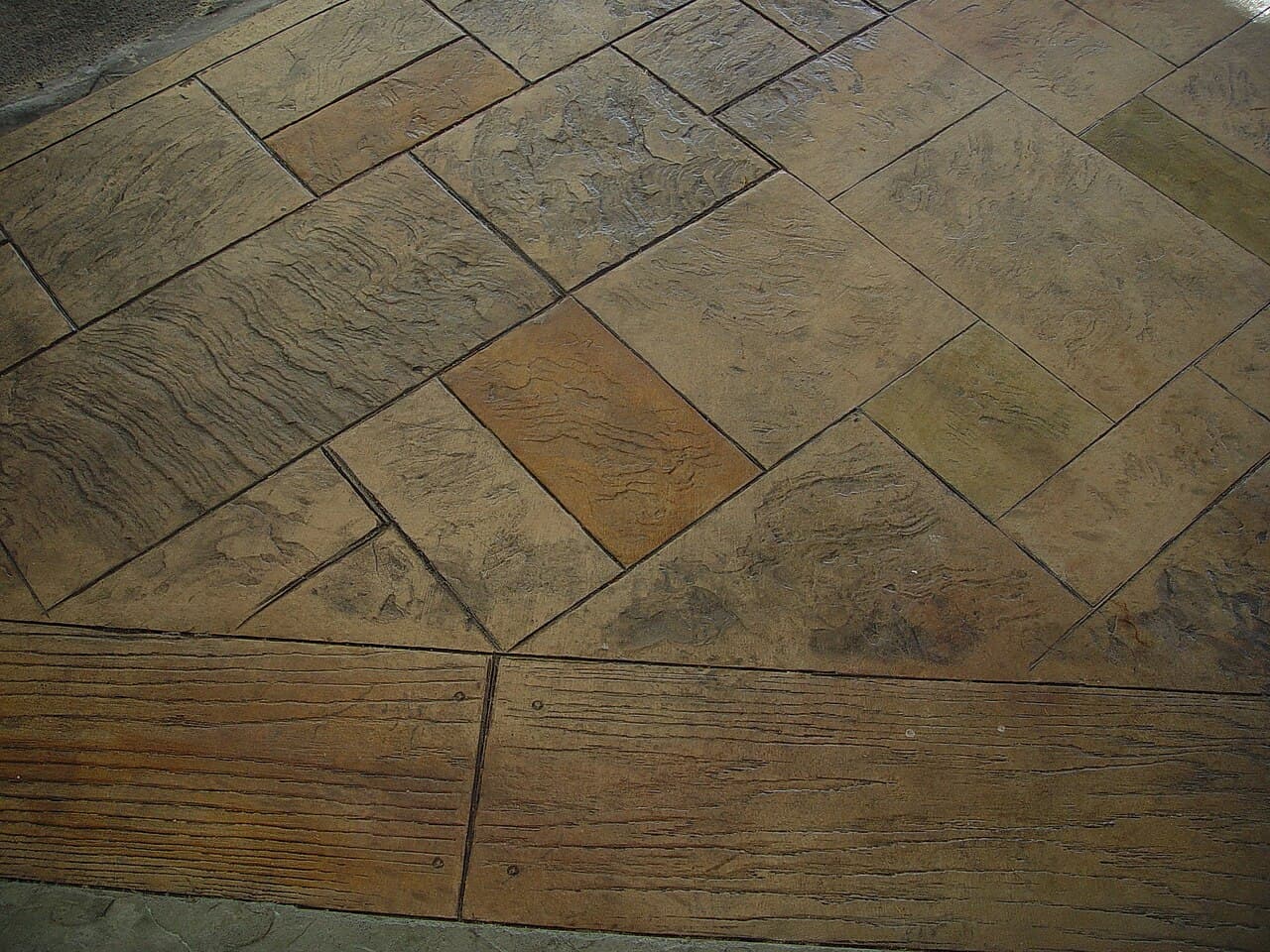
The accent color has worn off the high spots
Many stamped patios have two colors: a base color and a darker accent that sits in the grout lines and texture. The accent often comes from a colored release powder that contains iron-oxide pigments.[5] During installation, an acid wash removes excess release from the high points while leaving the secondary color in the deeper areas and grout lines,[5] and care is needed not to wash the secondary color off completely.[5]
Because the accent sits on the surface, it is often the first color to go. Foot traffic wears it off the raised areas, and so can an aggressive pressure washer held too close or repeated acid cleaning. The result is a flatter, one-tone look. Resealing slows further wear, but it will not put the accent back.
The surface itself is wearing away
The base color from a color hardener is broadcast onto freshly placed concrete and floated in,[4] so the most intense color is at the surface. If that surface is damaged, the color goes with it. Scaling, the flaking or peeling of the finished surface, is the damage freezing and thawing does to concrete, and the Federal Highway Administration notes that the most common distress associated with deicer applications on concrete flatwork has been surface scaling.[7] In Virginia, the Town of Berryville warns that salt and other deicers on new concrete can lead to chips and cracks, discoloration, and surface weakening.[8]
Scaled areas cannot be resealed back to color. Repairs are possible, but a patch or resurfacing may not match the color and character of the original concrete, so ask a contractor to show you how a repair will look. Prevention is the better answer: keep salt off new concrete, use deicers sparingly after that, and keep the sealer in good shape. How to keep stamped concrete from getting slippery covers safer winter traction.
Can the color be restored?
If the base color is still there, a clean and reseal is usually enough. If it is uneven or washed out, a contractor can even it out with a tinted sealer or a stain; some sealers can be tinted with color packs.[2] Tinting a patterned surface evenly is harder than it looks, so it is worth a test patch or a professional.
Stop and call a pro if
- A solvent-based sealer has gone cloudy because it went on too thick. The fix is that scrubbing with a solvent such as xylene re-liquefies the sealer so the excess can be wiped off,[2] without adding more. That is solvent work across the whole slab, best left to a contractor equipped for it.
- The sealer is peeling, flaking or white across large areas and needs stripping.
- The surface is scaling or spalling, or plain gray concrete shows through in patches.
- You want the color changed or restored with stain or tinted sealer on a large or highly visible area.
- The slab has new cracks, sinking or heaving, which point to the base, not the finish. See why concrete cracks.
Getting help in Virginia
Loclis lists DPOR-licensed businesses with their licence number and class. Browse stamped and decorative concrete, look up concrete contractors in Blacksburg, or read more concrete and hardscaping answers.
Describe the faded concrete once and licensed local concrete businesses quote the fix.
Common questions
- Does sunlight fade stamped concrete?
- Sun, foot traffic and weather all wear down the sealer, which is what gives stamped concrete its deeper, wet-looking color, so worn sealer is a common reason it looks faded. How well the pigment itself resists sun depends on the product. If the color comes back when you wet the surface, worn sealer is the likely cause.
- Will resealing bring the color back?
- If the problem is worn sealer, yes. A fresh coat of a film-forming acrylic deepens the color again, and on one professional acrylic sealer an additional coat restores the original luster once the surface dulls. Resealing will not restore color that has physically worn or flaked away.
- Why is my stamped concrete turning white?
- Either the sealer is whitening or salts are coming out of the concrete. Whitening sealer looks milky inside the film and is usually caused by moisture under it, a too-thick coat or poor weather during application. Efflorescence is a white, powdery deposit on the concrete itself, and an efflorescence cleaner, used with gloves and eye protection as its label directs, can remove it.
- Can faded stamped concrete be recolored?
- Often. Contractors can restore color with a tinted sealer or a stain, and some sealers can be tinted with color packs. Getting an even result over a patterned surface takes practice, so test a small area or hire a decorative concrete contractor.
- Did salt cause my new patio to lose its color?
- It can. The Town of Berryville warns that salt and other deicers on new concrete can lead to chips and cracks, discoloration, and surface weakening, and asks residents to avoid them for about the first year.
Sources
- [1] Diagnosing 5 Common Concrete Sealer Problems, The Euclid Chemical Company. Checked October 26, 2026.
- [2] INCRETE CLEAR SEAL technical data sheet, The Euclid Chemical Company. Checked October 26, 2026.
- [3] INCRETE CLEAR SEAL WATER-BASE technical data sheet, The Euclid Chemical Company. Checked October 26, 2026.
- [4] INCRETE COLOR HARDENER technical data sheet, The Euclid Chemical Company. Checked October 26, 2026.
- [5] INCRETE COLOR RELEASE technical data sheet, The Euclid Chemical Company. Checked October 26, 2026.
- [6] EUCO R&E CLEANER technical data sheet, The Euclid Chemical Company. Checked October 26, 2026.
- [7] Chemical Deicers and Concrete Pavement: Impacts and Mitigation (FHWA-HIF-17-008), Federal Highway Administration, U.S. Department of Transportation. Checked October 27, 2026.
- [8] Notice Regarding New Concrete, Town of Berryville, Virginia. Checked October 26, 2026.
Want a pro to handle it?
Describe the job once. Licensed local businesses send quotes, and you pay only when you book one.
Get a quote from a local pro