How do I keep stamped concrete from getting slippery?
Mix a slip-resistant additive into the final coat of sealer next time you reseal, and do not pile on extra coats for shine. Between reseals, keep the surface clean of leaves, mildew and standing water, and in winter use sand for traction instead of heavy salt. A lower-gloss or penetrating sealer also leaves a less slick surface.
Free to ask. Local shops send quotes, and you pay only when you book one.
By Kasra Taheri, Founder, LoclisUpdated
Researched and drafted with AI, then checked claim by claim against the sources listed below before it was published. Prices and rules change; the dates beside each source say when it was last checked.
Step by step
Read when to stop and call a pro, further down this page, before you start.
Step 1: Find where it gets slick
Walk the patio when it is wet and note the spots that feel slippery, such as shade, steps, the area by the door or a downspout outlet.
Step 2: Keep it clean
Sweep off leaves and wash away dirt and mildew with mild detergent, a stiff brush and water, then rinse.[6]
Step 3: Stop water from standing
Clear nearby drains and point downspouts away from the patio so water does not sit on the surface.
Step 4: Skip the extra coats
Do not reseal just to restore shine, because extra coats build up a thick, glossy film.[7]
Step 6: Mix it at the label rate
Stir the additive in at the rate on its label, for example about 1 cup per gallon for one polypropylene additive.[1]
Step 8: Keep it mixed as you work
Stir the sealer again every so often so the additive does not settle to the bottom of the bucket.[4]
Step 9: Roll it out evenly
Apply the sealer as its label directs without over-rolling, so the grit stays spread across the surface.[1]
Step 10: Test it when wet
Once the sealer has cured, wet the surface and walk it carefully to check the grip before furniture and guests go back on.
Step 11: Plan for winter
Use clean sand for traction, use deicers sparingly, and avoid calcium chloride and magnesium chloride deicers, which the Federal Highway Administration links to damage on concrete.[9]
The most effective fix is a slip-resistant additive mixed into the final coat of sealer the next time you reseal, along with resisting the urge to add coats for shine. Between reseals, keep the surface clean and free of standing water, and in winter use sand for traction rather than heavy salt. If the patio is slick everywhere, the sealer choice is the place to start.
Why stamped concrete gets slippery
Bare concrete has a fine, gritty texture. Sealer changes that. Most acrylic sealers will darken concrete and leave a glossy shine to some extent,[7] and some are sold that way: one professional acrylic sealer markets as a "High gloss formula".[6] A smooth film over a smooth stamp texture can be slick under water, and the same manufacturer's instruction is plain: "For a slip-resistant surface, add INCRETE SHUR GRIP to the final coat of sealer".[6]
Extra coats make it worse. Heavy coats of sealer, or a buildup of sealer applied numerous times over the years,[7] can trap moisture under the film until it turns white and peels, and every coat fills the texture a little more. The rest is everyday: wet leaves, pollen, mildew in shaded corners, and water that sits where a downspout empties.
Add grip when you reseal
Slip-resistant additives are fine particles you stir into the sealer. Once it dries, they leave a slightly textured surface that grips better when wet. There are several types, and they are not interchangeable.
Polypropylene additives for decorative concrete. Euclid's Increte Shur-Grip, for example, is a colorless, finely graded polypropylene additive that leaves a finely textured surface,[1] dosed at 1 cup per gallon of sealer,[1] and designed for use in solvent-based sealers.[1] Its sister product, Ultra-Grip, uses a larger particle for places where slip hazards are more severe.[2] Euclid says Shur-Grip can be used to create a static coefficient of friction of 0.8 or greater, while noting that results vary with the coating, the surface and how it is applied.[1]
Polymer additives for water-based and oil-based products. Sherwin-Williams sells H&C SharkGrip for latex-based and oil-based coatings, stains and sealers,[3] and describes it as adding slip resistance, fine texturing, and gloss reduction.[3]
Grit additives for paints and coatings. Rust-Oleum's Anti-Skid Additive is sold as an aluminum oxide based additive for epoxy, latex or oil-based paints and stains.[4]
Whatever you use, the application rules are much the same. Rust-Oleum says that if you apply more than one coat, mix it into the final coat only,[4] and to remix several times during use so settled additive goes back into the coating.[4] Shur-Grip's instructions add to apply the sealer as directed without over-rolling.[1] Do a test patch, let it cure, and check the feel and look when wet before doing the whole patio. The full reseal process is in how to clean and reseal stamped concrete.
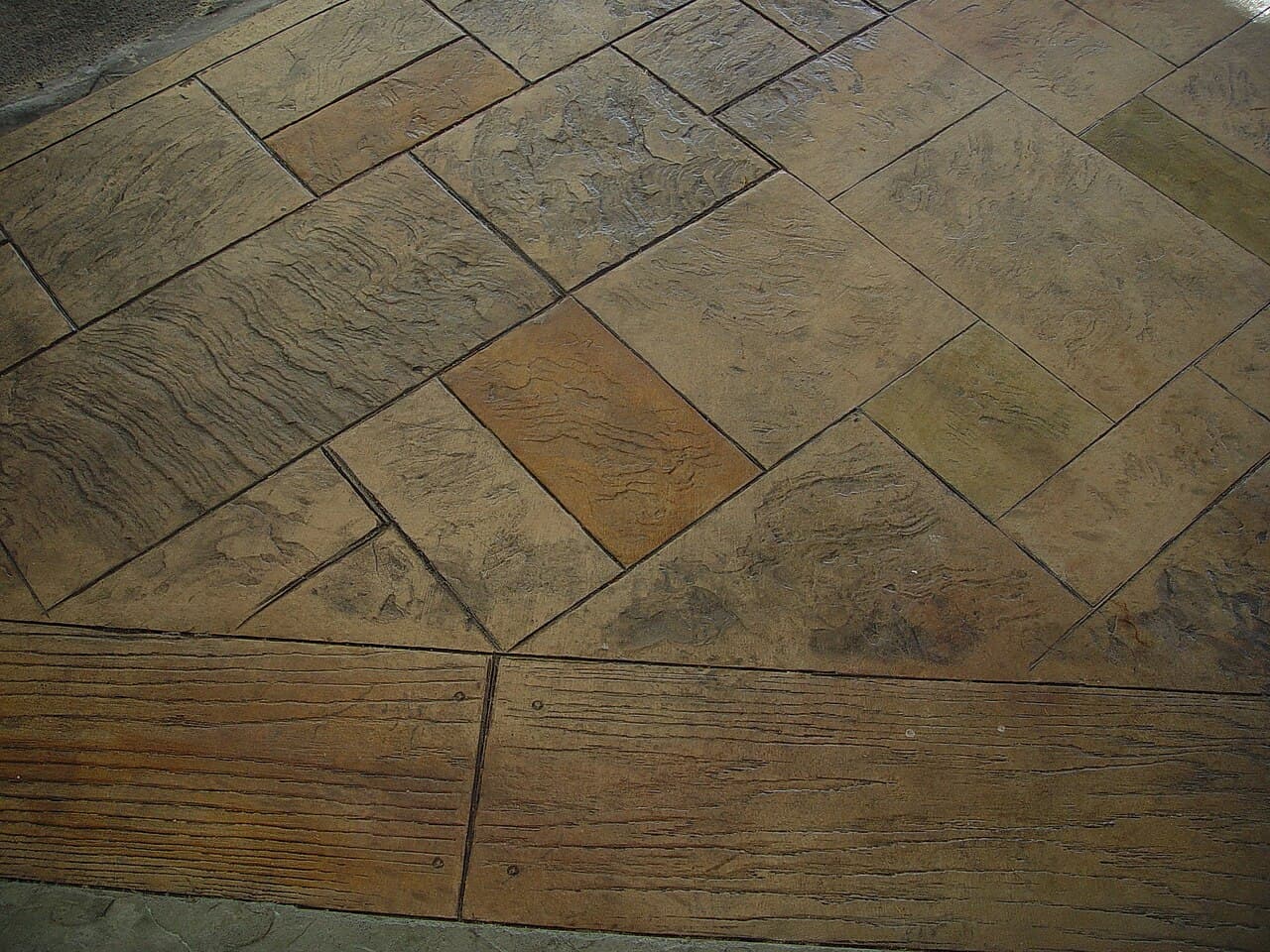
Consider a less glossy finish
Gloss and slipperiness often go together. A flattening additive can take the shine down: Euclid's Matte Add turns a solvent-based acrylic sealer into a low-gloss coating,[5] but it is not recommended for water-based sealers.[5] Ask your supplier which low-gloss options suit the sealer already on your patio.
A penetrating sealer is the other route. One water-based penetrating water repellent soaks into the concrete and is described as non film-forming, leaving no gloss or shine; it does not alter the appearance or texture of the substrate,[8] which leaves the stamp closer to bare concrete. The trade-off is looks, since a film-forming sealer is what deepens the color. The same product needs a surface that is clean, dry and free of all curing compounds, form release agents and any other contaminants,[8] so switching from a film-forming sealer usually means stripping the old one first. If color has already been fading, read why stamped concrete fades before you choose.
Everyday habits that help
- Sweep often in fall, when wet leaves make a patio slick.
- Wash off mildew and algae in shaded areas with mild detergent and a stiff brush, and rinse.
- Keep water moving. Point downspouts away from the patio and keep drains clear. A low spot that holds water is often a base problem, not a sealer problem.
- Mats at doors catch water and grit where people step on and off the slab.
Winter traction without damage
For ice, clean sand gives traction without harming the surface. Be careful with melting products: the Federal Highway Administration has linked calcium chloride and magnesium chloride deicers to a form of deterioration on concrete that starts at the joints and can progress into disintegration of the concrete.[9] New concrete needs more care still: the Town of Berryville asks residents to avoid salt and other deicers on new concrete for about a year and suggests alternatives such as sand, sawdust, clean kitty litter, and birdseed.[10] They do not melt ice, but they do improve grip.
Stop and call a pro if
- Steps, ramps or a pool deck are slippery. These need a dependable fix, and a contractor can strip and reseal with the right additive and texture.
- The sealer has built up into a thick, glossy or peeling layer. Removing it takes stripping or blasting.
- Water pools because part of the slab has sunk or slopes the wrong way.
- Someone has already fallen, or the patio serves older adults or a rental property where you need it right the first time.
Getting help in Virginia
Loclis lists DPOR-licensed businesses with their licence number and class. Browse stamped and decorative concrete, look up concrete contractors in Blacksburg, or read more concrete and hardscaping answers, including whether stamped concrete suits a Virginia patio.
Describe the slippery patio once and licensed local concrete businesses quote the fix.
Common questions
- Why is my stamped concrete so slippery when wet?
- Usually because of the sealer. Most stamped concrete is finished with a film-forming sealer, often a glossy one, that fills in the fine texture, and a film like that can be slick under water. Heavy or repeated coats make it worse. Leaves, mildew and standing water add to it, especially in shade.
- Can I add anti-slip grit to the sealer I already have?
- Usually, but check that the additive suits the sealer. Some polypropylene additives are designed for solvent-based sealers, while others, such as Sherwin-Williams' H&C SharkGrip, are sold for latex-based and oil-based coatings, stains and sealers. Mix at the label rate and add it to the final coat only.
- Will an anti-slip additive change the look?
- A little. The surface gets a fine texture, and some additives also cut gloss, which many owners like. Clear polypropylene and polymer additives are made to keep the color looking the same. Try it on a small area first.
- How long does an anti-slip additive last?
- Usually about as long as the sealer coat it is in, since it wears with the sealer. Plan to add it again each time you reseal, and recheck the grip near steps and doors once a year.
- What should I put on icy stamped concrete?
- Clean sand gives traction without harming the surface. The Federal Highway Administration has linked calcium chloride and magnesium chloride deicers to damage on concrete, so go light on melting products. On a patio less than a year old, the Town of Berryville suggests sand, sawdust, clean kitty litter or birdseed instead of salt.
Sources
- [1] INCRETE SHUR-GRIP technical data sheet, The Euclid Chemical Company. Checked October 26, 2026.
- [2] INCRETE ULTRA-GRIP technical data sheet, The Euclid Chemical Company. Checked October 26, 2026.
- [3] H&C SharkGrip Slip Resistant Additive, The Sherwin-Williams Company. Checked October 26, 2026.
- [4] Rust-Oleum Anti-Skid Additive technical data (ROC-183), Rust-Oleum Corporation. Checked October 26, 2026.
- [5] INCRETE MATTE ADD technical data sheet, The Euclid Chemical Company. Checked October 26, 2026.
- [6] INCRETE CLEAR SEAL technical data sheet, The Euclid Chemical Company. Checked October 26, 2026.
- [7] Diagnosing 5 Common Concrete Sealer Problems, The Euclid Chemical Company. Checked October 27, 2026.
- [8] BARACADE WB 244 technical data sheet, The Euclid Chemical Company. Checked October 27, 2026.
- [9] Chemical Deicers and Concrete Pavement: Impacts and Mitigation (FHWA-HIF-17-008), Federal Highway Administration, U.S. Department of Transportation. Checked October 27, 2026.
- [10] Notice Regarding New Concrete, Town of Berryville, Virginia. Checked October 26, 2026.
Want a pro to handle it?
Describe the job once. Licensed local businesses send quotes, and you pay only when you book one.
Get a quote from a local pro