Is stamped concrete a good choice for a patio in Virginia?
Often, yes, if it is built for freeze-thaw winters and you accept the upkeep. Ask for air-entrained concrete of the right strength, a well-compacted base, joints planned into the pattern and a sealer suited to outdoor use. Expect to reseal every few years, keep salt off it, and know that cracks and patches are hard to hide.
Free to ask. Local shops send quotes, and you pay only when you book one.
By Kasra Taheri, Founder, LoclisUpdated
Researched and drafted with AI, then checked claim by claim against the sources listed below before it was published. Prices and rules change; the dates beside each source say when it was last checked.
Step by step
Read when to stop and call a pro, further down this page, before you start.
Step 1: Decide what the patio must do
Write down its size, what will sit on it, whether it touches the house, and how wet and shaded the spot is, so the design suits the use.
Step 2: Look at finished work
Ask each contractor for addresses of stamped patios that are at least a few winters old, and look at the color, cracks and joints.
Step 5: Ask about slip resistance
Ask whether the sealer will include a slip-resistant additive, especially near steps, a pool or a door.[7]
Step 7: Compare three written bids
Get at least three bids on the same specification and ask about any price far below the others.[10]
Step 8: Agree on care and warranty
Get in writing what the warranty covers, when the first reseal is due and whether the contractor offers it.
Often, yes. A stamped concrete patio gives you the look of stone, brick or slate in one continuous slab, and it holds up well in Virginia when it is built for freezing winters and looked after. The trade-offs are real, though: it needs resealing every few years, salt and poor installation can damage the surface, and cracks or patches are hard to hide. Whether it is a good choice depends more on the contractor and the specification than on the material.
What makes stamped concrete last here
Concrete built for freeze-thaw. Concrete's durability against freeze-thaw damage is commonly linked to exposure conditions, the most severe of which is when deicers are present, and the Federal Highway Administration says the air-void system that protects it typically includes air contents ranging from 5 to 8 percent.[1] Ask for air-entrained concrete, stated in the written specification with its strength. Also ask the crew not to add extra water at the jobsite or overwork the surface, both of which weaken the top layer where the color and pattern live.
A good base. Most slab problems start underneath. One manufacturer's instructions say to tamp the subbase firm, and in areas of poor drainage, dig to a greater depth and add several inches of gravel or crushed stone.[2] Ask how the contractor will prepare the base and how the patio will slope water away from the house.
Joints planned into the pattern. A concrete slab has low tensile strength and is subject to cracking unless steps are taken to prevent it.[2] Control joints give the cracking a place to happen: one manufacturer says control joints should penetrate roughly a quarter of the slab thickness and be spaced every 6 to 8 feet in a 4-inch slab.[2] A skilled installer hides the joints in the grout lines of the pattern. A patio with no planned joints will choose its own, often across the middle.
The trade-offs to weigh
Sealer upkeep. Stamped concrete is sealed to protect it and to bring out its color, since a sealer will deepen the true color of concrete.[6] How often it needs redoing depends on the product: one manufacturer's water-based sealer calls for a light maintenance coat every 1 to 2 years depending on the concrete's exposure to traffic, abrasion and weathering,[5] while the surface of its solvent-based acrylic typically begins to dull after 3 to 4 years of use.[4] It is a job many owners do themselves; see how to clean and reseal stamped concrete.
Slipperiness. A glossy sealer on a smooth texture can be slick when wet, especially in shade or near a pool. The fix is designed in: there are slip-resistant additives made to stir into the final coat of sealer.[7] Ask for one near steps and doors, and read how to keep stamped concrete from getting slippery.
Salt. A new patio is the most vulnerable. The Town of Berryville asks residents to avoid the use of salt and other deicers on new concrete for approximately one year, and suggests sand, sawdust, clean kitty litter, and birdseed for traction instead.[3] After that, go light: the Federal Highway Administration links calcium chloride and magnesium chloride deicers to a form of deterioration on concrete that often starts at the joints.[1]
Repairs show. When a stamped slab is damaged, a patch rarely disappears. A repair or resurfacing may not match the color and character of the original concrete, and a pattern makes the difference more obvious. Ask a contractor to show you finished repairs. If you expect to dig up part of the patio later, for a drain or a gas line, that matters.
Color changes over time. Sealer wear, efflorescence and surface wear can make the color look washed out; why stamped concrete fades explains the causes and fixes.
Hiring the right contractor
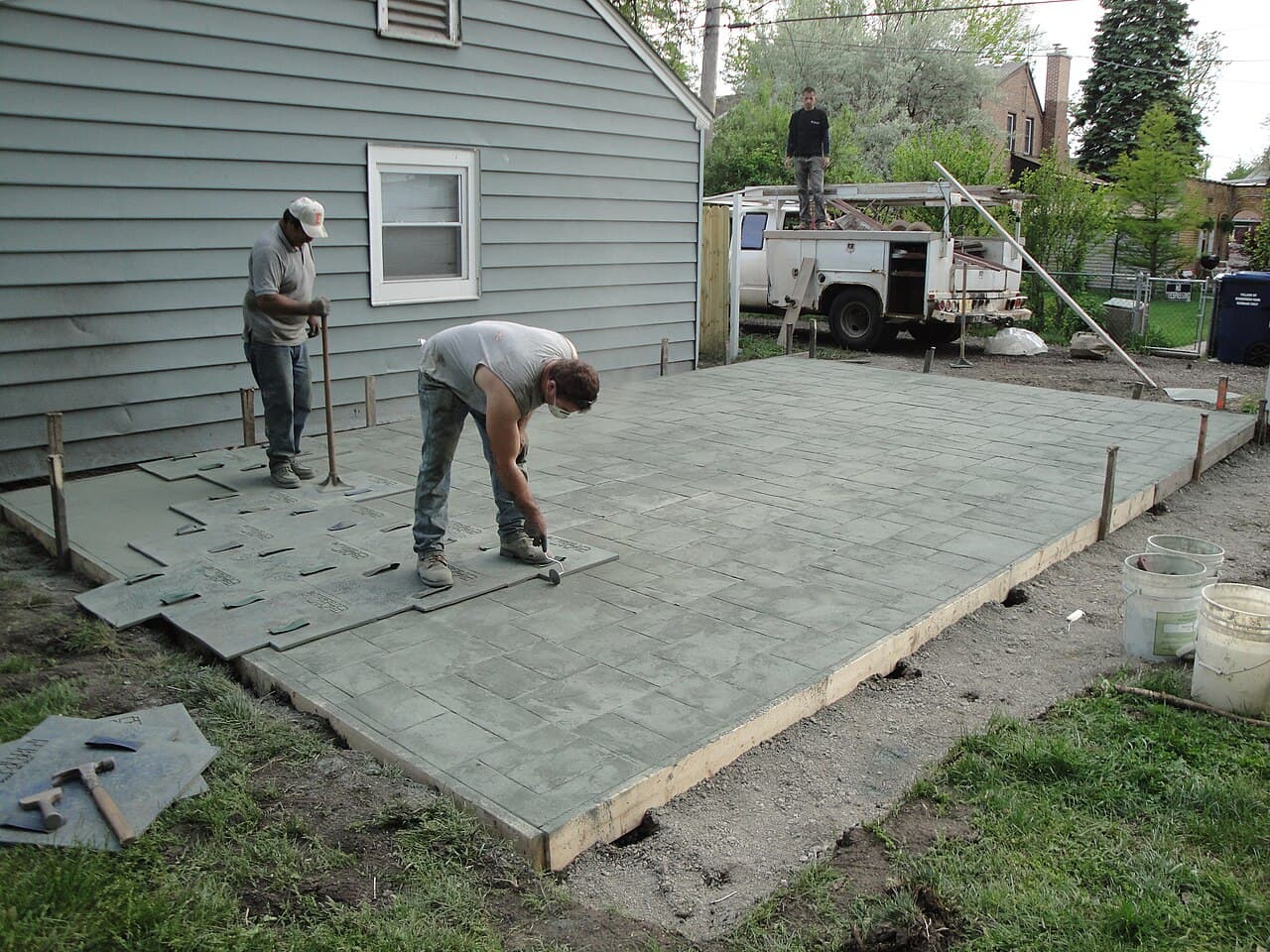
Stamped concrete is a short-window job: the pattern has to be pressed in while the concrete is still workable, and a missed window cannot be redone. The crew matters more than the pattern catalogue.
Licence. In Virginia, the Board for Contractors' concrete contracting specialty (CEM) covers placing concrete, and it "includes finishing, coloring, curing, repairing, testing, sawing, grinding, grouting, placing of film barriers, sealing, and waterproofing."[8] The CBC, RBC and H/H classifications also cover concrete work.[8] A home improvement contractor (HIC) can build a residential patio too: that specialty covers repairs and improvements to houses and townhouses, and its new construction beyond the existing house is limited to decks, patios, driveways and utility outbuildings that do not require a permit under the USBC.[8] The class must fit the price: Class C contractors work on a single contract or project over $1,000 but less than $30,000.[9] Contracting without the required licence is illegal in Virginia.[10]
Due diligence. Check references and look at past work, get at least three written bids, and keep the deposit to 10% down or $1,000, whichever is less.[10] For stamped work, ask to see patios that have been through a few winters.
Approvals. Check with your county or city before work starts. Prince William County, for example, lists concrete patio slabs on grade that are not designed to support a future building addition among work that needs no building permit, but zoning or watershed approval, or both, will be required.[11] When a contractor does the digging, the contractor is responsible for contacting Virginia 811,[12] so confirm it has done so before excavation starts. What to ask before you sign is in questions to ask a concrete contractor, and the cost side is in what stamped concrete costs in Virginia.
Stop and call a pro if
- The patio will carry a roof, a hot tub, an outdoor kitchen or a future room. That is a foundation and needs a design, and gas or electrical work needs licensed trades.
- The yard slopes toward the house or needs a retaining wall to make the patio level.
- There are buried lines, a septic field or a drain where the patio will go. Locate them through 811 before any digging.
- You were thinking of stamping it yourself. A first-time pour and stamp on a large patio is hard to get right, and mistakes are permanent.
Getting quotes in Virginia
Loclis lists DPOR-licensed businesses with their licence number and class. Browse stamped and decorative concrete, look up concrete contractors in Blacksburg, or read more concrete and hardscaping answers.
Describe the patio once and licensed local concrete businesses quote it.
Common questions
- Does stamped concrete crack in Virginia winters?
- Any concrete slab can crack, stamped or not. Joints placed at the right spacing control where shrinkage cracks form, and air-entrained concrete resists the surface scaling that freezing, thawing and salt cause. Ask for both in the written specification.
- Can I use ice melt on a stamped concrete patio?
- Not on new concrete: the Town of Berryville asks residents to avoid salt and other deicers for approximately one year and suggests sand, sawdust, clean kitty litter or birdseed for traction. After that, go light, because the Federal Highway Administration links calcium chloride and magnesium chloride deicers to deterioration of concrete.
- Can a cracked stamped patio be repaired invisibly?
- Usually not. Repairs to concrete surfaces rarely match the original color and texture exactly, and a stamped pattern makes the difference easier to see. That is one reason the joint layout matters so much when the patio is built.
- Do I need a permit for a stamped concrete patio in Virginia?
- It depends on your county or city, so check with yours before work starts. Prince William County, for example, lists patio slabs on grade that are not designed to support a future building addition among work that needs no building permit, but zoning or watershed approval, or both, will be required there. Ask the contractor who will handle any approval.
- What licence should a stamped concrete contractor have?
- A Virginia contractor licence of the right class (A, B or C) for the contract amount, with a classification or specialty that covers the work. The concrete contracting specialty (CEM) includes coloring and sealing, and the CBC, RBC and H/H classifications also cover concrete. A home improvement contractor (HIC) can build a residential patio that does not require a permit under the USBC. Look the business up on DPOR's licence lookup.
Sources
- [1] Chemical Deicers and Concrete Pavement: Impacts and Mitigation (FHWA-HIF-17-008), Federal Highway Administration, U.S. Department of Transportation. Checked October 27, 2026.
- [2] Concrete Sidewalks and Small Slabs (project instructions), The QUIKRETE Companies. Checked October 27, 2026.
- [3] Notice Regarding New Concrete, Town of Berryville, Virginia. Checked October 26, 2026.
- [4] INCRETE CLEAR SEAL technical data sheet, The Euclid Chemical Company. Checked October 26, 2026.
- [5] INCRETE CLEAR SEAL WATER-BASE technical data sheet, The Euclid Chemical Company. Checked October 26, 2026.
- [6] Diagnosing 5 Common Concrete Sealer Problems, The Euclid Chemical Company. Checked October 26, 2026.
- [7] INCRETE SHUR-GRIP technical data sheet, The Euclid Chemical Company. Checked October 26, 2026.
- [8] 18VAC50-22-30, Definitions of specialty services, Virginia Administrative Code, Board for Contractors. Checked October 26, 2026.
- [9] Va. Code § 54.1-1100, Definitions (contractors), Code of Virginia, Virginia General Assembly. Checked October 26, 2026.
- [10] What You Should Know Before You Hire a Contractor, Virginia Board for Contractors, DPOR. Checked October 26, 2026.
- [11] Do I Need a Permit?, Prince William County Building Development Division. Checked October 26, 2026.
- [12] Homeowners FAQ, Virginia 811. Checked October 26, 2026.
Want a pro to handle it?
Describe the job once. Licensed local businesses send quotes, and you pay only when you book one.
Get a quote from a local pro