How much does stamped concrete cost in Virginia?
There is no published Virginia price for stamped concrete. Each contractor prices it from the slab itself (size, thickness, base and access), the coloring method, the pattern and borders, the joints, and the sealer, plus resealing every few years. Get at least three licensed contractors to price the same written specification and compare itemized quotes.
Free to ask. Local shops send quotes, and you pay only when you book one.
By Kasra Taheri, Founder, LoclisUpdated
Researched and drafted with AI, then checked claim by claim against the sources listed below before it was published. Prices and rules change; the dates beside each source say when it was last checked.
Step by step
Read when to stop and call a pro, further down this page, before you start.
Step 1: Measure and sketch the area
Write down the length, width, shape and use, such as a patio, a walk or a driveway, so every contractor prices the same job.
Step 2: Choose the look in writing
Name the pattern, any border, the base color and the accent color, and ask whether the color is integral, a color hardener or both.
Step 3: Ask for the mix and thickness
Ask each contractor for the slab thickness and the specified strength, and whether the concrete is air-entrained, since air bubbles are what protect outdoor concrete from freeze-thaw damage.[1]
Step 4: Show where the truck can go
Walk each contractor to the spot and ask how the concrete will get there, by truck, pump or wheelbarrow.
Step 7: Get three written bids
Get at least three written bids on the same specification and ask about any large difference in price.[10]
Step 8: Check the licence class
Confirm the contractor's Virginia licence class covers the contract amount, for example Class C for jobs over $1,000 but less than $30,000.[9]
Step 9: Keep the deposit small
Follow DPOR's rule of thumb of a deposit no more than 10% of the price or $1,000, whichever is less.[10]
There is no published price for stamped concrete in Virginia. Every contractor prices it from its own costs and the details of your site, so the useful answer is what drives the price and how to get quotes you can compare. Ask at least three licensed contractors to price the same written specification, and the differences between them start to mean something.
The slab under the pattern
Stamped concrete is a concrete slab first, so everything that drives the cost of a plain slab applies.
Volume and thickness. Concrete is bought by the cubic yard, so area and thickness set the biggest material cost. One manufacturer's patio instructions call a 4-inch thick slab set 2 inches above ground level suitable for a patio.[3] A small patio uses a fraction of a truckload, so the trip, the crew and the setup are spread over little concrete. That is why small jobs cost more per square foot.
Access. A backyard behind a fence, or a soft lawn a loaded truck should not cross, may need a pump or wheelbarrows, which adds equipment and labour. Show each contractor the route.
The mix. Concrete that freezes while wet and meets deicing salt needs air entrainment: the air bubbles are purposely formed in the fresh concrete during mixing,[1] and they are what protect it from freeze-thaw damage. Ask each bid to state the strength and whether the mix is air-entrained.
The base. A good slab sits on well-prepared ground. One manufacturer says to build up a thicker crushed stone subgrade if a patio would otherwise sit more than 8 inches below the doorway.[3] If an old patio has to be broken out and hauled away, or stone brought in for the base, ask for the demolition, hauling and base work as separate lines in each quote so you can compare them. More on the plain-slab side is in what a concrete slab costs in Virginia.
What the decorative work adds
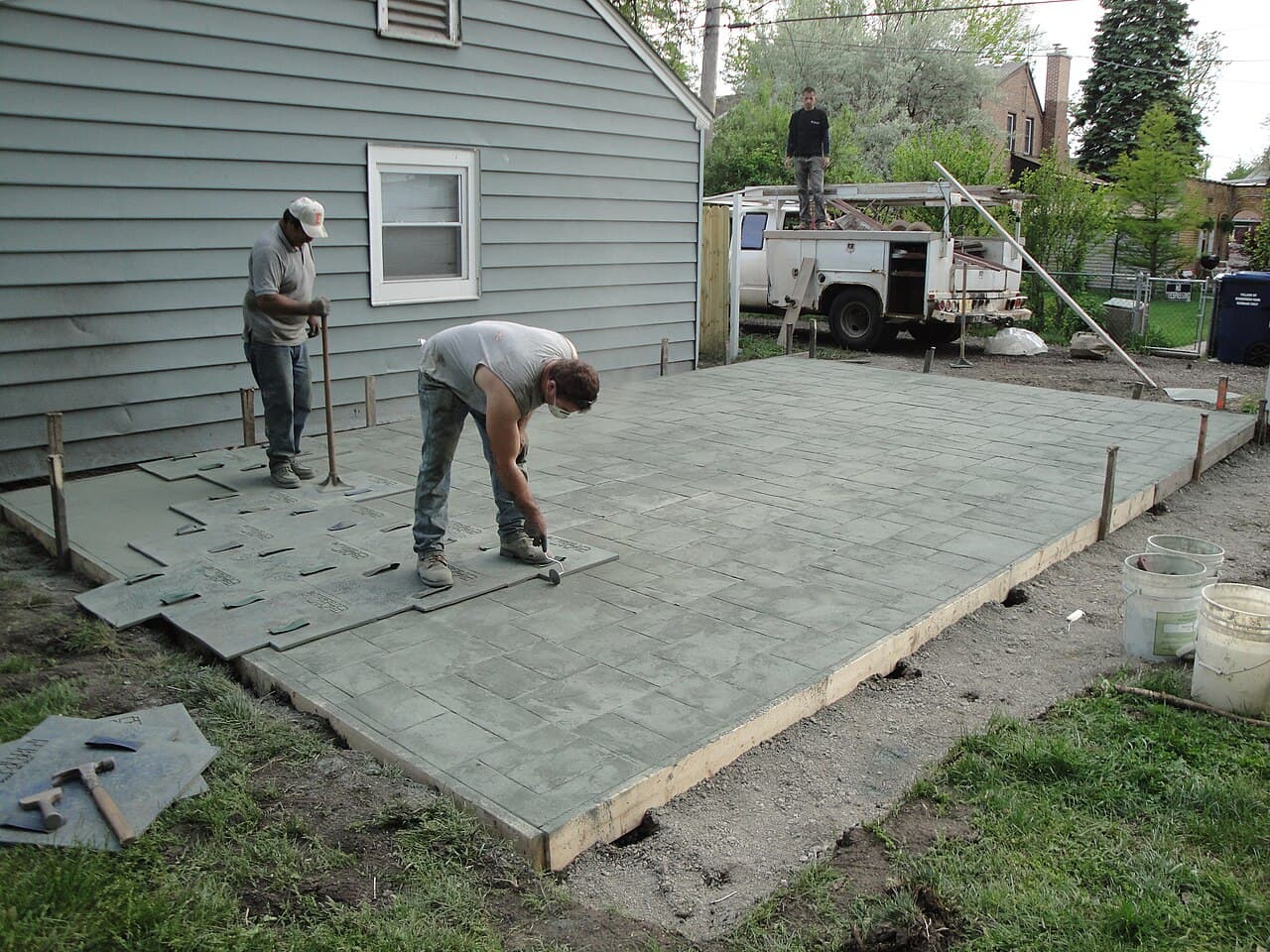
Color. There are two common ways to color the slab, and some jobs use both. Integral color is mixed into the concrete at the plant; it is ordered with the mix. A color hardener is broadcast onto the fresh surface: one manufacturer's product is typically used to provide the base color for stamped concrete,[4] two applications are generally required for uniform coverage,[4] and its stated yield is approximately 100 square feet per 60 lb pail, less for lighter colors.[4] More material and more hand work both show up in the quote.
Release and accent color. Stamping mats need a release agent so they do not stick. A colored release powder adds the darker accent in the joints: one product covers about 800 to 1,000 square feet per 20 lb pail,[5] and the excess is rinsed off after the concrete has set, with a dilute muriatic acid wash.[5] That cleanup is often a second visit.
Pattern and borders. A single pattern across an open rectangle is the simplest. Borders, curves, steps, several colors and detail work around posts and drains take a bigger crew and more time while the concrete is still workable, and that is usually where prices spread out the most.
Joints. Concrete shrinks as it cures and dries, and a slab cracks unless steps are taken to prevent it. One manufacturer's instructions have you cut 1-inch control joints into the slab every 6 to 8 feet,[2] so the cracking happens in the joint instead of across the face. A good installer plans the joints into the pattern, which takes layout time but costs far less than a crack across the middle. See why new concrete cracks.
Sealer. The finished surface is sealed, and one water-based product lists a coverage of 200 to 300 ft² per gallon.[6] Ask whether the price includes one coat or two.
The cost after it is built
Budget for upkeep: resealing is the usual maintenance on stamped concrete. One manufacturer's water-based sealer calls for a light maintenance coat every 1 to 2 years depending on traffic, abrasion and weathering.[6] Many owners reseal themselves; how to clean and reseal stamped concrete explains the job.
Approvals that can add cost
Check with your county or city before work starts, and ask the contractor who will handle any approval. Prince William County, for example, lists concrete patio slabs on grade that are not designed to support a future building addition among work that needs no building permit, but zoning or watershed approval, or both, will be required.[7] When you hire someone to dig, the contractor is responsible for contacting Virginia 811, and you should check that it has done so before any excavation starts.[8]
Getting quotes you can compare
Get at least three bids, all priced on the same set of specifications,[10] and be wary of one that comes in far below the rest, which can mean a mistake or missing work.[10] Virginia's Board for Contractors suggests an initial deposit of "no more than 10% of the total price or $1,000, whichever is less".[10]
Match the licence to the price. Under the Code of Virginia, Class C contractors work on a single contract or project over $1,000 but less than $30,000.[9] Virginia law "requires all licensed contractors to provide a written contract for residential work", and the contract "should include the total price, when payments will be made, and whether there is a cancellation penalty".[10] A good stamped-concrete quote also names the pattern, colors, thickness, base preparation, joint layout, sealer and number of coats, and what the warranty covers.
Stop and call a pro if
- The slab will carry a structure, such as a roof over the patio, a hot tub or a future room. That is a foundation and needs a design.
- The patio meets the house where water could drain back toward it, or the yard needs regrading or a retaining wall.
- You want to stamp concrete yourself. Stamping has to be finished in a short window before the concrete sets, and a missed window cannot be redone.
Getting quotes in Virginia
Loclis lists DPOR-licensed businesses with their licence number and class. Browse stamped and decorative concrete, look up concrete contractors in Blacksburg, or read more concrete and hardscaping answers, such as whether stamped concrete suits a Virginia patio. Loclis's own fees are on the pricing page.
Describe the stamped concrete job once and licensed local concrete businesses quote it.
Common questions
- Is there a standard price per square foot for stamped concrete in Virginia?
- No. There is no official price list, and a per-square-foot figure hides what changes the price most: the base work, access for the truck, the coloring method, the pattern and borders, and the sealer. Compare quotes that price the same written specification.
- Why is stamped concrete more expensive than a plain slab?
- It is a plain slab plus extra materials and crew time on the same day: color, usually as a dry-shake hardener or integral color, a release agent, the stamping itself while the concrete is still workable, a later wash to remove excess release, and sealer. The crew also has to be big enough to stamp the whole pour before it sets.
- Does stamped concrete cost more to maintain?
- Yes, a little. Resealing is the usual maintenance on stamped concrete. A water-based sealer from one manufacturer calls for a light maintenance coat every 1 to 2 years depending on traffic and weather. Ask each contractor what resealing will involve and whether they offer it.
- Do I need a permit for a stamped concrete patio?
- It depends on your locality. Prince William County, for example, lists concrete patio slabs on grade that are not designed to support a future building addition among work that needs no building permit, but zoning or watershed approval, or both, will be required there. Ask your county or city, and ask the contractor who handles it.
- Does a stamped concrete contractor need a Virginia licence?
- For work over $1,000, yes. The Code of Virginia defines Class C contractors as working on a single contract or project over $1,000 but less than $30,000, with Class B and Class A above that. Check the licence and its class on DPOR's lookup before you sign.
Sources
- [1] Chemical Deicers and Concrete Pavement: Impacts and Mitigation (FHWA-HIF-17-008), Federal Highway Administration, U.S. Department of Transportation. Checked October 27, 2026.
- [2] Concrete Sidewalks and Small Slabs (project instructions), The QUIKRETE Companies. Checked October 27, 2026.
- [3] Concrete Patios (project instructions), The QUIKRETE Companies. Checked October 27, 2026.
- [4] INCRETE COLOR HARDENER technical data sheet, The Euclid Chemical Company. Checked October 26, 2026.
- [5] INCRETE COLOR RELEASE technical data sheet, The Euclid Chemical Company. Checked October 26, 2026.
- [6] INCRETE CLEAR SEAL WATER-BASE technical data sheet, The Euclid Chemical Company. Checked October 26, 2026.
- [7] Do I Need a Permit?, Prince William County Building Development Division. Checked October 26, 2026.
- [8] Homeowners FAQ, Virginia 811. Checked October 26, 2026.
- [9] Va. Code § 54.1-1100, Definitions (contractors), Code of Virginia, Virginia General Assembly. Checked October 26, 2026.
- [10] What You Should Know Before You Hire a Contractor, Virginia Board for Contractors, DPOR. Checked October 26, 2026.
Want a pro to handle it?
Describe the job once. Licensed local businesses send quotes, and you pay only when you book one.
Get a quote from a local pro