How do I fix a running toilet?
A running toilet nearly always comes down to two parts in the tank. If water spills into the overflow tube, the fill valve is set too high or not shutting off. If the level slowly drops and the valve keeps refilling, the flapper is leaking. Lower or clean the fill valve, or fit a flapper of the right size with one or two links of chain slack.
Free to ask. Local shops send quotes, and you pay only when you book one.
By Kasra Taheri, Founder, LoclisPublished
Researched and drafted with AI, then checked claim by claim against the sources listed below before it was published. Prices and rules change; the dates beside each source say when it was last checked.
Step by step
Read when to stop and call a pro, further down this page, before you start.
Step 1: Watch the tank refill
Lift the lid and flush: water spilling into the overflow pipe points to the fill valve, while a level that creeps down later points to the flapper.[11]
Step 2: Run a dye test
Put a few drops of food coloring in the tank without flushing; color in the bowl after 10 minutes means water is leaking past the flapper.[2]
Step 3: Shut off the supply
Turn the shut-off valve on the wall or floor near the base of the toilet clockwise until it stops.[7]
Step 4: Drain the tank
Flush and hold the handle down to empty the tank, then sponge out what is left if you are changing the fill valve.[6]
Step 5: Lower the water level
Adjust the fill valve so the water stops about 1/2 inch below the top of the overflow tube, or at the water line marked in your tank.[5]
Step 6: Check the refill tube
Clip the small refill tube to the overflow tube with the metal clip, as the valve maker directs.[5]
Step 7: Clean or replace the fill valve
If the level is right but water still trickles in, flush debris out of the valve following its maker's instructions, or replace the valve.[11]
Step 8: Match the flapper
Measure the flush valve opening: most toilets take a standard 2-inch flapper, and 3-inch flappers have become popular since 2000.[8]
Step 9: Clean the flapper seat
Wipe sediment and mineral build-up off the rim of the flush valve where the flapper seals.[6]
Step 10: Fit the new flapper
Hook its ears onto the arms at the sides of the flush valve and clip the chain to the handle arm with one or two links of slack.[6]
Step 11: Refill and retest
Open the supply valve slowly, let the tank fill, flush once, then repeat the dye test to confirm the leak has stopped.
A running toilet is nearly always one of two parts inside the tank, and both are cheap and made to be swapped by hand. Loudoun Water notes that toilets are the most common source of household leaks, and that typically the fill valve and the flapper need to be replaced due to wear and tear.[1] The trick is working out which one is at fault before you buy anything.
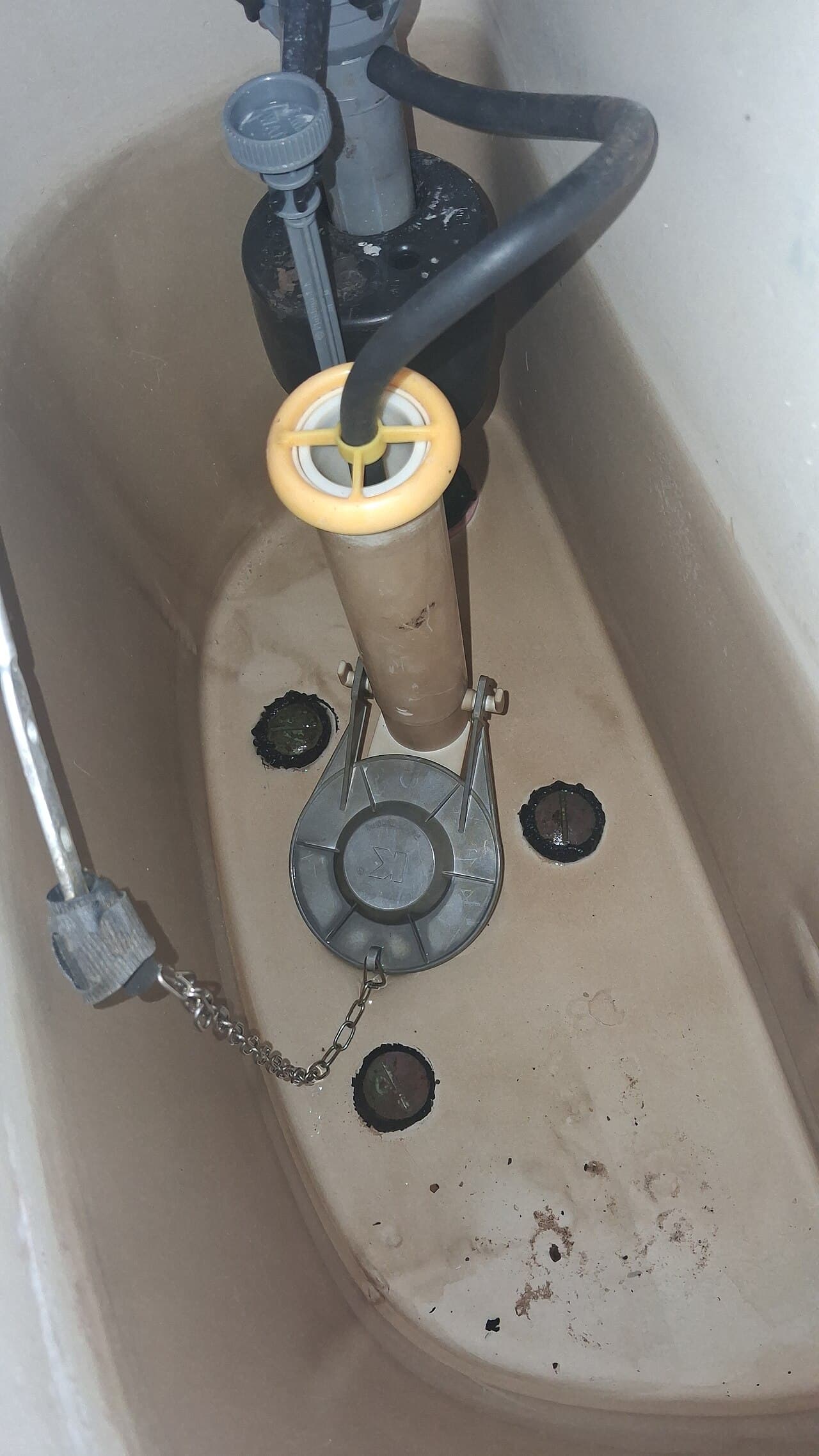
How the tank works
When you press the handle, the lever arm lifts the flapper and water rushes from the tank into the bowl. As the tank empties, the flapper drops back over the flush valve opening, and the fill valve refills the tank and, through a small refill tube, the bowl.[3] A float tells the fill valve when to stop.
The tall overflow tube in the middle of the tank is a safety drain: it prevents flooding if the water is rising because of a malfunctioning fill valve.[3] Water going down that tube is water you are paying for that never does any flushing.
Find the faulty part first
Take the lid off, flush, and watch. Fluidmaster's first check is whether the water level is rising so high it is draining into the overflow pipe.[11] If it is, start with the fill valve.
If the water stops at the right level but the fill valve hisses back on a few minutes later, water is leaking past the flapper into the bowl. Korky explains that as the water level inside the tank drops, the fill valve float also drops and turns the water back on,[4] so the valve you hear is often doing its job.
Two quick tests confirm a flapper leak:
- Dye test. Put a few drops of food coloring in the tank and do not flush. EPA's WaterSense program says that if any color shows up in the bowl after 10 minutes, you have a leak, and to flush afterward so the dye does not stain the tank.[2]
- Pencil-mark test. With the tank full, close the supply valve and mark the water line. Fluidmaster says to wait 10-15 minutes, and if the level drains down from your mark, replace the flapper first as this is the most common problem.[11]
Fix a fill valve that won't shut off
Start with the adjustment, which costs nothing. Korky warns that a fill valve set too high won't shut off, so the toilet can run constantly or overflow, and sets the water level mark about 1/2 inch below the top of the overflow tube.[5] Loudoun Water's guidance is to set the level so the water shuts off 1 inch below the overflow tube.[1] If your tank has a water line marked inside it, use that.
How you lower the float depends on the valve. Most modern fill valves have a float cup on the valve body with an adjusting clip, rod or screw. Older ballcock valves have a float ball on an arm, usually with an adjusting screw where the arm meets the valve.
Check the refill tube while you are there. Korky's instructions have it attached to the overflow tube with the included metal clip; some Kohler valves instead need the tube pressed into the top, so match what your valve's instructions say.[5]
If the level is right and water still trickles in, grit may be holding the valve open. Fluidmaster's cleaning method for its own valve is to shut off the water, take off the valve cap, hold a cup upside down over the opening and turn on the water supply full force for 10-15 seconds to flush the debris out.[11] Caps come off differently on each brand, so follow the instructions for yours. If cleaning does not stop it, replace the fill valve. Korky's instructions have the new valve fitted hand-tight on both the mounting nut and the supply connection, without sealants or tape.[5]
Replace a leaking flapper
Buy by size. Korky notes that flapper valves come in two sizes, standard two-inch and large three-inch, and that most toilets use the two-inch. Judged by the old flapper, an opening about the size of an orange or baseball takes a 2-inch flapper, and one more like a grapefruit or softball takes a 3-inch flapper.[8] EPA's tip is to bring the old flapper, or a picture of it, to the store, and pay attention to its width and whether it has a foam float.[2]
Some toilets have a tall tower or canister in the middle of the tank instead of a hinged flapper. They use a round rubber seal made for that model, and "A worn or damaged toilet flush valve seal can cause running toilets, weak flushes, and hard-to-flush toilets."[9]
Wipe the flush valve rim clean before the new flapper goes on, then set the chain. Korky's rule is one to two links of slack. If the chain is too loose, the flapper will not open all the way and the flush is weak; if it is too tight, the flapper cannot seal and the toilet keeps running.[6]
Skip the blue tablets. Fluidmaster prints its warning in capitals: "DO NOT USE IN-TANK DROP-IN TOILET BOWL CLEANERS CONTAINING BLEACH OR CHLORINE", because they damage the tank parts.[11]
If a new flapper still leaks, look closely at the rim it sits on. If mineral deposits are present, clean the drain opening so the flapper can seal; if you notice cracks, warping, or other damage, the flush valve will need to be replaced.[4]
When the handle is the problem
"Do you jiggle the handle to keep the toilet from running?" If so, Loudoun Water says the flush lever and chain, or the handle itself, may be sticking.[1] Tighten the nut that holds the handle inside the tank so it is snug but still moves freely, check that the chain is not catching, and replace the handle if it still sticks.
Stop and call a pro if
- The shut-off valve behind the toilet will not close, or starts leaking at its stem when you turn it. Replacing it usually means shutting off the whole house.
- The flush valve is cracked. Replacing a flush valve means separating the tank from the bowl, and overtightening the tank bolts when it goes back on can crack the porcelain.[10]
- Water is on the floor. Fluidmaster's advice is that if the toilet keeps running and you see water on the floor, turn off the water immediately and look for where it is coming from.[11] Leaks at the tank bolts or base are a different repair; see why water leaks around the base of a toilet.
- The tank or bowl is cracked, or the toilet rocks.
- The job grows into moving the toilet or changing pipes. Virginia's building code exempts from a permit the "Replacement of plumbing fixtures and well pumps in all groups without alteration of the water supply and distribution systems, sanitary drainage systems, or vent systems".[12]
If the toilet keeps running after a new flapper, why a toilet runs on its own every few minutes goes deeper, and when to call a plumber for a running toilet covers the cases that need one. For prices, see what fixing a running toilet costs in Virginia. You can browse all plumbing repair answers or find plumbers in Blacksburg.
If it still runs, describe the running toilet once and licensed local plumbers quote the repair.
Common questions
- Is it the flapper or the fill valve?
- Watch the tank after a flush. If the water rises until it pours into the overflow tube, the fill valve is not shutting off. If the water stops at the right level but the valve switches itself back on later, water is leaking past the flapper, and a dye test will show color in the bowl.
- Why does jiggling the handle stop it?
- Jiggling usually reseats a flapper that is catching on its chain or a lever that is sticking. It is a sign that the chain needs adjusting to one or two links of slack, the handle nut needs tightening, or the flapper needs replacing.
- Do I need a special flapper for my toilet?
- Size matters most: standard 2-inch or large 3-inch. Some toilets, such as tower or canister designs from Kohler, American Standard and Mansfield, use a round seal instead of a flapper and need the seal made for that model. Take the old part or a photo to the store.
- Can I use bleach tablets in the tank?
- Fluidmaster warns against in-tank drop-in cleaners containing bleach or chlorine because they damage tank parts and can cause flooding. Korky also lists in-tank cleaning tablets among the things that wear out flappers. Clean the bowl from the bowl side instead.
- Do I need a permit to fix a running toilet in Virginia?
- Not for replacing parts inside the tank. Virginia's building code lists replacing plumbing fixtures as an ordinary repair that needs no permit when the water supply, drainage and vent piping are not altered. Moving the toilet or changing its pipes does need one.
Sources
- [1] Check For Leaks, Loudoun Water. Checked October 26, 2026.
- [2] Fix a Leak Week, U.S. Environmental Protection Agency, WaterSense. Checked October 26, 2026.
- [3] Anatomy of a Toilet, Korky (Lavelle Industries). Checked October 26, 2026.
- [4] How to Fix a Running Toilet, Korky (Lavelle Industries). Checked October 26, 2026.
- [5] How to Replace Toilet Fill Valve, Korky (Lavelle Industries). Checked October 26, 2026.
- [6] How to Replace a Toilet Flapper, Korky (Lavelle Industries). Checked October 26, 2026.
- [7] How to Fix Toilet Flushing on its Own, Korky (Lavelle Industries). Checked October 26, 2026.
- [8] What Size Flapper Do I Need?, Korky (Lavelle Industries). Checked October 26, 2026.
- [9] What Flush Valve Seal Do I Need?, Korky (Lavelle Industries). Checked October 26, 2026.
- [10] How to Install a Flush Valve, Korky (Lavelle Industries). Checked October 26, 2026.
- [11] How to Fix a Toilet That is Constantly Running, Fluidmaster. Checked October 26, 2026.
- [12] 13VAC5-63-80. Section 108 Application for permit (Virginia Uniform Statewide Building Code), Virginia Administrative Code, Virginia General Assembly. Checked October 26, 2026.
Want a pro to handle it?
Describe the job once. Licensed local businesses send quotes, and you pay only when you book one.
Get a quote for Plumbing Repair