When should I call a plumber for a running toilet?
Call a plumber when a new flapper and a fill valve adjustment have not stopped the running, when water shows up outside the toilet, when the shut-off valve will not close, or when the fix means taking the tank off the bowl. In Virginia, hire a licensed plumber, check the licence with DPOR, and get the price in writing.
Free to ask. Local shops send quotes, and you pay only when you book one.
By Kasra Taheri, Founder, LoclisPublished
Researched and drafted with AI, then checked claim by claim against the sources listed below before it was published. Prices and rules change; the dates beside each source say when it was last checked.
Step by step
Read when to stop and call a pro, further down this page, before you start.
Step 1: Stop the water between flushes
If the toilet will not stop running, turn the shut-off valve near its base clockwise, and open it only when you need to flush.
Step 2: Run a dye test
Put a few drops of food coloring in the tank without flushing; color in the bowl after 10 minutes points to a leaking flapper.[2]
Step 3: Look outside the toilet
Check under the tank, at the supply line and down the back of the bowl for drips, which point to a different repair.[7]
Step 4: Read the water meter
With the toilet shut off and no water running anywhere, watch the meter; if it still moves, there may be a hidden leak elsewhere.[3]
Step 5: Note the toilet's make
Photograph the inside of the tank and any brand or model marks so the plumber can bring the right parts on the first visit.
Step 6: Check the licence
Look up the plumber on DPOR's website before you book; a licence number on a card or advert does not prove the licence is valid.[12]
Step 7: Get the price in writing
Ask for the parts, labour and total price in a written contract before work starts.[12]
Most running toilets are a homeowner fix: a new flapper or a fill valve adjustment. Call a plumber when those have not worked, when water is showing up where it should not, or when the repair means taking the tank off the bowl. As Chesterfield County's utilities department puts it, "If you are not comfortable making repairs on a toilet or faucet yourself, you may want to call a plumber of your own choice."[1] EPA's WaterSense program likewise points owners who need more help toward your local hardware store, home improvement retailer, or a licensed plumber.[2]
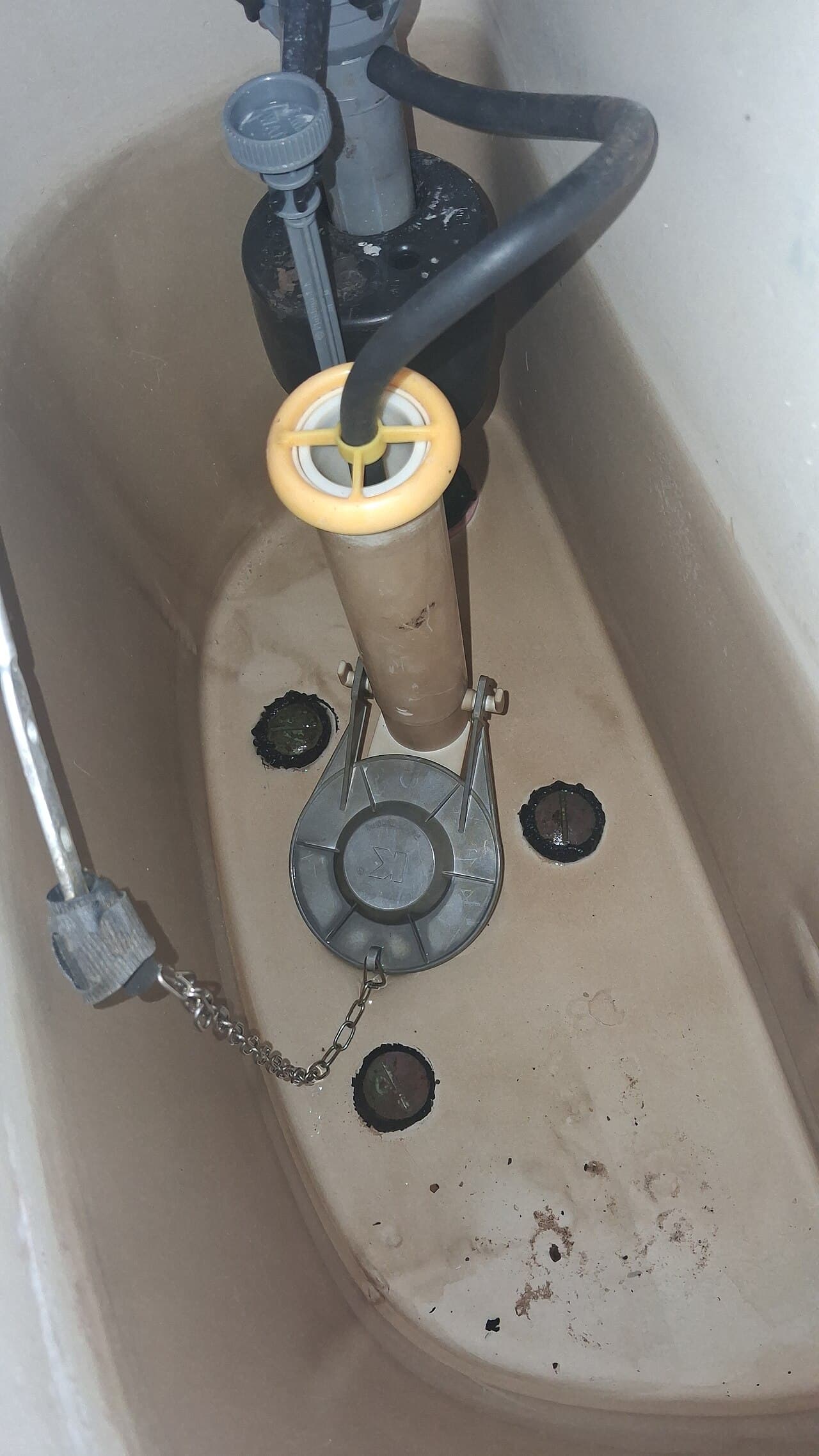
Try the simple fixes first
Two checks sort out most running toilets in a few minutes. If water rises until it spills into the overflow tube, the fill valve needs lowering, cleaning or replacing. If the level drops between flushes and a dye test turns the bowl colored, the flapper is leaking. Both parts are inexpensive and made to be swapped by hand; how to fix a running toilet walks through each.
If the toilet runs on its own every few minutes even after a new flapper, why a toilet runs on its own covers the less obvious causes, such as the chain length, the refill tube and the flush valve seat.
Stop and call a pro if
New parts have not stopped it. Korky's test is to shut off the water and watch where the level settles over a few hours: "If the water level drops to a point on your overflow tube or the bottom of the tank, you need to replace your flush valve."[4] The same applies to the flapper seat itself: "If you notice cracks, warping, or other damage, the flush valve will need to be replaced."[4] A flush valve sits under the tank, so the tank has to come off the bowl and be rebolted. That is a reasonable job for a plumber.
Water is outside the toilet. Fluidmaster notes: "Water visible at the rear of the toilet is most likely coming from the bottom of the fill valve, the water supply line or the seals between the tank and the bowl (in 2-piece toilets)."[7] Tank bolts can sometimes be snugged up, and Korky's warning is blunt: do not overtighten them or allow the tank to touch the bowl, as the porcelain can crack.[6] Water at the base of the bowl is a different job again; see why water leaks around the base of a toilet.
The shut-off valve will not close or leaks. An old valve that is stuck open, or that weeps at its stem once you turn it, usually means shutting off the whole house to replace it.
No water reaches the tank. If the tank will not fill and water does not flow when the supply line is disconnected into a bucket, Korky says the problem is with the home's water supply and to contact a plumber.[5]
The meter keeps moving. Close the toilet's valve, turn off every other tap and appliance, and watch the water meter. Richmond's utilities department puts it plainly: "If the meter is still moving, you may have a hidden leak." It adds: "If you're unsure, a licensed plumber can help identify and repair the issue."[3] See how to find a hidden water leak.
The china is cracked or the toilet rocks. A crack in the tank or bowl is not repairable with tank parts, and a toilet that moves on the floor can break its seal.
The job grows into moving the toilet or changing pipes. Virginia's building code exempts replacing a plumbing fixture from a permit only without alteration of the water supply and distribution systems, sanitary drainage systems, or vent systems.[11]
Hiring a licensed plumber in Virginia
Virginia licenses plumbers. DPOR's Board for Contractors regulates individual tradesmen who engage in the trades of electrical; plumbing; heating, ventilation, and air conditioning (HVAC); gas fitting, and notes that state certification of these trades is mandatory, not optional.[8] It also says that starting April 1, 2025, new license types, including a Residential Plumbing license, give an additional pathway to licensure for those seeking to work as plumbers in residential structures (no commercial work permitted).[8]
For the business itself, the Code of Virginia is direct: "No person shall engage in, or offer to engage in, contracting work in the Commonwealth unless he has been licensed under the provisions of this chapter."[9] Virginia requires a master tradesman licence as a condition of licensure for plumbing contractors.[10]
Check before you book. The Board's consumer guide warns: "A license number in an advertisement or on a business card does not necessarily mean the contractor's license is valid."[12] Look the plumber up on DPOR's website. The same guide says Virginia law requires all licensed contractors to provide a written contract for residential work, and suggests an initial deposit of no more than 10% of the total price or $1,000, whichever is less.[12] A running toilet should not need a deposit at all, but the price, parts and labour should still be in writing.
You can browse the Blacksburg plumbing directory for local businesses. For what the visit is likely to cost, see what fixing a running toilet costs in Virginia, or browse more plumbing repair answers.
When it is time to bring someone in, describe the running toilet once and licensed local plumbers quote the repair.
Common questions
- Is a running toilet an emergency?
- Usually not. Close the shut-off valve behind the toilet and open it only to flush, and it can wait for a booked visit. Water on the floor, a valve that will not close, or a tank that keeps rising toward overflow is more urgent.
- Can I just replace the flapper myself first?
- Yes. A worn flapper is the most common cause, it is an inexpensive part, and it hooks on by hand. If a new flapper of the right size and a fill valve adjustment do not stop the running, that is the point to call a plumber.
- How do I check a plumber's licence in Virginia?
- Look up the person or business on DPOR's website, or call the Board for Contractors. Virginia licenses plumbers as tradesmen, and plumbing contractors must hold a master tradesman licence. A number printed on a card or advert is not proof on its own.
- Does a plumber need a permit to fix a running toilet?
- Not for replacing parts inside the tank or replacing the toilet in place. Virginia's building code treats replacing plumbing fixtures as an ordinary repair when the water supply, drainage and vent piping are not altered. Moving the toilet or changing its pipes needs a permit.
- What should I tell the plumber when I call?
- Say whether water spills into the overflow tube or the tank refills on its own, what a dye test showed, whether there is water outside the toilet, what you have already replaced, and the toilet's brand if you can find it. A photo of the inside of the tank helps.
Sources
- [1] High Usage and Leaks, Chesterfield County, Virginia, Department of Utilities. Checked October 26, 2026.
- [2] Fix a Leak Week, U.S. Environmental Protection Agency, WaterSense. Checked October 26, 2026.
- [3] Fix a Leak Week: Simple Steps to Save Water and Money, City of Richmond, Department of Public Utilities. Checked October 26, 2026.
- [4] How to Fix a Running Toilet, Korky (Lavelle Industries). Checked October 26, 2026.
- [5] How to Replace Toilet Fill Valve, Korky (Lavelle Industries). Checked October 26, 2026.
- [6] How to Fix Leak Between Toilet Tank and Bowl, Korky (Lavelle Industries). Checked October 26, 2026.
- [7] Fix Toilet Ghost Flushing & Refill Sounds, Fluidmaster. Checked October 26, 2026.
- [8] Tradesmen Program, Virginia Department of Professional and Occupational Regulation. Checked October 26, 2026.
- [9] Code of Virginia § 54.1-1103. Necessity for license, Code of Virginia, Virginia General Assembly. Checked October 26, 2026.
- [10] Code of Virginia § 54.1-1100. Definitions, Code of Virginia, Virginia General Assembly. Checked October 26, 2026.
- [11] 13VAC5-63-80. Section 108 Application for permit (Virginia Uniform Statewide Building Code), Virginia Administrative Code, Virginia General Assembly. Checked October 26, 2026.
- [12] What You Should Know Before You Hire a Contractor, Virginia Board for Contractors, DPOR. Checked October 26, 2026.
Want a pro to handle it?
Describe the job once. Licensed local businesses send quotes, and you pay only when you book one.
Get a quote for Plumbing Repair