How do I keep assembled furniture from loosening over time?
Build it completely, with every dowel, cam lock and back-panel nail, and tighten screws by hand without overdoing it. Then go round the hardware when the seasons change, keep indoor humidity steady, keep particleboard dry, lift pieces instead of dragging them, load heavy things low and anchor tall furniture to a wall stud.
Free to ask. Local shops send quotes, and you pay only when you book one.
By Kasra Taheri, Founder, LoclisPublished
Researched and drafted with AI, then checked claim by claim against the sources listed below before it was published. Prices and rules change; the dates beside each source say when it was last checked.
Step by step
Read when to stop and call a pro, further down this page, before you start.
Step 1: Build it completely
Use every dowel, cam lock, screw and back-panel nail the instructions call for, even the ones that seem optional.
Step 2: Tighten by hand
Finish screws with a hand screwdriver and modest force, since screws in particleboard strip their threads when overtightened.[2]
Step 3: Keep the paperwork
Tape the instructions, the hex key and any spare hardware inside the piece so they are there for the next check or move.
Step 4: Check with the seasons
When the heat or air conditioning comes on for the season, go round each piece and snug any cam lock or screw that has loosened.[1]
Step 5: Keep humidity steady
Use a humidity meter and keep indoor relative humidity below 60 percent, ideally between 30 and 50 percent.[5]
Step 6: Keep it dry
Wipe spills at once, keep mop water off the bottom edges and keep particleboard furniture off damp basement floors.[3]
Step 7: Lift, do not drag
Empty drawers and lift a piece to move it, because dragging twists the frame and works the joints loose.
Step 8: Load it low
Put the heaviest items in the bottom drawer and open one drawer at a time.[6]
Step 9: Anchor tall pieces
Fasten dressers, bookcases and wardrobes to a wall stud so they cannot rock or tip.[7]
Step 10: Fix stripped holes early
Repair a screw that spins without tightening with wood glue and a wooden dowel or toothpicks before the joint around it loosens too.
Assembled furniture stays tight when it is built completely, tightened without stripping, checked as the seasons change and kept dry. The rest is how you treat it: lift instead of dragging, load heavy things low and fasten tall pieces to the wall so they do not rock every time a drawer opens.
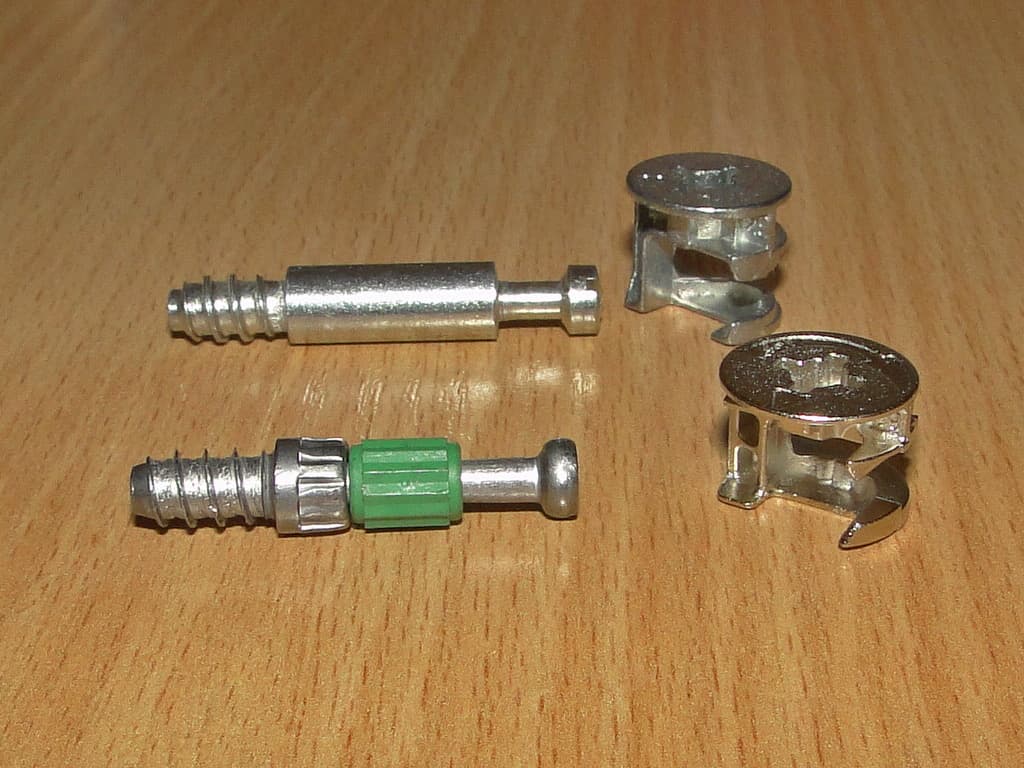
Why assembled furniture loosens
Three things work on it every day.
Use. Every drawer pulled and every lean against a bookcase flexes the joints a little. Cam locks and screws that were only just snug slowly back off.
Humidity. "Wood in service is always undergoing slight changes in moisture content."[1] The Wood Handbook explains that changes from daily humidity swings are usually small, while seasonal changes are gradual but of more concern.[1] Indoor wood's moisture depends mainly on indoor relative humidity, which air conditioning, ventilation and moisture sources in the house all affect,[1] and finishes slow wood's dimensional changes but do not prevent them.[1] A house that is humid in summer and dry with the heat on in winter puts every piece through that cycle once a year.
The material. Particleboard is the predominant material in ready-to-assemble furniture,[3] and it holds a screw well only if the threads in it stay intact. The Forest Products Laboratory warns that care must be taken when tightening screws in particleboard to avoid stripping the threads,[2] and notes that a modest tightening of screws in many cases is an effective compromise between holding strength and stripped threads.[2]
Build it to last
Most loosening starts on assembly day.
- Use every part. Dowels, cam locks, back-panel nails and corner brackets all share the load. A piece missing a few of them will loosen sooner.
- Fit the back panel properly. On bookcases, wardrobes and dressers, the thin back is what keeps the frame square. Seat it in its grooves and fasten it at every point the instructions show.
- Turn every cam until it is snug. A cam lock that is only part way round leaves its joint free to move.
- Finish screws by hand. A cordless driver is quick for starting screws, but set the clutch low or finish them with a hand screwdriver.
A seasonal check
When the air conditioning or the heat starts running for the season, go round your assembled furniture with a screwdriver and the hex key. Snug any cam lock or screw that has backed off, gently. Check bed frames and desk chairs, which take the most movement, and any piece a child climbs or pulls on. If a screw spins without tightening, repair the hole with wood glue and a wooden dowel or toothpicks before the joint around it works loose.
Keep humidity steady
Big swings are what move wood the most. Virginia Cooperative Extension describes 40 to 55 percent relative humidity as comfortable and healthy for a building,[4] and the EPA advises homeowners to keep indoor humidity below 60 percent, ideally between 30 and 50 percent.[5] You can check it with a moisture or humidity meter, which many hardware stores sell.[5] Running a dehumidifier in a damp basement in summer and keeping furniture away from heating vents and radiators both help.
Keep particleboard dry
According to the Wood Handbook, most panels made from particles swell in thickness when they get wet, and that swelling does not go back down.[3] A swollen edge never closes up tight again. Wipe spills at once, keep mop water off the bottom edges, use a tray under plants and keep particleboard furniture off a basement floor that gets damp.
Move it gently
Empty the drawers and lift a piece to move it; dragging a loaded dresser across carpet twists the frame. For a long move, take large pieces apart, bag and label the hardware, and when you rebuild, drive screws back into their old holes by hand so they find their original threads.
Load it and anchor it
Keep the weight low. The warning labels the dresser safety standard calls for include placing the heaviest items in the bottom drawer and not opening more than one drawer at a time.[6] A low centre of weight also means less rocking on the joints.
Fasten tall pieces to the wall. CPSC's advice is to "Anchor furniture to the wall or the floor."[7] A dresser or bookcase held to a stud does not sway, which also spares its joints. See how to anchor furniture to the wall.
Stop and call a pro if
- Panels have swollen or crumbled around the hardware, so cams and screws no longer pull tight.
- The same joint keeps loosening after it has been repaired, or a panel has cracked.
- A loft bed, bunk bed or loaded bookcase has loose joints; anything people sleep in or under should be repaired properly before it is used again.
- Furniture in a damp basement shows swelling, mildew or a musty smell, which points to a moisture problem in the house, not just the furniture.
If a piece already rocks, start with why flat-pack furniture wobbles. You can also browse assembly and mounting services, find handyman businesses around Blacksburg, or read the other handyman answers.
To have loose furniture tightened, repaired or anchored, describe the job on Loclis and local businesses will quote it.
Common questions
- How often should I tighten flat-pack furniture?
- Check it when the seasons change, when the heat or air conditioning starts running, and after any move. Pieces that get heavy daily use, such as a desk chair, a bed frame or a child's dresser, are worth checking more often. Snug the hardware by hand rather than cranking it.
- Does humidity really loosen furniture?
- It contributes. Wood and wood panels take on and give off moisture as indoor humidity rises and falls, and the seasonal swing is the one that matters. That movement can loosen joints a little each year, which is why a seasonal check catches most of it.
- Can flat-pack furniture survive a move?
- Often, if it is treated gently. Empty it, lift rather than drag, and for a long move take large pieces apart. Each rebuild wears the holes a little, so drive screws back by hand into their old threads instead of forcing new ones.
- Will adding glue stop furniture from loosening?
- Glue in the dowel holes during assembly makes many pieces stiffer, but the piece then cannot be taken apart for a move without damage. Decide before you build whether it will ever need to come apart.
Sources
- [1] Wood Handbook, Chapter 13: Drying and Control of Moisture Content and Dimensional Changes (FPL-GTR-190), USDA Forest Service, Forest Products Laboratory. Checked October 27, 2026.
- [2] Wood Handbook, Chapter 8: Fastenings (FPL-GTR-190), USDA Forest Service, Forest Products Laboratory. Checked October 27, 2026.
- [3] Wood Handbook, Chapter 11: Wood-Based Composite Materials (FPL-GTR-190), USDA Forest Service, Forest Products Laboratory. Checked October 27, 2026.
- [4] What Can Builders Do to Help Prevent Moisture Problems in New Construction? (Energy Series, 2901-9012), Virginia Cooperative Extension. Checked October 27, 2026.
- [5] A Brief Guide to Mold, Moisture and Your Home, U.S. Environmental Protection Agency. Checked October 27, 2026.
- [6] Safety Standard for Clothing Storage Units, final rule (87 FR 72598, November 25, 2022), U.S. Consumer Product Safety Commission, Federal Register. Checked October 27, 2026.
- [7] Anchor It and Protect a Child (Publication 5004), U.S. Consumer Product Safety Commission. Checked October 27, 2026.
Want a pro to handle it?
Describe the job once. Licensed local businesses send quotes, and you pay only when you book one.
Get a quote from a local pro