How do I keep garage door sensors working?
Wipe both sensor lenses and test the door's reversal about once a month, keep bins and tools out of the beam zone, shade the receiving sensor from direct sun, and check the thin sensor wires for staples and nicks. Re-aim a sensor that has been bumped and replace one that has gone dark or will not stay clean.
Free to ask. Local shops send quotes, and you pay only when you book one.
By Kasra Taheri, Founder, LoclisPublished
Researched and drafted with AI, then checked claim by claim against the sources listed below before it was published. Prices and rules change; the dates beside each source say when it was last checked.
Step by step
Read when to stop and call a pro, further down this page, before you start.
Step 1: Wipe the lenses
Wipe both sensor lenses with a soft dry cloth and check that the beams are parallel.[4]
Step 2: Look at the lights
Check that the light on each sensor is steady, as described in your opener's manual.
Step 3: Clear the zone
Keep bins, bikes, hoses and stored items out of the strip near the door.
Step 4: Snug the brackets
If a sensor bracket is loose, snug the screw or wing nut and re-check the aim.
Step 5: Shade the receiving sensor
If sun causes trouble, shade the receiving sensor with cardboard without blocking its eye.[3]
Step 6: Check the wire you can see
Look along each sensor wire for staples, nicks or slack; do not touch the connections at the opener.[2]
Step 7: Test the reversal
Lay a 2x4 flat in the door's path and make sure the door reverses when it touches it.[1]
A monthly habit does most of the work
Safety sensors rarely fail on their own. Most problems come from a bump, dirt, sun or a pinched wire, and all of them show up in a quick monthly check. The CPSC recommends that you inspect the garage door and the garage door opener every 30 days to make sure they are working properly,[1] and LiftMaster's maintenance list puts the same job under every month: "Test the safety reversal system."[5]
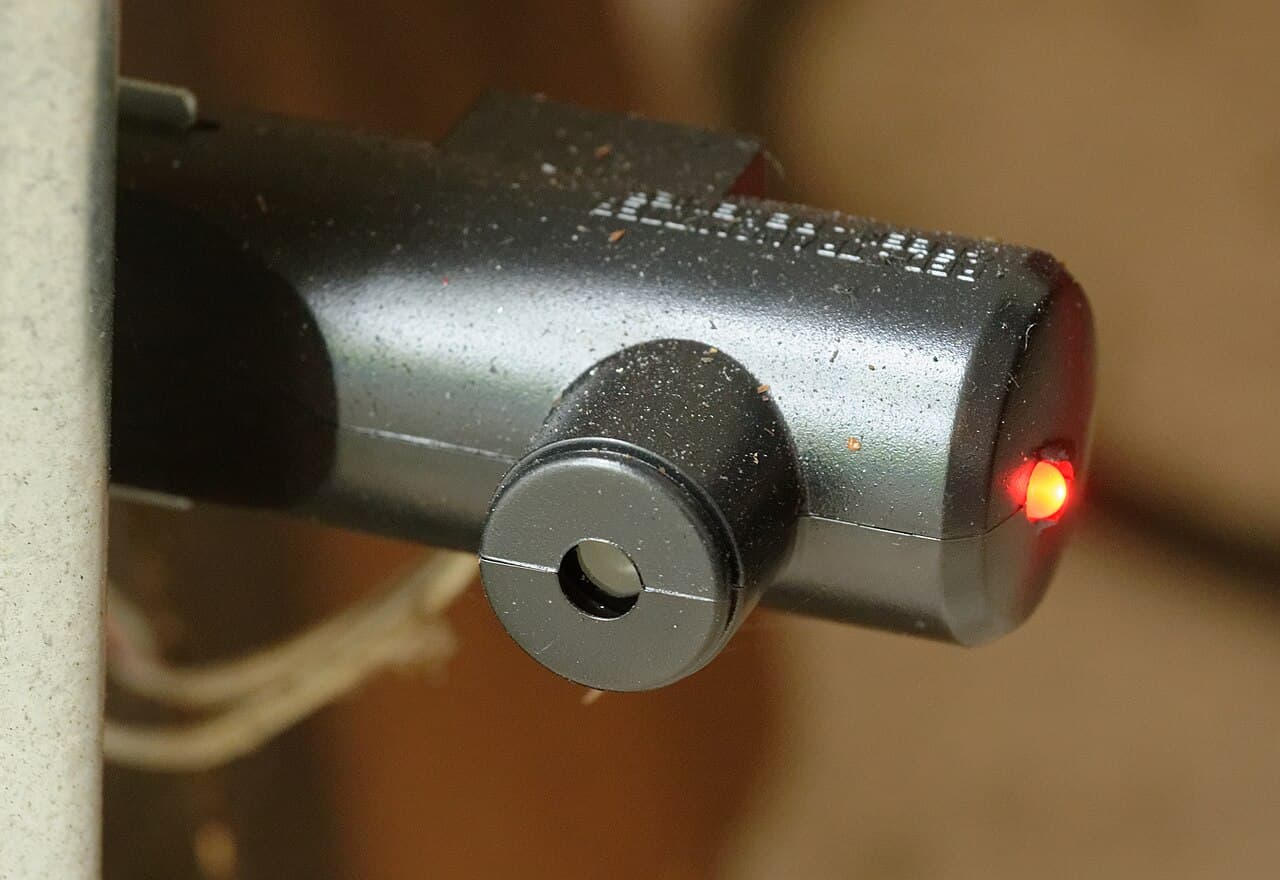
The monthly check
Do it with the door closed and nothing parked in the way.
First, wipe both lenses with a soft dry cloth. Genie's advice is to wipe the lens with a clean cloth and make sure the beams are parallel from each other.[4] Spider webs, dust and condensation are the usual lens problems, and a wet garage in a Virginia summer collects all three.
Second, look at each sensor's light. A steady light on both is normal on many models; a dark or flickering light on one means the sensor needs attention before it fails on a busy morning. Your manual says what each light means for your brand.
Third, test the reversal. The CPSC says to place a 2x4 on the floor of the garage in the door's path, and if the door does not properly reverse when striking the 2x4, the opener should be disengaged until it is adjusted, repaired or replaced.[1]
Keep the sensors from getting knocked
Bumps are the most common cause of a misaligned sensor. Keep bikes, bins, mowers and hoses out of the zone near the door, and park so the car does not swing close to a bracket. If a sensor keeps drifting, snug its bracket screw or wing nut and re-check the aim, as in how to align garage door safety sensors.
Keep the sun out of the receiving sensor
Sunlight carries infrared light, just like safety sensors do.[3] If the door fails to close only at certain times of the day, shade the receiving sensor. On Genie units, the green LED sensor should be positioned out of direct sunlight.[3] A simple shade is to build a box around the green LED sensor lens or tape a piece of cardboard to the top of the sensor, taking care to avoid blocking the actual sensor.[3] On other brands the receiving sensor is marked in the manual.
If you have two doors with two sets of sensors, Genie says to avoid crosstalk by setting the red LED sensors back-to-back or the green LED sensors back-to-back.[3]
Look after the wire
Walk the thin wire from each sensor toward the opener once or twice a year. Look for slack that could snag, wire hanging where a ladder or bike could catch it, and staples that squeeze the insulation. Genie's troubleshooting chart warns that staples can cut insulation and short wires.[2] If you see a nick, do not tape it and hope. A damaged sensor wire is a job for a technician.
Replace old sensors before they fail
Sensors do wear out. Genie notes that a sensor may have become defective and that it may be time to update your Safe-T-Beams.[4] If one is cracked, yellowed or has a lens that will not stay clean, or if a light has gone dark, plan a replacement rather than waiting for the morning it will not close.
Stop and call a pro if
- The reversal test fails. Disengage the opener and have it serviced.[1]
- A sensor light stays dark or keeps flashing after cleaning and re-aiming. The sensor, the wire or the opener may have failed.
- The door is heavy, uneven or binds by hand. The CPSC says that doors which are not balanced, or that bind or stick, should be serviced by a professional.[1] Do not touch springs or cables.
- You find damaged wire or need a replacement sensor connected. That is work at the opener's terminals.
Getting help in Virginia
If the door will not close and the opener light blinks, read why the door will not close when the opener light blinks. Loclis lists local garage door businesses under garage door repair, and there are more garage door answers.
When you are ready, describe the job and local pros quote it.
Common questions
- How often should I check garage door sensors?
- About once a month. The CPSC recommends inspecting the garage door and opener every 30 days, and LiftMaster's maintenance list includes testing the safety reversal system every month.
- How do I clean garage door sensors?
- Wipe each lens with a soft dry cloth. Genie advises wiping the lens with a clean cloth and making sure the beams are parallel. Do not spray cleaner into the housing.
- Why do my sensors stop working when the sun hits them?
- Sunlight carries infrared light, just like the sensors do, so strong sun on the receiving sensor can stop the pair signalling. Shade the receiving sensor with a small box or cardboard, without blocking its eye.
- How long do garage door sensors last?
- There is no fixed life. Genie notes a sensor may have become defective and it may be time to update it. Replace one that has gone dark, cracked or will not stay aligned.
- Can I tape over a sensor that keeps acting up?
- No. The sensors are the safety system that stops and reverses the door on an obstruction. Fix or replace the sensor, then test reversal with a 2x4.
Sources
- [1] Non-Reversing Automatic Garage Door Openers Are a Hazard (CPSC publication 523), U.S. Consumer Product Safety Commission. Checked October 28, 2026.
- [2] Genie Excelerator Series Garage Door Opener Self-Diagnostic Troubleshooting, The Genie Company. Checked October 28, 2026.
- [3] Interference Solutions for Genie Safe-T-Beams, The Genie Company. Checked October 28, 2026.
- [4] Garage Door Won't Open or Close? Try These Tips!, The Genie Company. Checked October 28, 2026.
- [5] LiftMaster Residential Maintenance, LiftMaster. Checked October 28, 2026.
Want a pro to handle it?
Describe the job once. Licensed local businesses send quotes, and you pay only when you book one.
Get a quote for Garage Doors