Why won't my garage door close when the opener light blinks?
The blinking opener light usually means the safety sensors cannot see each other: something is in the beam, a sensor has been knocked out of line, a lens is dirty, or sun is shining into the receiving eye. Clear the beam, wipe the lenses, check both sensor lights, then re-aim. The blink count differs by brand, so check your manual.
Free to ask. Local shops send quotes, and you pay only when you book one.
By Kasra Taheri, Founder, LoclisPublished
Researched and drafted with AI, then checked claim by claim against the sources listed below before it was published. Prices and rules change; the dates beside each source say when it was last checked.
Step by step
Read when to stop and call a pro, further down this page, before you start.
Step 1: Clear the beam
Move anything out of the line between the two sensors and wipe each lens with a soft dry cloth.
Step 2: Read the blink count
Count the flashes on the opener and look them up in your owner's manual, because the codes differ by brand and model.[3]
Step 3: Check the sensor lights
Look at the light on each sensor; both should be steady, and a dark or flickering one points to the sensor that needs attention.[3]
Step 4: Check height and aim
Both sensors should be at the same height and face each other, with an electric eye 4 to 6 inches above the floor.[2]
Step 5: Rule out sunlight
If it fails only at certain times of day, shade the receiving sensor with cardboard, without blocking its eye.[5]
Step 6: Look at the visible wire
Check each sensor wire for a staple, nick or break, without disconnecting anything at the opener.
Step 7: Test the reversal
Place a 2x4 flat on the floor in the door's path and confirm the door reverses when it touches it.[2]
Start with the sensors
The blinking light is a signal, not a broken door. When the opener flashes its light and the door stays up, or drops a little and reverses, the usual reason is the safety sensors: the opener cannot confirm that the path under the door is clear, so it will not close. Chamberlain's support page says to "check that your safety sensors are aligned, as this is a common cause for garage doors not closing".[1]
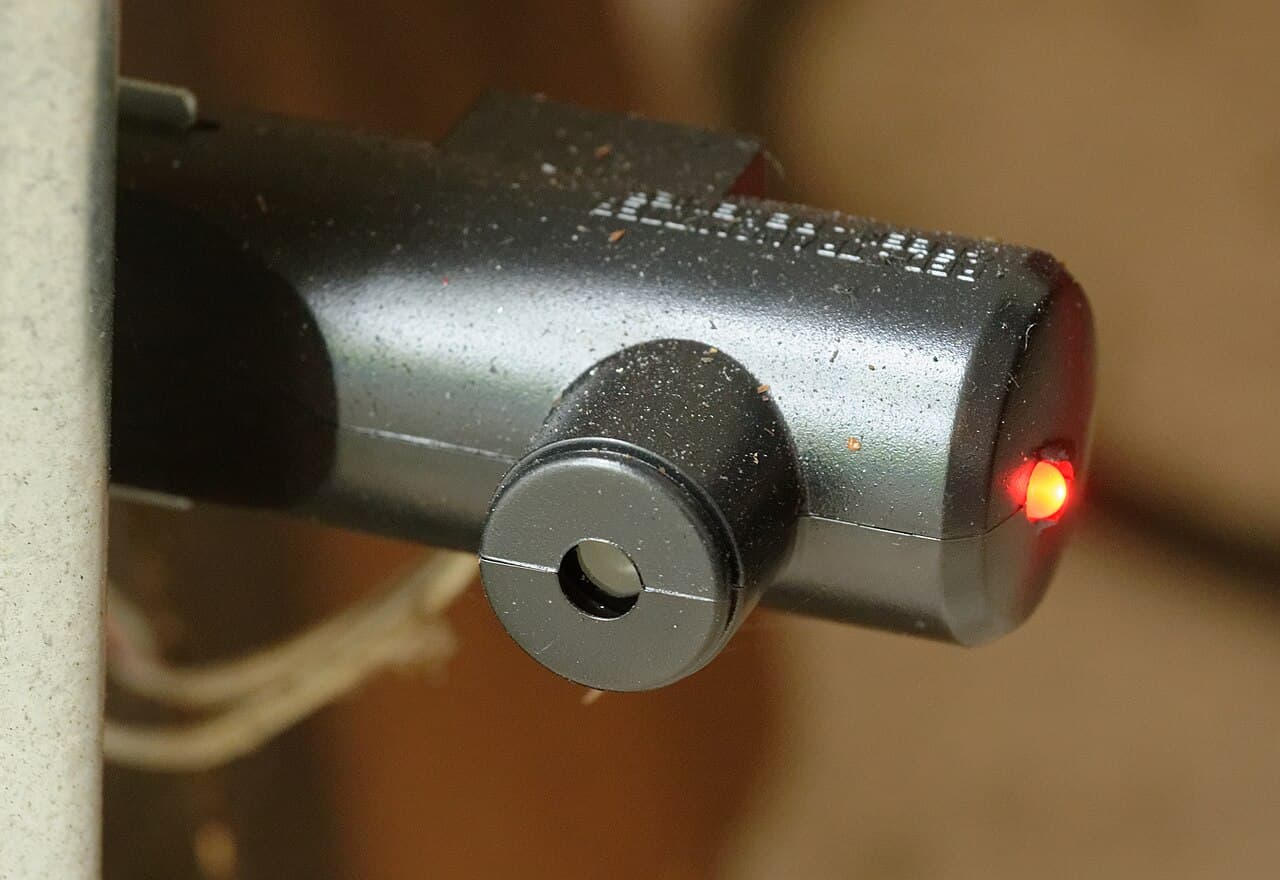
The sensors are the two small eyes mounted low on each side of the door. Genie describes them as using an invisible infrared beam to communicate between the two sensors, and says that when an obstruction is sensed, the opener will automatically reverse.[5] If the beam is blocked, bumped out of line or washed out by bright light, the opener treats it as an obstruction.
What the blinking is telling you
Many openers are self-diagnostic: they flash a light on the motor unit or the sensors a set number of times, and the count points to the fault. The count differs by brand and model, so your owner's manual is the key. As one example, Genie's Excelerator screw-drive openers use a status light, and 5 blinks are listed as a Safe-T-Beam malfunction.[3] On those openers, the Safe-T-Beam system must be installed and operational to enable the garage door to close.[3]
Chamberlain describes a different signal. If the door hits an obstruction, the door will reverse, the opener will beep and the lights will flash 5 times.[1] The same flash count can therefore mean different things on different brands. Find the model number on the motor unit, look up its manual, and read the blink chart before changing anything.
Quick checks, in order
- Clear the beam. Look across the opening at sensor height for a bin, hose, bike wheel, stored box or cobweb, and wipe both lenses with a soft dry cloth.
- Look at both sensor lights. On Genie units, one safety sensor has a green LED light, and one has a red LED light,[5] and both LED lights should be solid.[3] A dark, dim or flickering light on one sensor usually points to alignment, a loose wire or a failed sensor.
- Check height and aim. The CPSC says an electric eye should be installed at a height of 4 to 6 inches above the floor.[2] Both sensors should sit at about the same height and face each other. The full method is in how to align garage door safety sensors.
- Think about the sun. If nothing is in the way and the door only fails at a certain time of day, sunlight may be the cause. Sunlight carries infrared light, just like safety sensors do.[5]
- Look at the wire you can see. Follow each thin sensor wire toward the opener and look for a staple pinching it, a nick or a break. Do not disconnect anything at the opener.
If sunlight is the problem
Genie's advice is that the green LED sensor should be positioned out of direct sunlight.[5] If you cannot move it, Genie suggests you build a box around the green LED sensor lens or tape a piece of cardboard to the top of the sensor, and says to make sure to avoid blocking the actual sensor.[5] Shading is a cheap test: if the door closes with the shade in place, sun was the problem.
An older sensor can be swapped for a newer one. Genie says its newer model has a lens that helps to protect it from sunlight interference.[5] Replacing a sensor means connecting low-voltage wires at the opener, so for most people that is a technician's job.
Do not work around it
Genie notes that its remote and wireless keypad will not work without Safe-T-Beams,[4] and a door that closes with no working sensors has lost protection that exists for a reason: the CPSC reports that about 73 children between the ages of 2 and 14 have been trapped and killed under automatic garage doors since March 1982.[2] Do not disconnect or bypass the sensors to get the door shut. Fix them, or have a technician do it, and keep children and pets clear of the door until it is done.
After any fix, test the reversal. The CPSC says to place a 2x4 on the floor of the garage in the door's path, and if the door does not properly reverse when striking the 2x4, the opener should be disengaged until it is adjusted, repaired or replaced.[2]
Stop and call a pro if
- The sensors look aligned and clean but a light stays dark or keeps flashing. The sensor, its wire or the opener's circuit board may have failed, and a technician can test each.
- The door starts down and reverses even with the sensors steady. That can be a force or travel setting, or a binding door. Genie's list of checks for a door that starts down and goes back up includes "Check garage door for binding."[3]
- The door feels heavy or uneven by hand. The CPSC says that if doors are not "balanced," or if they bind or stick, they should be serviced by a professional.[2] Leave springs and cables alone.
- You would need to splice, replace or re-run sensor wire. That is work at the opener's terminals, best left to a technician.
- The reversal test fails. Disengage the opener and have it serviced.[2]
Getting help in Virginia
If only the remote misbehaves, read why a garage door remote stops working, and see how to keep garage door sensors working to prevent a repeat. Loclis lists local garage door businesses under garage door repair, and there are more garage door answers.
When you are ready, describe the problem and local pros quote it.
Common questions
- Why does my garage door light blink but the door won't close?
- Most often the safety sensors cannot see each other. Something is in the beam, a sensor has been bumped, a lens is dirty, or sun is shining into the receiving eye. The blink count is a diagnostic code that differs by brand, so look it up in your opener's manual.
- What does it mean when the opener light flashes 5 times?
- It depends on the brand. Chamberlain says that after hitting an obstruction the door will reverse, the opener will beep and the lights will flash 5 times. On Genie Excelerator openers, 5 blinks are listed as a Safe-T-Beam malfunction. Check your manual.
- Can sunlight stop a garage door closing?
- Yes. Genie notes that sunlight carries infrared light, just like safety sensors do, so strong sun on the receiving sensor can stop the pair signalling each other. Shading that sensor, without blocking its eye, is a cheap test.
- Should I disconnect the sensors to get the door closed?
- No. The sensors are the protection that stops and reverses the door on an obstruction, and the CPSC reports about 73 children between 2 and 14 trapped and killed under automatic garage doors since March 1982. Fix the sensors or call a technician, and test reversal afterwards.
- Where is the model number so I can find the blink chart?
- It is normally on a label on the motor unit. Search the model number with the word manual on the maker's own website.
Sources
- [1] Fix Your Garage Door's Closing Issues, Chamberlain Group support. Checked October 28, 2026.
- [2] Non-Reversing Automatic Garage Door Openers Are a Hazard (CPSC publication 523), U.S. Consumer Product Safety Commission. Checked October 28, 2026.
- [3] Genie Excelerator Series Garage Door Opener Self-Diagnostic Troubleshooting, The Genie Company. Checked October 28, 2026.
- [4] Genie Safe-T-Beams Explained, The Genie Company. Checked October 28, 2026.
- [5] Interference Solutions for Genie Safe-T-Beams, The Genie Company. Checked October 28, 2026.
Want a pro to handle it?
Describe the job once. Licensed local businesses send quotes, and you pay only when you book one.
Get a quote for Garage Doors