How do I keep my outdoor AC unit clear of debris?
Manufacturers advise at least 2 feet of open space around the outdoor unit on every side, leaves, twigs and grass kept off the top and base, mowing that throws clippings away from it, and a dryer vent well away. A winter cover must be breathable and used only while the AC is off. Coil cleaning inside the cabinet is for a technician.
Free to ask. Local shops send quotes, and you pay only when you book one.
By Kasra Taheri, Founder, LoclisPublished
Researched and drafted with AI, then checked claim by claim against the sources listed below before it was published. Prices and rules change; the dates beside each source say when it was last checked.
This is a job for a licensed pro in Virginia
This page explains what the work involves, the permits, what a licensed pro does and what drives the cost. It does not give step-by-step instructions, because this work needs a licence, a permit or both, and doing it wrong can injure someone. Before you hire, check the licence on Virginia's DPOR record.
Manufacturers advise at least 2 feet of open space around the outdoor unit on every side, leaves, twigs and grass kept off the top and base, mowing that throws clippings away from it, and a dryer vent well away. A winter cover must be breathable and used only while the AC is off. Coil cleaning inside the cabinet is for a technician.
Why a clear unit matters
The outdoor unit's job is to throw away the heat taken out of your house. A fan in the outdoor unit pulls air through the condenser coil, and debris restricts that airflow.[1] Shrubs, fences or debris too close to the unit can trap heat and cause the system to overheat,[2] and dirty coils reduce the system's ability to cool your home, make it run longer, raise energy costs and shorten the equipment's life.[3]
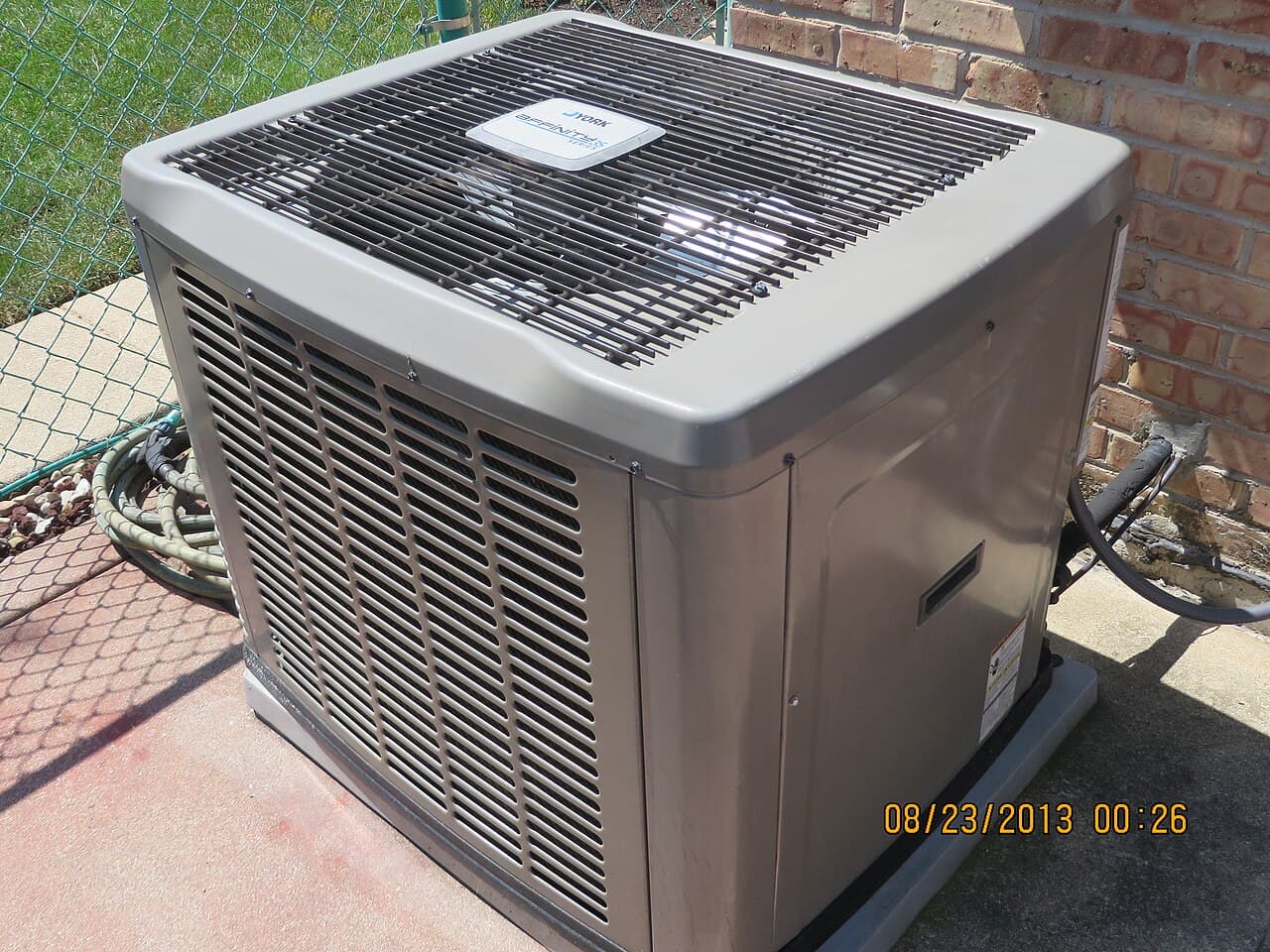
Give it room on every side
Plants are the usual problem, because they grow back toward the unit every summer.
- Two feet, at least. Trane advises keeping landscaping trimmed to at least two feet from the unit on all sides,[4] and American Standard gives the same distance for shrubs and other plants.[5] Carrier suggests trimming back shrubs or flowers to give 2 to 3 feet of clearance.[1]
- Vines and weeds count too. Plants, trees, vines or weeds growing too close to the unit can interfere with how it works.[6]
- Check the installation manual. Manufacturer clearance distances should be followed so nothing blocks the unit's airflow.[7] The model number is on the unit's nameplate, and the manual gives the clearance for the top and each side.
- Mind fences and screens. A decorative screen or fence around the unit is a solid wall to the air it needs, so the same open space applies.
Keep the top and base clear
Leaves, seeds and grass collect on the top grille and around the bottom of the cabinet, especially in autumn. Trane suggests picking off leaves, twigs, cottonwood fuzz and oak pollen clumps that land on top of the unit,[4] and Carrier says to remove leaves that collect at the base.[1]
For a side-discharge mower, Trane says to mow so the grass is discharged away from the AC unit.[4] String trimmers are a hazard to the cabinet, since the coil fins bend easily.
Rinse gently, and only from the outside
Between service visits, Trane says a garden hose can be used to gently spray the condenser coil from the outside, but not on the jet setting and never with a power washer, because the force of the water can bend or damage the fins.[4] Carrier gives the same warning: never use a power washer, and report any visible damage to a professional.[1]
Trane recommends a professional for inspecting and cleaning the coils, and warns that some DIY maintenance can void the warranty on a unit still covered.[4] Opening the cabinet, using coil chemicals or straightening fins is the technician's part of the job.
Keep dryer lint and other debris away
A clothes dryer should not vent within 10 feet of the outdoor unit, because the lint clings to the condensing coil and lowers both the system's efficiency and its service life.[7] A dryer vent, grill or compost pile close to the unit is a reason to ask a contractor about relocating it.
Covers and winter care
Trane says a breathable protective cover can be used in the winter when the AC is not operating, never with the AC running, and that a tarp or other solid covering can trap moisture and promote corrosion, mold and mildew.[6] A heat pump runs in winter, so check the maker's instructions before covering one. American Standard also advises clearing snow from the unit in winter to prevent rust.[5]
What the annual service adds
Clearing the outside is half of it. ENERGY STAR recommends a contractor check-up every year, with the cooling system checked in the spring,[3] and a spring tune-up typically includes cleaning both the condenser and evaporator coils, testing the system and checking for refrigerant leaks.[4] Many manufacturers state on warranty documents that installation and maintenance by a licensed professional are required to keep the warranty valid.[1] With that care, Trane says a condenser coil can last 10 to 15 years or longer.[4] For timing and prices, see how often an air conditioner should be serviced.
When to call a licensed pro
Book a technician when the coil is still matted with dirt after a gentle rinse, when fins are bent or crushed, or when the unit has been hit by a mower, a falling branch or hail. Call sooner for an oily residue around the unit, which can mean a refrigerant leak,[2] for grinding, banging or rattling from the cabinet,[2] or for an outdoor unit that stops running; see why an outside AC unit stops running.
When you hire it out, coil cleaning, electrical checks and refrigerant work are licensed trade work in Virginia: a tradesman includes an individual who does heating, ventilation and air conditioning work for the general public for compensation,[10] and no individual may work or offer to work as a tradesman without a licence, unless supervised by a tradesman licensed in that specialty.[8] Check a business on DPOR's License Lookup[9] before booking.
Loclis lists DPOR-licensed HVAC businesses with their licence number and class. Find HVAC businesses in Blacksburg, browse condenser repair, or read more HVAC repair answers.
If your outdoor unit needs a cleaning or a check, describe it once and licensed local HVAC businesses quote the visit.
Common questions
- How much space does an outdoor AC unit need?
- At least 2 feet on every side is the common manufacturer advice: Trane and American Standard say 2 feet, and Carrier suggests 2 to 3 feet. Your unit's installation manual gives the exact clearances for the sides and the top, and they take precedence.
- Can I plant shrubs to hide my AC unit?
- Yes, if they stay at least 2 feet away once grown and do not form a solid wall. Choose plants that will not outgrow the space, keep vines off the cabinet, and leave the top completely open.
- Should I cover my AC unit in winter?
- Only with a breathable cover, only while the air conditioner is off for the season, and never while it runs. Trane warns that a tarp or other solid covering traps moisture and can cause corrosion and mildew. A heat pump runs in winter, so check the maker's instructions before covering one.
- Can I pressure wash my outdoor AC unit?
- No. Trane and Carrier both say never to use a power washer, because the force of the water bends or damages the coil fins. A gentle spray from a garden hose from the outside, with the system off, is the most a homeowner should do.
- How often should I clear debris from the outdoor unit?
- Look at it every few weeks during the cooling season and after storms, mowing and leaf fall, and clear what has collected. Book a professional coil cleaning and tune-up once a year in the spring.
Sources
- [1] Air Conditioner Maintenance, Carrier. Checked October 26, 2026.
- [2] What Is an AC Condenser?, Carrier. Checked October 26, 2026.
- [3] Maintenance Checklist, ENERGY STAR, U.S. Environmental Protection Agency. Checked October 26, 2026.
- [4] How to Clean Condenser Coils, Trane Residential. Checked October 26, 2026.
- [5] Air Conditioner Maintenance Tips, American Standard Heating & Air Conditioning. Checked October 26, 2026.
- [6] Air Conditioner Maintenance Tips, Trane Residential. Checked October 26, 2026.
- [7] ENERGY SERIES: What about the Air Conditioning System? (2901-9001), Virginia Cooperative Extension, Virginia Tech. Checked October 26, 2026.
- [8] Va. Code § 54.1-1129, Necessity for license (tradesmen), Code of Virginia, Virginia General Assembly. Checked October 26, 2026.
- [9] License Lookup, Virginia Department of Professional and Occupational Regulation. Checked October 26, 2026.
- [10] Va. Code § 54.1-1128, Definitions, Code of Virginia, Virginia General Assembly. Checked October 26, 2026.
Want a pro to handle it?
Describe the job once. Licensed local businesses send quotes, and you pay only when you book one.
Get a quote for HVAC Repair