What does replacing an AC condenser involve?
Replacing an AC condenser means a licensed HVAC contractor recovers the refrigerant, removes the outdoor unit, sets a new one, connects the refrigerant lines and wiring, evacuates and charges the system, and tests it. First you decide whether to replace only the outdoor unit or the indoor coil as well. Virginia's code exempts replacing an electric unit in a house from a permit, but issues one on request.
Free to ask. Local shops send quotes, and you pay only when you book one.
By Kasra Taheri, Founder, LoclisPublished
Researched and drafted with AI, then checked claim by claim against the sources listed below before it was published. Prices and rules change; the dates beside each source say when it was last checked.
This is a job for a licensed pro in Virginia
This page explains what the work involves, the permits, what a licensed pro does and what drives the cost. It does not give step-by-step instructions, because this work needs a licence, a permit or both, and doing it wrong can injure someone. Before you hire, check the licence on Virginia's DPOR record.
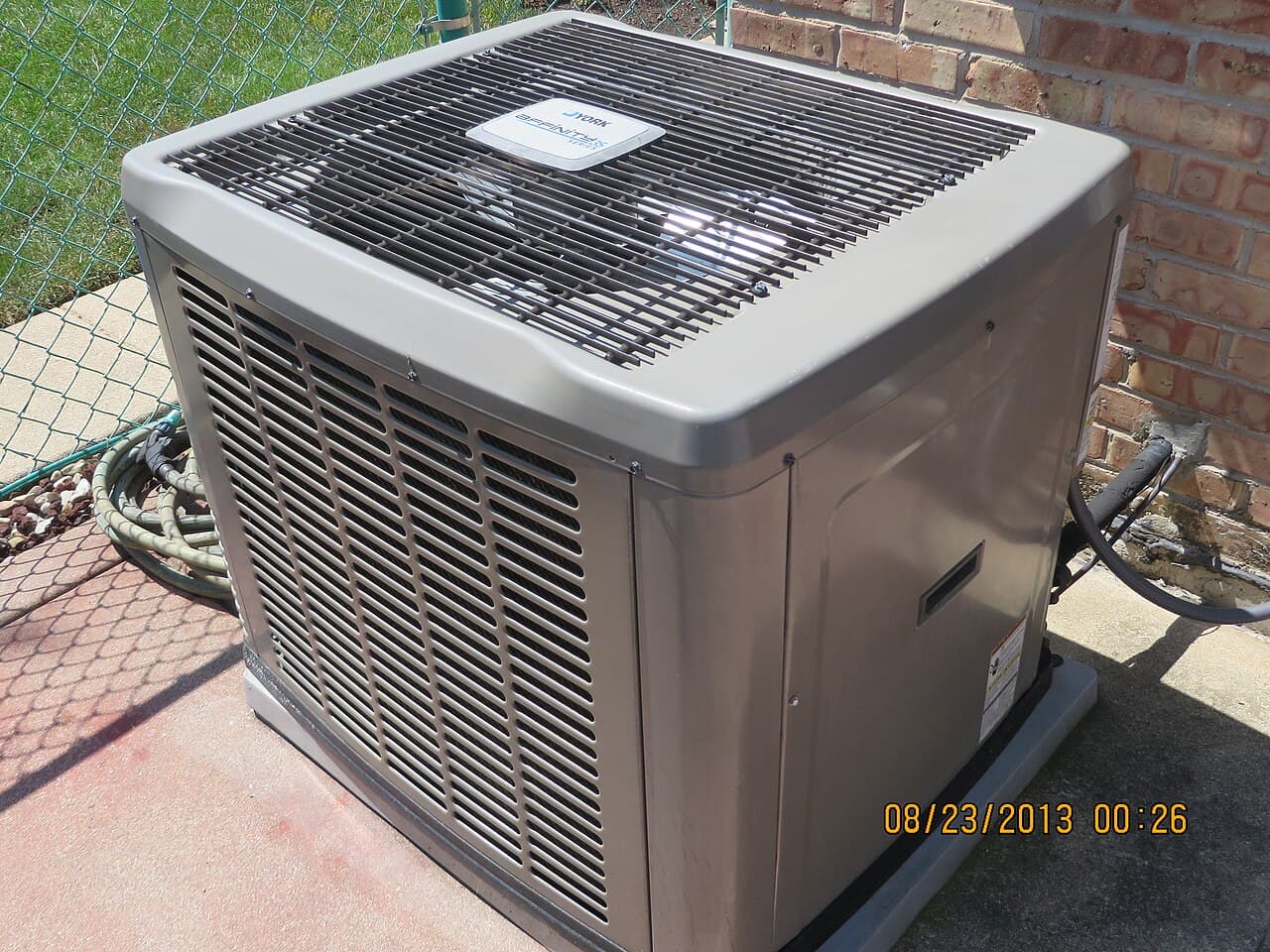
Replacing an AC condenser means swapping the outdoor half of a split system for a new unit. The condenser is the box outside that releases the heat taken out of your house, and the compressor is a pump inside it that pressurizes the refrigerant.[1] A licensed HVAC contractor recovers the old refrigerant, sets and connects the new unit, evacuates and charges the system, and tests it. Most of the decisions that matter happen before anyone lifts a wrench.
What the outdoor unit does
Inside the cabinet, the compressor pumps hot refrigerant gas into the condenser coil, a fan blows outdoor air over the coil, and the refrigerant gives up its heat and condenses back into a liquid before it returns to the indoor coil.[1] That is why a condenser needs open air around it, and why a failed fan, compressor or coil stops the cooling even when the indoor blower still runs.
A condensing unit contains the condenser coil and the compressor; the indoor coil, called the evaporator, sits with the furnace or air handler.[2] The two are connected by a pair of copper refrigerant lines, the line set.
The first decision: condenser only, or both coils
Federal rules allow either. Homeowners can repair their systems over the equipment's useful life, including replacing a faulty condensing unit with a similar R-410A component.[2] If both the condensing unit and the indoor coil are replaced together, that counts as a new system even when the old refrigerant lines stay.[2] A whole new system installed after January 1, 2026 must use a lower-GWP refrigerant,[2] but EPA's May 2026 rule removed that deadline for residential systems made or imported before January 1, 2025, and lets that inventory be installed until supply runs out.[3]
For an older R-22 system, EPA regulations allow the owner to replace a broken condensing unit with a new one, as long as it meets regional efficiency standards.[4] No refrigerant is a "drop in" substitute for HCFC-22,[4] so changing refrigerant means changing components.
The efficiency case points the other way. Virginia Cooperative Extension advises replacing both the indoor and outdoor coils on a matched system for maximum efficiency and reliability,[5] and Carrier recommends replacing the two units together for compatibility, efficiency and warranty coverage.[1] The full trade-off is in whether to replace the whole AC system or just the condenser.
Sizing before anything is ordered
A replacement is the moment to check that the size is right. Carrier's residential air conditioners run from 2 to 5 tons, and an undersized unit won't keep up on hot days while an oversized one short-cycles, leaving humidity behind.[1] ENERGY STAR tells homeowners to make sure the contractor uses the actual characteristics of the home to size the equipment, not a rule of thumb,[6] and Virginia Cooperative Extension says not to hire a contractor who sizes the unit solely on the square footage of the house.[5] When only the condenser is replaced, its capacity and refrigerant have to suit the indoor coil that stays.
What happens on installation day
A typical job looks like this, done by the contractor's crew:
- Recovery. The refrigerant in the old unit is recovered, never vented. It is illegal to intentionally release any refrigerant when maintaining, servicing, repairing or disposing of AC equipment.[4]
- Removal and setting. The old unit is disconnected and hauled away, and the new one is set on a level pad. Trane's installed prices include removing and disposing of the old system, flushing the existing line set or installing a new one, testing and cleanup.[7]
- Refrigerant connections. The line set is joined to the new unit, then the lines are evacuated to pull out air and moisture.
- Electrical. The unit's power and the low-voltage control wires from the thermostat are reconnected.
- Charge and test. ENERGY STAR tells homeowners to make sure the contractor tests and adjusts the refrigerant charge, and to ask that the new system's airflow meets the manufacturer's performance specifications.[6]
Every refrigerant step needs certification. Attaching hoses and gauges, adding or removing refrigerant, adding or removing components and cutting the refrigerant line all require EPA Section 608 technician certification.[4]
Placement
The new unit usually goes where the old one sat, but it is worth a look. Manufacturer clearance distances should be followed so nothing blocks the unit's airflow, and a clothes dryer should not vent within 10 feet of it, because lint clings to the condensing coil.[5]
Permits and inspection
Virginia's building code requires a permit before work on mechanical systems, electric wiring or equipment the code regulates,[8] then exempts replacing mechanical appliances that are not fueled by gas or oil in single-family homes.[8] The exemption is not a ban: when an owner or an owner's agent asks for a permit for exempt work, the permit is issued and the related inspections are required.[8] Decide with the contractor whether to ask for one, put the answer in the contract, and read whether you need a permit to replace an HVAC system in Virginia.
Cost
Price depends on size, efficiency, refrigerant and whether the indoor coil is replaced too. When we checked on October 26, 2026, Trane's 2026 guide put its installed air conditioner replacements at $6,568 to $13,669, based on national averages.[7] For what moves the number, see what replacing an AC condenser costs in Virginia.
When to call a licensed pro
From the start. Replacing a condenser means refrigerant, line-voltage wiring and sometimes a permit, so it is not a homeowner job. In Virginia, no individual may work or offer to work as a heating, ventilation and air conditioning tradesman without a licence, unless supervised by a tradesman licensed in that specialty.[9][10] Check the company on DPOR's License Lookup[11] and ask whether its technicians are Section 608-certified.[4]
Get the job in writing, with the model numbers of the new unit and of any indoor coil. Virginia's Board for Contractors requires a residential contract to state the total cost, the down payment and progress payments, and the contractor's licence number and class.[12] For a full system swap, read what installing a new HVAC system involves.
Loclis lists DPOR-licensed HVAC businesses with their licence number and class. Find HVAC businesses in Blacksburg, browse condenser repair, or read more HVAC repair answers.
If your outdoor unit needs replacing, describe the job once and licensed local HVAC businesses quote it.
Common questions
- Can I replace just the outdoor AC unit?
- Yes. EPA lets homeowners replace a faulty condensing unit with a similar component that uses the same refrigerant, and an R-22 owner can replace a broken condensing unit if the new one meets regional efficiency standards. Whether it is wise depends on the age and match of the indoor coil; Carrier and Virginia Cooperative Extension favour a matched pair.
- Do the refrigerant lines have to be replaced too?
- Not always. Trane's installed prices cover either flushing the existing line set or installing a new one. The contractor decides based on the lines' condition, size and the refrigerant the new unit uses, and the quote should say which.
- Can a homeowner install a new condenser to save money?
- No. Attaching hoses and gauges, adding or removing refrigerant and cutting the refrigerant line all require EPA Section 608 certification. In Virginia, HVAC work for the general public for pay needs a licensed tradesman, and the wiring and permit side make it a job for a licensed contractor.
- Does replacing a condenser need a permit in Virginia?
- Not usually. Virginia's statewide building code exempts replacing mechanical appliances not fueled by gas or oil in single-family homes. If you want the work inspected, you or the contractor can ask for a permit, and the code then requires it to be issued and inspected. The contract should say who pulls it.
- Will a new condenser use a different refrigerant?
- It can. A replacement condensing unit for an existing R-410A system can still use R-410A. A whole new split system installed after January 1, 2026 must use a lower-GWP refrigerant, except that EPA's May 2026 rule lets residential systems made or imported before 2025 be installed until that stock runs out.
Sources
- [1] What Is an AC Condenser?, Carrier. Checked October 26, 2026.
- [2] Frequent Questions on the Phasedown of Hydrofluorocarbons, U.S. Environmental Protection Agency. Checked October 26, 2026.
- [3] Fact Sheet: Final Rule, Reconsideration of Certain Technology Transitions Requirements (May 2026), U.S. Environmental Protection Agency. Checked October 26, 2026.
- [4] Homeowners and Consumers: Frequently Asked Questions, U.S. Environmental Protection Agency. Checked October 26, 2026.
- [5] ENERGY SERIES: What about the Air Conditioning System? (2901-9001), Virginia Cooperative Extension, Virginia Tech. Checked October 26, 2026.
- [6] HVAC Quality Installation, ENERGY STAR, U.S. Environmental Protection Agency. Checked October 26, 2026.
- [7] Trane 2026 HVAC Replacement Cost Guide, Trane Residential. Checked October 26, 2026.
- [8] 13VAC5-63-80, Virginia Uniform Statewide Building Code, Section 108 Application for permit, Virginia Administrative Code, Virginia General Assembly. Checked October 26, 2026.
- [9] Va. Code § 54.1-1129, Necessity for license (tradesmen), Code of Virginia, Virginia General Assembly. Checked October 26, 2026.
- [10] Va. Code § 54.1-1128, Definitions, Code of Virginia, Virginia General Assembly. Checked October 26, 2026.
- [11] License Lookup, Virginia Department of Professional and Occupational Regulation. Checked October 26, 2026.
- [12] 18VAC50-22-260, Filing of charges; prohibited acts, Virginia Administrative Code, Board for Contractors. Checked October 26, 2026.
Want a pro to handle it?
Describe the job once. Licensed local businesses send quotes, and you pay only when you book one.
Get a quote for HVAC Repair