How do I load a moving truck so nothing breaks?
Load the heaviest things first, against the front wall of the box, and build tight tiers from floor to ceiling back toward the door. Keep the weight balanced side to side, put mattresses and sofas along the walls, strap each tier with tie-downs, fill every gap with soft items, and finish with light, fragile boxes on top. Nothing should be able to slide or tip.
Free to ask. Local shops send quotes, and you pay only when you book one.
By Kasra Taheri, Founder, LoclisPublished
Researched and drafted with AI, then checked claim by claim against the sources listed below before it was published. Prices and rules change; the dates beside each source say when it was last checked.
Step by step
Read when to stop and call a pro, further down this page, before you start.
Step 1: Pack boxes full and taped
Fill every box so the top does not cave in, put books and other heavy things in small boxes, and mark fragile boxes on the sides as well as the top.
Step 2: Pad and wrap furniture
Wrap wood furniture, appliances and glass in furniture pads or blankets, and tape drawers and doors shut or empty them first.
Step 3: Stage by weight near the door
Group appliances and heavy furniture, mattresses and sofas, and boxes by weight, so the crew can load in order instead of searching.
Step 4: Load the heaviest items first
Put the heaviest objects, such as the refrigerator and washer, against the front wall of the box.[1]
Step 5: Keep the weight balanced
Spread heavy pieces evenly across the truck bed rather than all on one side.[1]
Step 6: Line the walls with soft pieces
Stand mattresses, box springs and large cushions along one side and sofas along the other.[1]
Step 7: Build tight tiers
Work from the front toward the door in tiers that run wall to wall and floor to ceiling, heaviest at the bottom, lightest on top.
Step 8: Strap each tier
Run tie-downs across each finished tier to keep the heaviest items from shifting.[1]
Step 9: Fill the gaps
Push pillows, bagged linens and soft boxes into gaps so nothing has room to slide or tip on a turn.
Step 10: Stand mirrors and art on edge
Wrap mirrors, framed art and tabletops and stand them on edge between mattresses or flat furniture, rather than lying flat under a load.
Step 11: Keep valuables in the cab
Keep small valuables and anything you will need to grab quickly with you in the cab.[1]
Step 12: Check before you close up
Push on the last tier to make sure it does not move, then close and lock the door.
Load the heaviest things first, against the front wall of the box, and build tight tiers toward the door so nothing has room to move. Penske's loading guide calls this an "I" formation:[1] the heaviest pieces across the front, mattresses along one side and sofas along the other, and heavy boxes at the back, with smaller boxes packed in around them. Then use tie-downs to keep the heaviest items from shifting, and balance the weight evenly on the truck bed.[1] Most breakage happens when a load slides or tips on a turn, so a tight, strapped load protects almost everything.
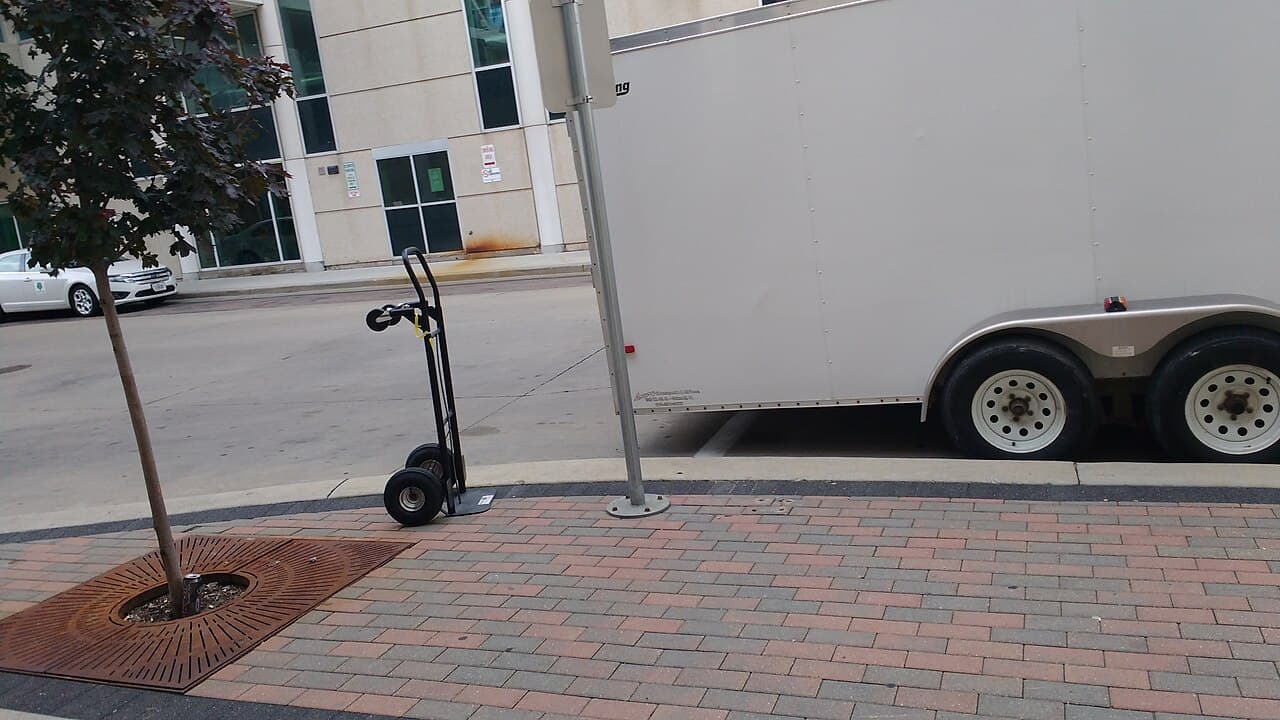
Before anything goes on the truck
A good load starts with good packing. Fill every box so the top will not cave in under the box above it, and put books, tools and dishes in small boxes so no single box gets too heavy to carry safely. Mark fragile boxes on the sides as well as the top, because the top is hidden once boxes are stacked.
Wrap wooden furniture, appliances and anything glass in furniture pads or moving blankets. Empty drawers or tape them shut, and take legs off tables when they come off easily. Stage everything near the door by weight: appliances and heavy furniture in one place, mattresses and sofas in another, boxes sorted heavy and light. The crew can then load in order instead of hunting for the next piece.
Penske suggests picking up the truck the day or evening before you move,[2] which gives you time to get used to the mirrors and the ramp before the crew arrives. U-Haul's loading ramp comes on its 15-foot and larger trucks,[3] and none of its trucks has a lift gate,[3] so plan on a ramp and a hand truck or appliance dolly for anything heavy.
The loading order
Work from the cab end of the box back toward the door:
- Front wall. The heaviest objects, such as the refrigerator and washer, go in the front of the box,[1] pushed tight to the wall.
- Middle. Desks and dining tables can go in the middle, with heavy boxes underneath if there is enough clearance.[1]
- Side walls. Mattresses, box springs and other large cushions go along the left side, with sofas along the right side opposite them.[1] They act as padding for everything in between.
- Back. More heavy boxes go in the center at the back to complete the "I", and smaller boxes and loose items fill in behind and around them.[1]
Within each section, build in tiers that run wall to wall and as close to the ceiling as you can safely reach: heavy boxes on the bottom, medium in the middle, light on top. A tier that fills the width of the truck cannot slide sideways. Strap each finished tier before starting the next.
Fill every gap. Pillows, bagged linens, couch cushions and soft boxes push into the spaces between furniture and keep pieces from rubbing. Mirrors, framed art and glass tabletops should be wrapped and stood on edge between mattresses or flat furniture, rather than laid flat where something can land on them. Keep small valuables with you in the cab, along with medicine, documents and anything you will need on the first night.
Lifting and carrying
When loading and unloading, bend your knees and lift with your legs, not your back.[2] Two people on anything awkward is usually faster than one person struggling, and a hand truck is safer than carrying a stack of boxes on the ramp. If the new place has stairs, unload enough to reach the heaviest items and move them first, before everyone gets tired.[2]
Batteries and things that should not ride in the back
Lithium-ion batteries in tools, laptops, e-bikes and scooters need care. To prevent fires, the EPA says to tape battery terminals or put lithium-ion batteries in separate plastic bags,[5] and a used battery can still hold enough energy to injure someone or start a fire.[5] If a lithium-ion battery is damaged, the EPA says to contact the battery or device manufacturer for handling information.[5]
On the road
A loaded box truck handles differently from a car. The clearance height of a 26-foot U-Haul truck is 12 feet,[4] and many overhead obstructions have no posted clearance,[4] so watch for drive-through canopies, parking garages, low branches and apartment awnings. Brake early and take turns slowly; a well-strapped load still shifts if the truck stops hard.
For protecting the house itself while the crew carries things out, see how to protect floors and walls on moving day. For the wider timeline, see how to plan a local move.
Stop and call a pro if
- You are moving a piano, a gun safe, a hot tub, a pool table or anything that needs rigging. Hire a crew that does specialty items and has the equipment.
- A gas range or gas dryer has to come off its gas line. Leave that to a licensed pro, not the loading crew.
- An appliance or piece of furniture has to go up or down a long, narrow or outdoor staircase and nobody on the crew has done it before.
- The truck is too big for you to drive confidently, or the route has low clearances you cannot avoid.
Getting loading help through Loclis
If you want help with the heavy lifting, read whether to hire movers or just loading help, browse more junk removal and moving answers, see loading and unloading crews, or describe your move and get quotes from loading crews.
Common questions
- What goes in a moving truck first?
- The heaviest items: refrigerator, washer, dryer and other appliances, against the front wall of the box. Heavy furniture follows, then tiers of boxes, with the lightest and most fragile things loaded last and on top.
- What should ride in the cab instead of the box?
- Small valuables and anything you need to grab quickly: keys, documents, medicine, chargers and the first night's essentials. Penske's loading guide suggests keeping small, valuable items with you in the cab.
- How do I keep boxes from crushing each other?
- Fill each box so the top cannot cave in, put heavy things in small boxes, and stack heavy boxes under light ones. Half-empty boxes are the ones that collapse under a stack.
- Do I need straps if the truck is packed full?
- Yes. A full load can still shift on a hard stop or a turn. Strap each tier as you finish it and fill gaps with soft items, so nothing can slide or tip.
- Can lithium batteries go in the truck?
- Pack them with care. The EPA advises taping battery terminals or bagging lithium-ion batteries separately to prevent fires. If a battery is damaged, the EPA says to contact the battery or device maker for handling information.
Sources
- [1] Learn How To Load a Moving Truck, Penske Truck Rental. Checked October 27, 2026.
- [2] How to Load a Moving Truck: Loading & Towing, Penske Truck Rental. Checked October 27, 2026.
- [3] How to Lock a U-Haul Truck, Open the Roll-Up Door, and Use the EZ-Load Ramp, U-Haul. Checked October 27, 2026.
- [4] Overhead Clearance Height for a 26-ft U-Haul Moving Truck, U-Haul. Checked October 27, 2026.
- [5] Used Lithium-Ion Batteries, U.S. Environmental Protection Agency. Checked October 27, 2026.
Want a pro to handle it?
Describe the job once. Licensed local businesses send quotes, and you pay only when you book one.
Get a quote from a local pro