How do I replace the bottom seal on a garage door?
Find out what kind of retainer is on the bottom edge of the door, because seals are not interchangeable. Disengage the opener, raise the door, clamp both tracks, slide out the old seal, slide in the new one, and trim it leaving two extra inches that you tuck in. Do not touch the bottom corner brackets or the springs: they are under heavy tension.
Free to ask. Local shops send quotes, and you pay only when you book one.
By Kasra Taheri, Founder, LoclisPublished
Researched and drafted with AI, then checked claim by claim against the sources listed below before it was published. Prices and rules change; the dates beside each source say when it was last checked.
Step by step
Read when to stop and call a pro, further down this page, before you start.
Step 1: Identify the retainer
Look at the bottom edge of the door to see whether the seal sits in a U-shaped retainer or a bulb-shaped one, because garage doors are manufactured with varying types of weather seal retainer designs.[1]
Step 2: Buy the matching seal
Get a replacement made for that retainer type, cut or ordered to the width of your door. If the floor is not level, ask about a special seal.[1]
Step 3: Disengage the opener
If your door is connected to an automatic opener, be sure to disengage the opener before beginning work.[1]
Step 4: Raise the door and clamp the tracks
Raise the door to the open position and place C-clamps or locking pliers in both tracks directly below the door and tighten them.[1]
Step 5: Remove the old seal
Slide the old seal out of the bottom section. It may be necessary to remove screws holding the weather seal to the retainer.[1]
Step 6: Fit the new seal
For a U-shaped retainer, insert the seal's T-shaped edges into their slots and slide it across the door. For a bulb retainer, curl the flat strip into a bulb shape and feed its T into the slot.[1]
Step 7: Trim and tuck
Cut off the excess seal flush, leaving two extra inches at the edge of the door, and tuck the extra into itself to allow for shrinkage.[1]
Step 8: Test the door and the reverse
Take off the clamps, reconnect the opener, run the door and test its reverse function with a 2x4 on the floor.[4]
Replacing a garage door bottom seal is a job a careful homeowner can do, as long as they leave the springs, cables and bottom corner brackets alone. The key is matching the seal to the retainer on your door, then sliding the old one out and the new one in.
Start with the retainer
Look at the bottom edge of the door. The rubber seal sits in a channel, called the retainer, fixed to the bottom section. Garage doors are manufactured with varying types of weather seal retainer designs, so the seal you buy has to fit yours.[1] Clopay's U-shaped seal fits U-shaped retainers and its bulb seal fits bulb-shaped retainers.[1]
Take a photo of the end of the old seal, or cut off a short piece to carry to the supplier. Measure the width of the door and buy a seal at least as long.
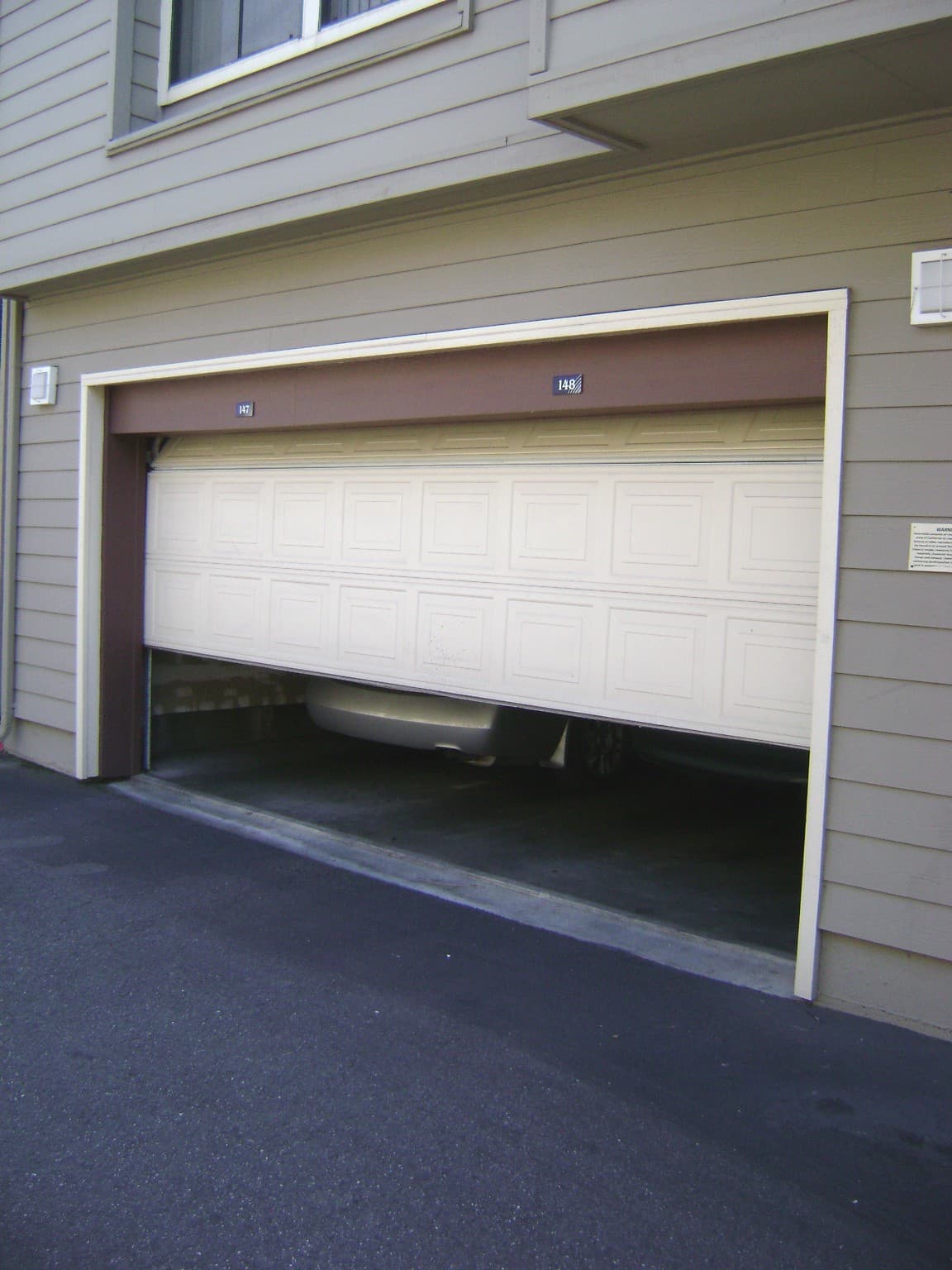
If your floor is not level, note that for non level floor surfaces, special weather seal may be available.[1] Ask about it before you buy a standard strip.
Before you start
Disengage the opener. Clopay's instructions are plain: if your door is connected to an automatic opener, be sure to disengage the opener before beginning work.[1] Then raise the door to the open position and clamp both tracks with C-clamps or locking pliers directly below the door and tighten, so it cannot drop.[1]
A door that will not stay where you leave it is a sign of a balance problem. CPSC warns that if doors are not "balanced," or if they bind or stick, they should be serviced by a professional.[4] Do not carry on with the seal.
Swap the seal
Slide the old seal out of the retainer, working from one end. On some doors you must first remove screws holding the weather seal to the retainer, as the Clopay instructions put it: it may be necessary to remove screws holding weather seal to retainer.[1]
For a U-shaped retainer, insert the new seal's T-shaped edges into the slots and slide the seal across the full width of the door.[1]
For a bulb-shaped retainer, make a bulb shape from the flat strip of weather seal by curling the ends together, then feed the T at the top of the bulb into the slot.[1] The weather seal will slide through the retainer slot easier if soapy water is applied.[1]
Finish by trimming. Cut off excess weather seal flush leaving two extra inches from the edge of door.[1] Tuck extra weather seal into itself to allow for future shrinkage.[1] Put back any screws you took out.
Test before you walk away
Take off the clamps and reconnect the opener. Then run the door through a full cycle and watch the new seal: it should sit evenly along the floor without folding under or dragging.
Finally, check the reverse function. CPSC's test uses a 2x4 on the floor in the door's path, and if the door does not properly reverse when striking the 2x4 then the garage door opener should be disengaged until it is adjusted, repaired or replaced.[4] Repeat the test after any seal change.
What the seal does
A bottom seal blocks drafts, rain and leaves at the gap between the door and the slab. The Department of Energy lists weather stripping materials for doors that include aluminum or stainless steel door sweeps, metal gaskets, bulb or fin seals.[3]
Stop and call a pro if
- The door is heavy, unbalanced or will not stay up. Springs do the lifting. Clopay's manual says that if your old door uses torsion springs, do not attempt to remove the door or the springs yourself.[2]
- The retainer is bent, rusted through or loose. That is a bottom section repair, not a seal swap.
- The seal is stuck behind a bottom corner bracket. The brackets at the bottom corners of your garage door are under great tension.[2] Do not loosen them.
- The door binds or sticks. CPSC says it should be serviced by a professional.[4]
- The door does not reverse after the swap. Leave the opener disengaged and call a door technician.[4]
Getting help in Virginia
If the seal is only part of the problem, see how to quiet a garage door, what the job costs and how to replace a broken hinge. Browse more garage door answers, or see garage door pros on Loclis.
When you would rather hand it over, describe the job and local garage door pros will quote it.
Common questions
- Can I use any bottom seal on my door?
- No. Clopay's instructions note that garage doors are manufactured with varying types of weather seal retainer designs, and its U-shaped and bulb-shaped seals fit different retainers.[^clopay-seal] Identify your retainer before you buy, and if the door is a different make, check that manufacturer's parts list.
- What is the seal made of?
- The Department of Energy lists weather-stripping products for doors as including aluminum or stainless steel door sweeps, metal gaskets, bulb or fin seals.[^doe-air]
- Why do I leave two extra inches at each end?
- Because a seal can shrink. Clopay's instructions say to cut off excess weather seal flush leaving two extra inches from the edge of door, and to tuck the extra into itself to allow for future shrinkage.[^clopay-seal]
- The seal will not slide into the retainer. What can I do?
- Clopay says the weather seal will slide through the retainer slot easier if soapy water is applied.[^clopay-seal] Work slowly and keep the seal straight so it does not twist in the slot.
- My garage floor is uneven. Will a standard seal work?
- Maybe not. For non level floor surfaces, special weather seal may be available, according to Clopay.[^clopay-seal] Measure the largest gap along the floor and ask the supplier which seal suits it.
Sources
- [1] Installation instructions for bulb-shaped and U-shaped astragal (garage door weather seal), Clopay Building Products. Checked October 27, 2026.
- [2] Avante Garage Door Installation Instructions, Clopay Building Products. Checked October 27, 2026.
- [3] Guide to Air Sealing, U.S. Department of Energy. Checked October 27, 2026.
- [4] Non-Reversing Automatic Garage Door Openers Are a Hazard (CPSC publication 523), U.S. Consumer Product Safety Commission. Checked October 27, 2026.
Want a pro to handle it?
Describe the job once. Licensed local businesses send quotes, and you pay only when you book one.
Get a quote for Garage Doors