How do I replace a broken garage door hinge?
Replace a broken middle or top hinge with the door closed, the opener disconnected, and only one hinge undone at a time. Match the number stamped on the old hinge. Do not touch the bottom corner brackets or anything attached to the lift cable: they are under heavy spring tension. If the broken hinge is down there, call a pro.
Free to ask. Local shops send quotes, and you pay only when you book one.
By Kasra Taheri, Founder, LoclisPublished
Researched and drafted with AI, then checked claim by claim against the sources listed below before it was published. Prices and rules change; the dates beside each source say when it was last checked.
Step by step
Read when to stop and call a pro, further down this page, before you start.
Step 1: Close the door and disconnect the opener
With the door fully closed, unplug the opener and pull the red quick-release cord so the door is detached from the opener.[2]
Step 2: Check which hinge is broken
Find the cracked or bent hinge. If it is at the bottom corner or touches the bracket holding the lift cable, stop here and call a pro.[1]
Step 3: Read the number on the old hinge
Hinges are numbered, and the number is stamped on the hinge.[1] Note it, and buy a hinge with the same number and gauge from a garage door supplier.
Step 4: Support the section
Keep the door locked and down, and have a helper hold the panel steady while one hinge is loose. No more than one hinge is to be removed from the door at any given time.[1]
Step 5: Undo the old hinge
Back out the screws or nuts and bolts holding the broken hinge, and lift it off. Leave every other hinge, roller and bracket alone.
Step 6: Fit the new hinge
Set the new hinge in the same position with the roller in the track, and fasten it with the same hardware, snug but not over-tightened.[1]
Step 7: Check the hardware and test by hand
Once the hinge is on, move the door up and down by its handle, watching the hardware and the springs.[2] It should move evenly without binding.
Step 8: Oil the new hinge
Put a drop of light household oil on the hinge pivots, as part of annual maintenance.[1] Wipe off any excess, then reconnect the opener.
Start with where the hinge is
Replace a broken middle or top hinge with the door closed, the opener disconnected, and only one hinge undone at a time. That is the job a careful homeowner can do. If the broken hinge is at the bottom corner, or anything attached to the lift cable is involved, the job is not safe to do yourself: the bottom brackets are under tension.
The brackets at the bottom corners of your garage door are under great tension.[1] Clopay's installation instructions add: "Do not attempt to loosen any bracket fasteners except when and as directed in detail in the following instructions."[1] Otherwise, the bracket could spring out with dangerous force.[1] The same manual adds: Springs, cables, and bottom fixtures are under strong spring tension.[1] Do not attempt to loosen any fasteners on these components.[1]
So look first. Hinges join the panels, running across the door. A cracked or bent hinge in the middle of the door or at the top is in scope. One right at the bottom corner is not.
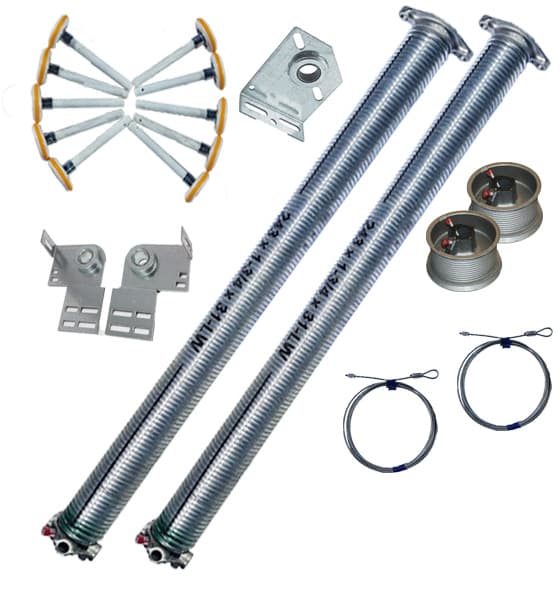
The photo shows what stays untouched: springs, cable drums, lift cables and the end plates they are fixed to.
Get the right replacement
Hinges are identified by number 1, 2, 3 (and higher for doors over 8 feet high).[1] This number is stamped on the hinge.[1] Note the number on the broken one and buy the same number and gauge from a garage door supplier. The number is stamped on the side of the hinge that is to be attached to the section.[1] Check which way round it goes before you take the old one off.
Take the old hinge with you if you can. A hinge that looks right but is a lighter gauge will crack again.
Replace it, one hinge at a time
Close the door fully and disconnect the opener. The CPSC describes pulling the quick-release to detach the garage door from the opener,[2] and it is sensible to unplug the opener as well. Then follow the steps above: support the panel, undo only the broken hinge, fit the matching one with the same hardware, and leave everything else alone.
Two habits make this go well. Clopay's maintenance caution for replacing a bent hinge reads: "Door must be locked and in the down position."[1] It adds: "No more than one hinge is to be removed from the door at any given time."[1] And keep the roller seated in its track while the hinge is off.
Afterward, move the door up and down by its handle. CPSC's advice: "Using the garage door handle, manually move the door up and down to check that the springs are operating properly."[2] Hardware and fittings should be checked to keep the door on track at all times.[2] It should travel evenly. Then oil the hinges: LiftMaster's yearly checklist says "Oil door rollers, bearings and hinges."[3] Clopay's annual maintenance says to "Lubricate all moving parts of the door with light household oil".[1]
Stop and call a pro if
- The broken hinge is at the bottom corner, or touches the bracket the lift cable hangs from. Those are under heavy tension.[1]
- A spring, cable or bracket is loose, frayed or bent. Springs, cables, and bottom fixtures are under strong spring tension.[1]
- The door is crooked, off its track or hard to move. If the garage door and/or any of the supporting track are damaged, operating the door could be hazardous.[1] Call an authorized representative of the manufacturer or professional door repair service promptly.[1]
- The door is unbalanced or binds. LiftMaster's monthly check says: "If it is unbalanced or binding, call a trained door systems technician."[3] If doors are not balanced, or if they bind or stick, they should be serviced by a professional.[2]
- Several hinges are cracked. That points to a door-wide problem, not one bad part.
Getting help in Virginia
If hinges keep breaking, or the job turns out to be a pro's, read what garage door repair costs in Virginia before you call anyone. Browse more garage door answers, or see garage door pros on Loclis.
When you want a technician to do it, describe the broken hinge and local garage door pros will quote it. Ask for the hinge number and gauge, and for the price in writing.
Common questions
- Which hinge number do I need?
- The same one that is on the broken hinge. Hinges are identified by number 1, 2, 3 and higher on taller doors, and the number is stamped on the hinge. Hinges at different joints carry different numbers, so do not assume one hinge fits every position.
- Can I replace the hinge at the bottom of the door?
- No. Clopay's instructions say the brackets at the bottom corners are under great tension, and that loosening bracket fasteners other than as directed could make the bracket spring out with dangerous force. A broken hinge near the bottom corner, or anything touching the lift cable, is a job for a door technician.
- Do I have to open the door to fit the hinge?
- For the safe scope here, no. Work with the door closed and fully supported, one hinge at a time. If the door will not sit square, binds or is out of balance, stop, because CPSC says a door that binds or sticks should be serviced by a professional.
- Why did the hinge break in the first place?
- Often it is wear and repeated stress, sometimes made worse by a door that is out of balance or binding, or by a roller that has stuck. Replacing only the broken hinge can leave the cause in place, so check how the door moves afterwards and oil the hinges.
Sources
- [1] Avante Garage Door Installation Instructions, Clopay Building Products. Checked October 27, 2026.
- [2] Non-Reversing Automatic Garage Door Openers Are a Hazard (CPSC publication 523), U.S. Consumer Product Safety Commission. Checked October 27, 2026.
- [3] LiftMaster Residential Maintenance, LiftMaster. Checked October 27, 2026.
Want a pro to handle it?
Describe the job once. Licensed local businesses send quotes, and you pay only when you book one.
Get a quote for Garage Doors