How do I store a tiller for the winter?
Let the engine cool, clean the tiller, add fuel stabilizer made for ethanol blends, run the engine a few minutes, then shut the fuel valve and run it until it stops from fuel starvation. For storage over 30 days, also change the oil. Disconnect the spark plug wire and keep it dry, out of sunlight and away from heat or flame.
Free to ask. Local shops send quotes, and you pay only when you book one.
By Kasra Taheri, Founder, LoclisPublished
Researched and drafted with AI, then checked claim by claim against the sources listed below before it was published. Prices and rules change; the dates beside each source say when it was last checked.
Step by step
Read when to stop and call a pro, further down this page, before you start.
Step 1: Let it cool
The tiller needs to cool for at a minimum of 5 minutes before storing.[1]
Step 2: Clean it
Clean the tiller before storage according to the maintenance section of the manual, including the tines and engine.[1]
Step 3: Add fuel stabilizer
Add a properly formulated fuel stabilizer to the tank, one made to work with ethanol-gasoline blends.[1]
Step 4: Run the engine
Run the engine for a minimum of 3 minutes with treated fuel so it cycles through the fuel system and carburetor.[1]
Step 5: Shut the fuel valve and run it dry
Turn the fuel valve off and let the engine run until fuel starvation stops it.[1]
Step 6: Change the oil for long storage
For storage over 30 days, change the engine oil.[1]
Step 7: Oil the cylinder
Remove the spark plug, pour in about 1/2 ounce (14.8 mL) of oil, crank the engine slowly to spread it, then refit the plug.[1]
Step 8: Disconnect the plug wire
Leave the spark plug wire disconnected while the tiller is stored.[1]
Step 9: Store it dry
Keep it in a clean, dry place out of direct sunlight, away from heat, flame and fertilizer.[1]
The short routine
A tiller that goes into storage clean, with stabilized or used-up fuel and a dry place to sit, starts in spring. One that sits with old gas in the carburetor often does not. Briggs & Stratton warns: "Gas begins to degrade in as little as 30 days which can lead to your engine's fuel system clogging and your equipment not starting the following season."[2]
The steps below follow Champion Power Equipment's rear tine tiller manual, which lists the storage routine in full. Check your own manual for your engine; the details vary by brand.
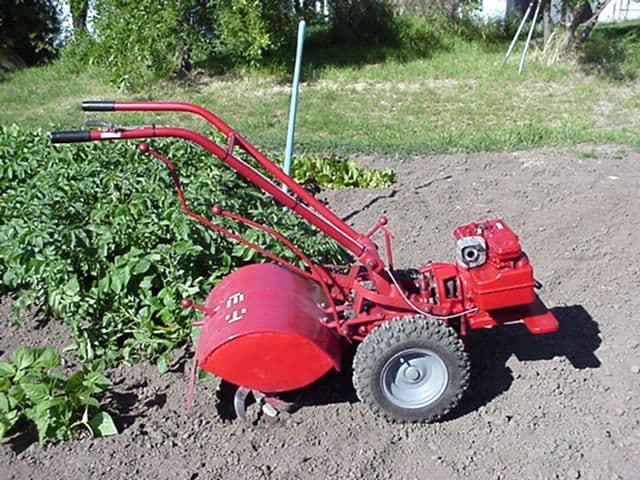
Cool down and clean
"The tiller needs to cool for at a minimum of 5 minutes before storing."[1] Then: "Clean the tiller before storage according to the Maintenance section."[1] In practice that means knocking dried soil and roots off the tines, tine shield and wheels, and wiping the engine and cooling fins. Packed damp soil holds moisture against metal all winter.
Disconnect the plug wire before you work near the tines. Virginia Cooperative Extension's rule for mowers applies here: "Disconnect the spark or electric plug before troubleshooting or repairing the mower."[4]
Fuel: treat it, then run it through
Champion's manual says: "Add a properly formulated fuel stabilizer to the tank."[1] Pick one made for ethanol blends, because "Ethanol-gasoline blends can absorb more water than gasoline alone."[1] The manual puts it this way: "If a fuel stabilizer is used, confirm that it is formulated to work with ethanol-gasoline blends."[1]
Then "Run the engine for a minimum of 3 minutes with treated fuel to cycle through the fuel system and carburetor."[1] Close the fuel valve and "Let the engine run until fuel starvation has stopped the engine."[1] Let it cool before you clean up and put it away.
Penn State Extension's general advice for seasonal engines agrees: "Add fuel stabilizer if the equipment will be idle for more than a few weeks, and avoid keeping stored fuel for long periods of time."[3]
Keep any leftover gas properly: "Store gasoline in an approved container with proper labeling."[4]
For storage longer than 30 days
Winter is longer than that, so the manual's list for "Engines Stored for Over 30 Days"[1] applies. After the steps above it adds "Change the oil."[1] Then remove the spark plug and "pour about ½ ounce (14.8 mL) of oil into the cylinder".[1] Crank the engine slowly to spread it, and refit the plug. Keep the plug wire disconnected until spring.
While the tiller is clean, look it over: tine bolts, belt condition and wear on the tines. Parts are easier to get before the spring rush.
Where to keep it
The manual says to "Store the unit in a clean, dry place out of direct sunlight."[1] It also warns: "DO NOT store a tiller near fertilizer or any corrosive material."[1] Garden sheds often hold fertilizer, so keep the tiller on the far side. Do not park it beside a furnace, water heater or other flame, since gasoline vapor can reach them even when the tank is empty.
Stop and call a pro if
- Fuel leaks from the tank, valve or carburetor when you drain or run it.
- The recoil cord will not pull or the engine will not turn over while you spread the oil.
- The spark plug is stuck or its threads look damaged.
- The belt is frayed or the transmission leaks gear oil. Have a shop look at it before spring.
Getting help in Virginia
If the engine did not start well last spring, read why a tiller will not start after sitting all winter and how to keep a small engine carburetor from gumming up. Browse more small engine repair answers or find tiller repair pros.
When you are ready, describe your tiller and local small engine shops can quote it.
Common questions
- Should I drain the gas or use fuel stabilizer?
- Champion's tiller manual combines both: add a properly formulated stabilizer, run the engine for at least 3 minutes, then shut the fuel valve and run the engine until it stops from fuel starvation. Briggs & Stratton, an engine maker, says stabilized fuel can stay in the tank instead; follow your own manual.
- Does the oil need changing before storage?
- Champion's manual says to change the oil for engines stored over 30 days. If you only park the tiller for a few weeks between uses, it lists a shorter routine without the oil change.
- Why disconnect the spark plug wire?
- So the engine cannot start by accident while the tiller sits or is moved around. Champion's manual says to disconnect it in times of inactivity, maintenance and storage.
- Can I keep the tiller in the garage next to the water heater?
- Champion's manual warns never to store the tiller indoors next to appliances where there is a source of heat, open flame, spark or pilot light, because they can ignite gasoline vapors. A detached shed away from those is better.
- What do I do with leftover gasoline?
- Keep it in a labeled approved container. Virginia Cooperative Extension says to store gasoline in an approved container with proper labeling. Check local rules on storing fuel.
Sources
- [1] Rear Tine Tiller Operator's Manual, model 201464, Champion Power Equipment. Checked October 28, 2026.
- [2] The Importance of Fuel Stabilizer, Briggs & Stratton. Checked October 28, 2026.
- [3] Fuel Ethanol: Hero or Villain?, Penn State Extension. Checked October 28, 2026.
- [4] Lawn Care: Rotary Mower Safety (BSE-42P), Virginia Cooperative Extension, Virginia Tech. Checked October 28, 2026.
Want a pro to handle it?
Describe the job once. Licensed local businesses send quotes, and you pay only when you book one.
Get a quote for Small Engines