Should I hire an HVAC technician to replace my thermostat?
Not always. Swapping a standard 24-volt thermostat on a simple furnace and air conditioner is a job manufacturers write homeowner guides for, and Virginia does not require a permit application for it. Hire a licensed HVAC technician when there is no C wire or you have a heat pump, dual fuel, zoning or a humidifier, and leave a line-voltage thermostat to a licensed professional.
Free to ask. Local shops send quotes, and you pay only when you book one.
By Kasra Taheri, Founder, LoclisPublished
Researched and drafted with AI, then checked claim by claim against the sources listed below before it was published. Prices and rules change; the dates beside each source say when it was last checked.
Step by step
Read when to stop and call a pro, further down this page, before you start.
Step 2: Turn the system off
Switch off the breaker or the switch that controls your heating and cooling system, then raise the setpoint and confirm nothing starts within five minutes.[1]
Step 4: Count the wires and look for C
Note which terminals have wires, whether one is on C, and whether there is more than one R wire.[2]
Step 5: Run the maker's compatibility checker
Enter the terminal letters, ignoring wire colours and jumper wires, and read whether the result recommends professional installation.[2]
Step 6: Decide
If the checker passes, you have a C wire and the system is a simple furnace and air conditioner, the swap is a reasonable owner job; otherwise, hire.
Step 8: Get the price in writing
Ask for a written proposal naming the thermostat model, labour, any adapter and the warranty before work starts.[9]
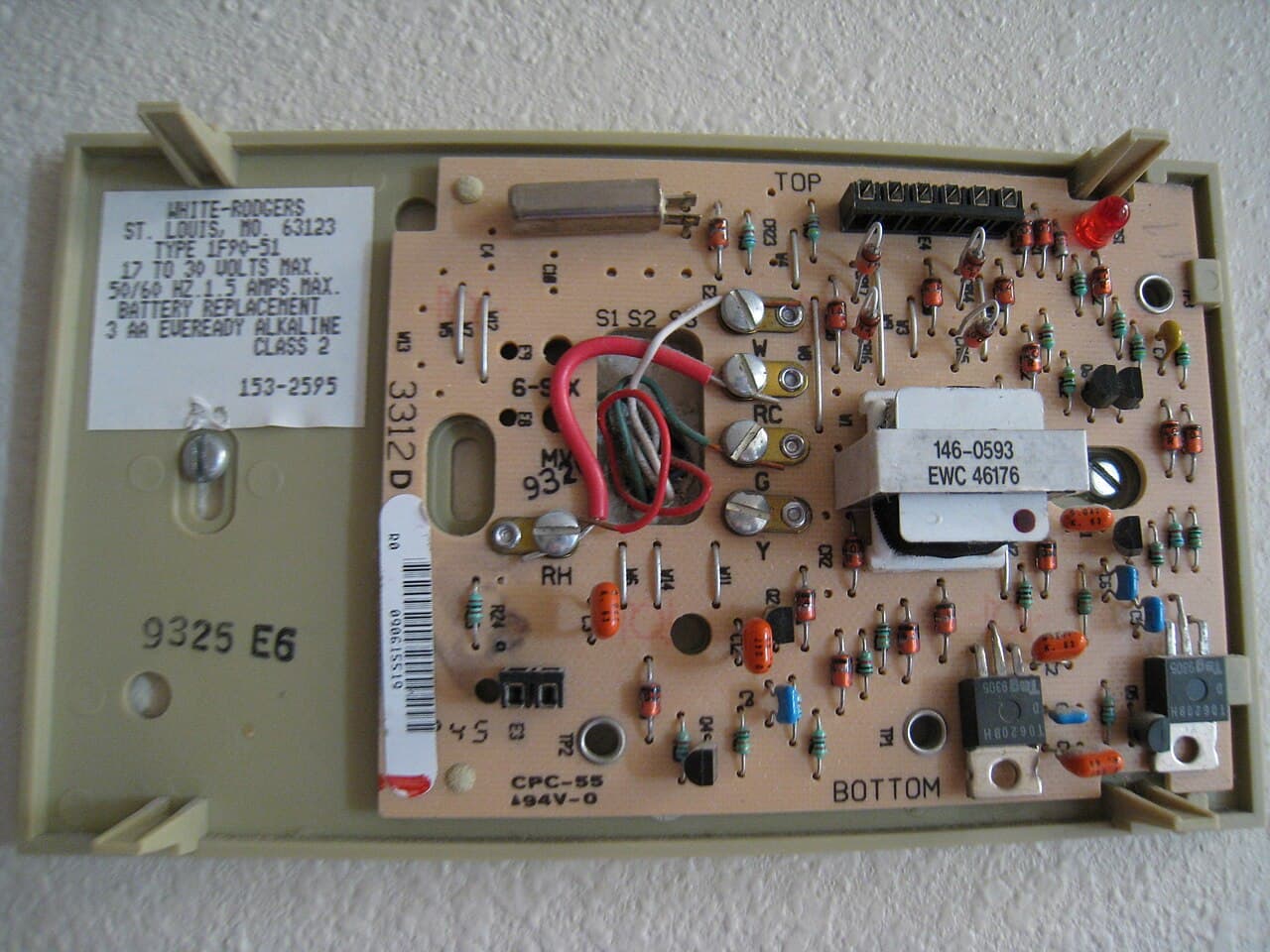
For a lot of Virginia homes, no. If the old thermostat is a 24-volt unit on a gas or oil furnace with central air, there is a C wire, and the new thermostat's compatibility checker gives you a clean result, the swap is the kind of job thermostat makers write homeowner guides for. Hire a licensed HVAC technician when the wiring or the system is anything more complicated than that.
What a simple swap involves
Manufacturers set it up for owners. Honeywell Home's T5 quick install guide tells the owner to turn off the power at the breaker box or the switch that controls the heating and cooling system, photograph the existing wiring with the terminal letters showing, and label each wire before moving anything.[1] Google says its Nest thermostats are designed to work with most 24 V systems. During setup, the Google Home or Nest app tells you whether your system is compatible before you install, and gives you a custom wiring guide.[2]
The legal side is light for a low-voltage thermostat. Under the Virginia Uniform Statewide Building Code, installing wiring and equipment that operates at less than 50 volts does not need a permit application, outside listed exceptions such as fire alarm and smoke control systems, though that does not exempt the work from the code's other requirements.[3]
Who needs a licence
Virginia licenses the person doing the work for others, not the homeowner doing his own. The Code defines a tradesman as someone who does work for the general public for compensation in the trades of electrical, plumbing and heating, ventilation and air conditioning,[4] and no individual may do that work without a licence, unless working under the supervision of a tradesman licensed in that specialty.[5] The contractor chapter of the Code also does not apply to a person who works on no more than one primary residence he owns, for his own use, in any 24-month period, but that owner must still follow the Uniform Statewide Building Code.[6]
The business you hire is licensed separately from its technicians. DPOR's Board for Contractors licenses businesses engaged in the construction, removal, repair, or improvement of facilities on property owned by others, and a contractor licence has two parts: a class (A, B or C), which sets the value of the contracts it may take on, and a classification or specialty, which sets the type of work allowed.[7] Tradesman licences belong to individuals.
So a handyman or a friend you pay to wire your thermostat is supposed to hold an HVAC or electrical licence, or work under someone who does. More on that in does an HVAC technician need a licence in Virginia.
When hiring is the better call
There is no C wire. Many smart thermostats need constant power; Honeywell's T5 requires 24 VAC power from a C wire.[1] If there is no spare wire in the bundle, the fix is usually an adapter fitted at the furnace or air handler, or a new cable. Opening the equipment cabinet and working on its control board is where a technician earns the fee.
The system is more than heat and cool. Google recommends professional installation for dual-fuel heat pump systems, systems with more than one R wire, and whole-home humidifiers and dehumidifiers.[2] Heat pumps usually need the auxiliary and emergency heat settings configured to match the equipment. Zoned systems and communicating systems, where the thermostat talks to the equipment over a data connection, are usually best left to the equipment's dealer.
It is a line-voltage thermostat. Baseboard heaters and some wall heaters are controlled by a thermostat on the heater's own 120- or 240-volt circuit. High-voltage systems, such as electric baseboard heaters, are not compatible with Nest thermostats, though a professional can sometimes adapt one with a step-down transformer to 20 to 30 volts.[2] Google says high-voltage thermostats should only be installed or uninstalled by a professional because of the high voltage they carry.[2]
The wires are old or odd. If your wires are stranded, Google suggests a local professional cap, solder or replace them with solid-core wire.[2] Brittle insulation, wires too short to reach and unlabelled terminals are also reasons to stop.
The old thermostat contains mercury. If the old control contains mercury in a sealed tube, Honeywell's guide says do not place the old control in the trash, and to contact your local waste management authority.[1] Virginia Code § 10.1-1425.26 lets a locality with a recycling program ban mercury thermostats from its landfills.[11] A contractor can take it for recycling, or you can ask your county's household hazardous waste program.
How to hire well
ENERGY STAR's tips for hiring a heating and cooling contractor are to find out about license and insurance requirements, compare written, itemized estimates, and sign a written proposal before work starts.[9] For a thermostat, the proposal should name the model, the labour, any adapter or new wire, and whether setup of heat pump or humidifier settings is included. Check the business's contractor licence on DPOR's License Lookup before booking, and ask for the technician's tradesman licence number.[8]
Price ranges and rebates are in how much it costs to replace a thermostat in Virginia.
Stop and call a pro if
- The old thermostat is marked 120 V or 240 V, or has thick wires joined by wire nuts.
- There is no C wire and the fix means working inside the furnace or air handler.
- You have a heat pump, dual fuel, zoning, a humidifier or more than one R wire.
- The heat, cooling or fan does not behave correctly after the swap, or a fuse on the equipment blows.
- You smell gas at any point. Columbia Gas of Virginia tells customers who smell gas to go outside and call 911 and then call the company at 1-800-544-5606, any hour.[10] Other gas utilities publish their own emergency numbers.
Browse more heating and cooling answers, see thermostat services, or find licensed HVAC businesses near Blacksburg.
To have it done, describe the thermostat job once and get quotes from licensed HVAC businesses.
Common questions
- Is it legal for me to replace my own thermostat in Virginia?
- Virginia's licensing law covers people who do electrical, plumbing and HVAC work for the public for pay. The contractor chapter of the Code does not apply to an owner working on no more than one primary residence he owns, for his own use, in a 24-month period, though that work must still follow the building code. A landlord's rental units and work for others are different, so check before relying on it.
- Do I need a permit to replace a thermostat?
- Not usually for a standard low-voltage thermostat. The Virginia Uniform Statewide Building Code does not require a permit application for wiring and equipment that operates at less than 50 volts, outside listed exceptions such as fire alarm systems. A line-voltage thermostat on baseboard heat is electrical wiring, so ask your local building department first.
- What if my thermostat has no C wire?
- Many smart thermostats need one. Look for a spare wire folded back into the wall first. If there is none, the maker may sell an adapter that is fitted at the furnace or air handler, or a new cable may be needed. Work inside the furnace or air handler cabinet is a good point to hire a technician.
- What can go wrong if I wire it myself?
- A wrong terminal can leave you with no heat, cooling when you asked for heat, or a fan that will not stop, and a short can blow a fuse on the furnace control board. That is why manufacturers tell you to turn the power off first, photograph the old wiring and use their compatibility checker before buying.
- How do I check that an HVAC technician is licensed?
- Search the business by name on DPOR's License Lookup at dpor.virginia.gov and check that its contractor licence is current and that its classification or specialty covers HVAC work. Separately, the individual doing HVAC work for the public for pay needs a tradesman licence, unless supervised by a licensed tradesman in that specialty, so ask for the technician's licence number too.
Sources
- [1] T5 Smart Thermostat Quick Install Guide, Resideo (Honeywell Home). Checked October 26, 2026.
- [2] Nest thermostat compatibility, Google Nest Help. Checked October 26, 2026.
- [3] 13VAC5-63-80, Section 108 Application for permit (Virginia Uniform Statewide Building Code), Virginia Administrative Code. Checked October 26, 2026.
- [4] Va. Code § 54.1-1128, Definitions (tradesmen), Code of Virginia, Virginia General Assembly. Checked October 26, 2026.
- [5] Va. Code § 54.1-1129, Necessity for licensure, Code of Virginia, Virginia General Assembly. Checked October 26, 2026.
- [6] Va. Code § 54.1-1101, Exemptions, Code of Virginia, Virginia General Assembly. Checked October 26, 2026.
- [7] Board for Contractors, Virginia Department of Professional and Occupational Regulation. Checked October 26, 2026.
- [8] License Lookup, Virginia Department of Professional and Occupational Regulation. Checked October 26, 2026.
- [9] 10 Tips for Hiring a Heating and Cooling Contractor, ENERGY STAR, U.S. Environmental Protection Agency. Checked October 26, 2026.
- [10] ENERGY STAR Smart Thermostat Rebates, Columbia Gas of Virginia. Checked October 26, 2026.
- [11] Va. Code § 10.1-1425.26, Cathode ray tube and mercury thermostat special waste recycling program, Code of Virginia, Virginia General Assembly. Checked October 26, 2026.
Want a pro to handle it?
Describe the job once. Licensed local businesses send quotes, and you pay only when you book one.
Get a quote for HVAC Repair