Should I hire a landscaper to design my garden beds or do it myself?
Design them yourself if the beds are small, the ground is fairly level and you enjoy choosing plants; your local Extension office and Extension Master Gardeners can help. Hire when the project involves slopes, grading, drainage, walls, irrigation or a whole-yard plan. Licensed landscape architects prepare full plans, and Virginia contractors who install landscaping are licensed through DPOR.
Free to ask. Local shops send quotes, and you pay only when you book one.
By Kasra Taheri, Founder, LoclisPublished
Researched and drafted with AI, then checked claim by claim against the sources listed below before it was published. Prices and rules change; the dates beside each source say when it was last checked.
Step by step
Read when to stop and call a pro, further down this page, before you start.
Step 1: Decide what each bed is for
Write down what each bed must do, such as hiding a foundation, framing an entry, screening a neighbor or growing food.[1]
Step 2: Map sun and shade
Note how many hours of direct sun each spot gets in summer, and where the wind blows and the rain runs.
Step 3: Contact Virginia 811
Request a free utility locate at least 3 working days before you dig a test hole or any bed.[10]
Step 4: Check drainage
Dig a planting hole and fill it with water; if it has not drained in 24 hours, plant elsewhere.[1]
Step 5: Test the soil
Send a sample to the Virginia Tech Soil Testing Lab, sampling each bed area separately from the lawn.[2]
Step 6: Sketch to scale
Draw the yard on graph paper with the house, walks, existing plants and marked utility lines, then outline the beds.
Step 7: Choose plants for the site
Pick plants suited to the bed's sun, moisture, soil and hardiness zone, and use more than one or two species.[1]
Step 8: Space for mature size
Space plants by their mature size, especially beside doors, windows and walkways.[1]
Step 9: Get a second opinion
Take the sketch and soil report to your local Extension office or Extension Master Gardeners for advice.[3]
Step 10: Plant in spring or fall
Set out container-grown shrubs in spring or fall, the best planting times in Extension's guidance.[1]
Do it yourself when the beds are modest, the ground is fairly level and the job is mostly choosing and setting out plants. Bring in help when the project starts moving soil and water: slopes, grading, drainage, walls or irrigation, or a plan for the whole yard. Plenty of people split the difference and pay for a design, then plant it themselves.
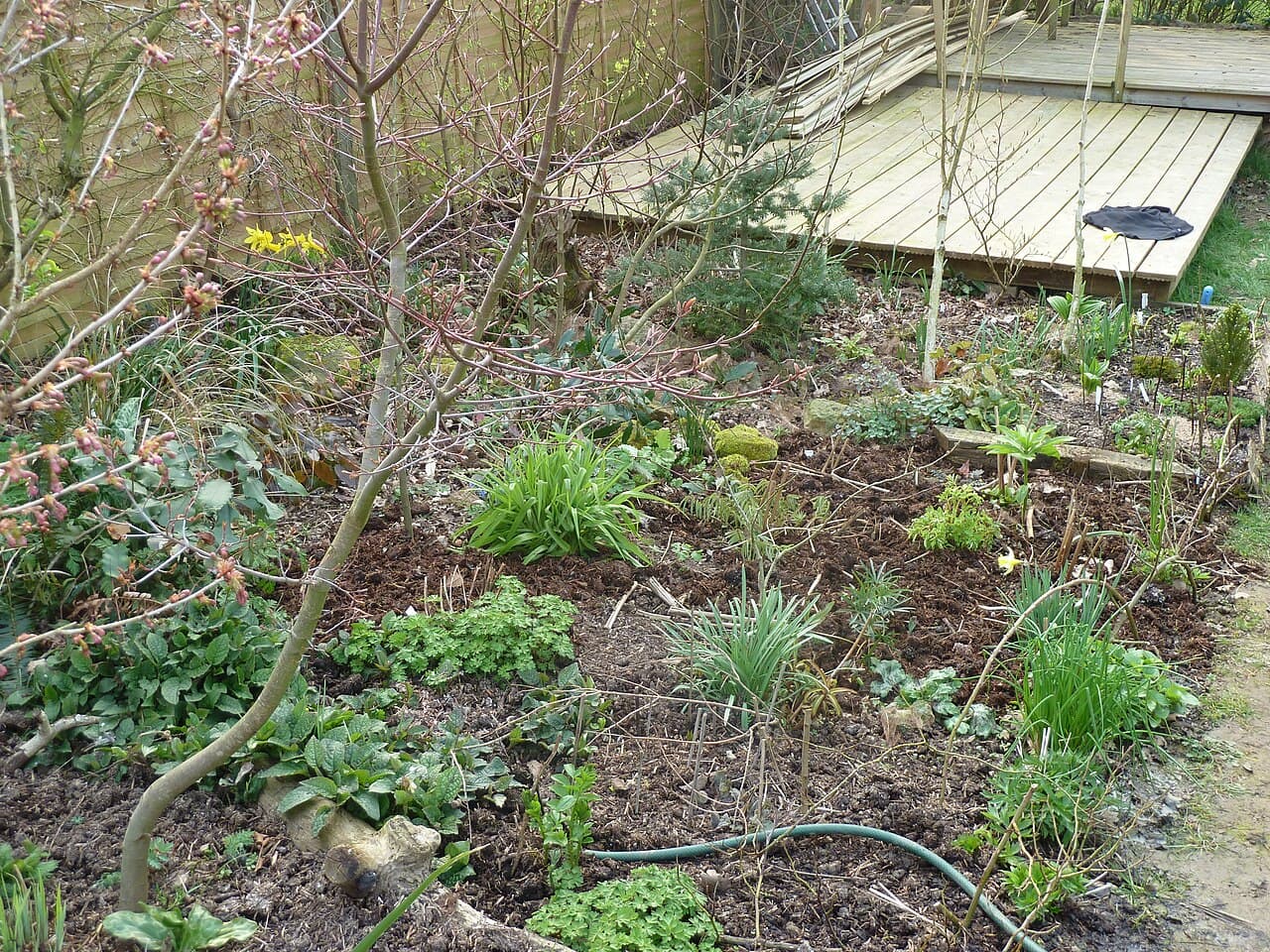
What a good design has to get right
Whoever draws the plan, it rests on the same three things. Virginia Cooperative Extension's shrub guide names them: what the planting is for, the site conditions, and plants that suit the site and the space.[1]
The site questions are ones you can answer yourself. Is the spot mostly sunny or mostly shady? Is the soil moist, average or dry? Is it good topsoil or poorly drained clay? Is it acid or alkaline, which only a soil test tells you? Is it windy, and what hardiness zone are you in?[1] Extension's drainage check is simple: if water poured into a planting hole has not drained in 24 hours, plant elsewhere.[1]
Two common mistakes are easy to avoid once you know them. Extension warns that using only one or two species is like putting all your eggs in one basket, because a single pest can take out much of the planting,[1] and it says to keep the mature size of each plant in mind, especially around doors, windows and walkways.[1] Many overgrown foundation beds are simply the second mistake, a few years later.
When doing it yourself makes sense
You are a good candidate if the beds are along the house or the lawn edge, the ground is level, and you can live with moving a plant that ends up in the wrong place. The research costs little. Take a soil sample a few months before putting in a flower bed or planting perennials,[2] and sample areas that are managed differently, such as a lawn and a garden, separately.[2]
Free advice is closer than most people think. Extension says there are teams of Extension Master Gardeners in almost every county in Virginia, trained volunteers who offer advice, education and resources, and that your local Extension office is the best place to start when seeking garden help.[3] Bring a sketch, photos and your soil report.
Doing it yourself also lets you plant when the timing is right. Extension notes that the best time to plant container-grown shrubs is spring and fall,[1] which is also when local nurseries are best stocked.
When to hire
Hire when any of these are true:
- the beds sit on a slope or need the ground regraded
- water stands where you want to plant, or runs toward the house
- the plan includes walls, steps, paths or edging that has to hold back soil
- you want irrigation, lighting or other utilities in the beds
- you want one plan for the whole property, phased over years
- you do not have the time or the back for digging out sod and moving soil
Who does what
Landscape architects. In Virginia law, a landscape architect is a person who, by reason of special knowledge of natural, physical and mathematical sciences and the principles of landscape architecture, is qualified to practice it, with competence attested by the Board through licensure.[4] Their practice covers consultation, evaluation, planning, including sketches, drawings, plans and specifications, and supervision of contracts for projects principally directed at the functional and aesthetic use of land.[4] They suit whole-yard plans, sloped lots and anything with grading or drainage.
Garden designers and design-build landscapers. Many smaller bed designs come from landscapers who design and install. Ask what training they have and to see plans and finished beds.
Landscape contractors. Virginia's Class C contractor licence covers a single contract or project over $1,000 but less than $30,000.[5] The Board for Contractors' landscape service specialty covers excavation, clearing, grading, construction of retaining walls for landscaping purposes, or placement of landscaping timbers.[6] Landscape irrigation and outdoor sprinkler systems are a separate specialty.[6]
Spray services. If the quote includes weed or pest spraying, anyone who uses pesticides on someone else's property in exchange for compensation must work for a company with a Pesticide Business License.[9]
Hiring well
Look up any contractor on DPOR's License Lookup before you sign.[8] DPOR's consumer guide suggests you ask for local references and, if you can, look at finished projects,[7] and get at least three written bids on identical plans and specifications.[7] It also notes that Virginia law requires licensed contractors to provide a written contract for residential work.[7] Whoever digs, Virginia 811 asks anyone breaking ground for landscaping to contact it at least 3 working days in advance.[10]
For prices, see what garden bed installation costs in Virginia, and for the build itself, how to build a raised garden bed.
Stop and call a pro if
- The bed would hold back a slope, or the plan needs a wall that retains soil.
- Water collects against the foundation or the bed would change where runoff goes.
- You want irrigation tied into the house water supply.
- Utility marks run through the planned beds.
- Large trees or shrubs need to be moved or set with equipment.
Browse the lawn and landscaping answers, see landscape design and install services, or look up lawn and landscaping businesses around Blacksburg. When you are ready, describe the job once and local businesses quote it.
Common questions
- What is the difference between a landscape architect and a landscaper?
- In Virginia, landscape architect is a licensed profession: the Board for Architects, Professional Engineers, Land Surveyors, Certified Interior Designers and Landscape Architects attests their competence. A landscaper or landscape contractor installs the work and is licensed under Virginia contractor rules. Many design-build landscapers do both small designs and installation.
- Can I pay for a design and plant it myself?
- Yes, and it is a common middle path. Ask for a scaled plan with a plant list, sizes and spacing, then buy and plant in stages. You can also do the reverse: have a crew dig the beds and bring soil, and choose and plant everything yourself.
- Where can I get free help designing a garden bed?
- Start with your local Virginia Cooperative Extension office. Almost every county has Extension Master Gardeners, trained volunteers who answer questions, and many run demonstration gardens where you can see plants growing in local conditions.
- Do I need to call 811 just to plant shrubs?
- Yes. Virginia 811 says there is no allotted depth before you need to contact it, and that planting small shrubs counts, because many utilities are buried just a few inches down. Contact it at least 3 working days before digging; the marking is free.
- How do I check a landscaper's licence?
- Ask for the licence number and the business name it is issued under, then search DPOR's License Lookup. Check that the licence is current and covers the work, such as the landscape service or irrigation specialty.
Sources
- [1] Shrubs: Functions, Planting, and Maintenance (426-701), Virginia Cooperative Extension, Virginia Tech. Checked October 26, 2026.
- [2] Soil Sampling for Residential Areas (452-129), Virginia Cooperative Extension, Virginia Tech. Checked October 26, 2026.
- [3] Extension Master Gardener Program, Virginia Cooperative Extension, Virginia Tech. Checked October 26, 2026.
- [4] Code of Virginia § 54.1-400. Definitions, Virginia General Assembly, Legislative Information System. Checked October 26, 2026.
- [5] Code of Virginia § 54.1-1100. Definitions, Virginia General Assembly, Legislative Information System. Checked October 26, 2026.
- [6] 18VAC50-22-30. Definitions of specialty services, Virginia Administrative Code, Board for Contractors. Checked October 26, 2026.
- [7] What You Should Know Before You Hire a Contractor, Virginia Board for Contractors, Department of Professional and Occupational Regulation. Checked October 26, 2026.
- [8] License Lookup, Virginia Department of Professional and Occupational Regulation. Checked October 26, 2026.
- [9] Becoming a Certified Pesticide Applicator, Virginia Department of Agriculture and Consumer Services. Checked October 26, 2026.
- [10] Homeowners, Virginia 811. Checked October 26, 2026.
Want a pro to handle it?
Describe the job once. Licensed local businesses send quotes, and you pay only when you book one.
Get a quote from a local pro