Why are the leaves on my plants turning yellow?
Yellow leaves often mean the roots cannot take up what the plant needs. The common causes in Virginia beds are soggy or compacted soil, a soil pH wrong for the plant, too little nitrogen, iron locked up by alkaline soil, and fertilizer or herbicide injury. Which leaves turn yellow, old or new, narrows it down, and a Virginia Tech soil test confirms it.
Free to ask. Local shops send quotes, and you pay only when you book one.
By Kasra Taheri, Founder, LoclisPublished
Researched and drafted with AI, then checked claim by claim against the sources listed below before it was published. Prices and rules change; the dates beside each source say when it was last checked.
Step by step
Read when to stop and call a pro, further down this page, before you start.
Step 1: Note which leaves
Check whether the yellow is on the oldest leaves, the newest leaves or the whole plant, and whether the veins stay green.[1]
Step 2: Feel the soil
Dig down a few inches beside the plant; soil that is still soggy days after rain points to drainage, not a missing nutrient.
Step 3: Check drainage
Fill a planting hole with water; if it has not drained in 24 hours, the spot is too wet for the plant.[7]
Step 4: Water new plants properly
In summer dry spells, water new container-grown plants two to three times a week so the root ball never dries out.[7]
Step 5: Fix the mulch
Keep mulch 2 to 3 inches deep and pulled back from stems and trunks.[7]
Step 6: Look at the new growth
If new leaves are twisted, cupped or strap-shaped, suspect herbicide residue from straw, manure, compost or grass clippings.[11]
Step 7: Test the soil
Send one sample from the yellow area and one from a healthy area to the Virginia Tech lab and compare them.[4]
Step 8: Adjust pH only as advised
Raise or lower the pH only by the amounts the soil report recommends, since over-liming is common in Virginia gardens.[2]
Step 9: Feed only if needed
Fertilize pale, slow-growing shrubs between bud break and midsummer, never in late summer or fall.[5]
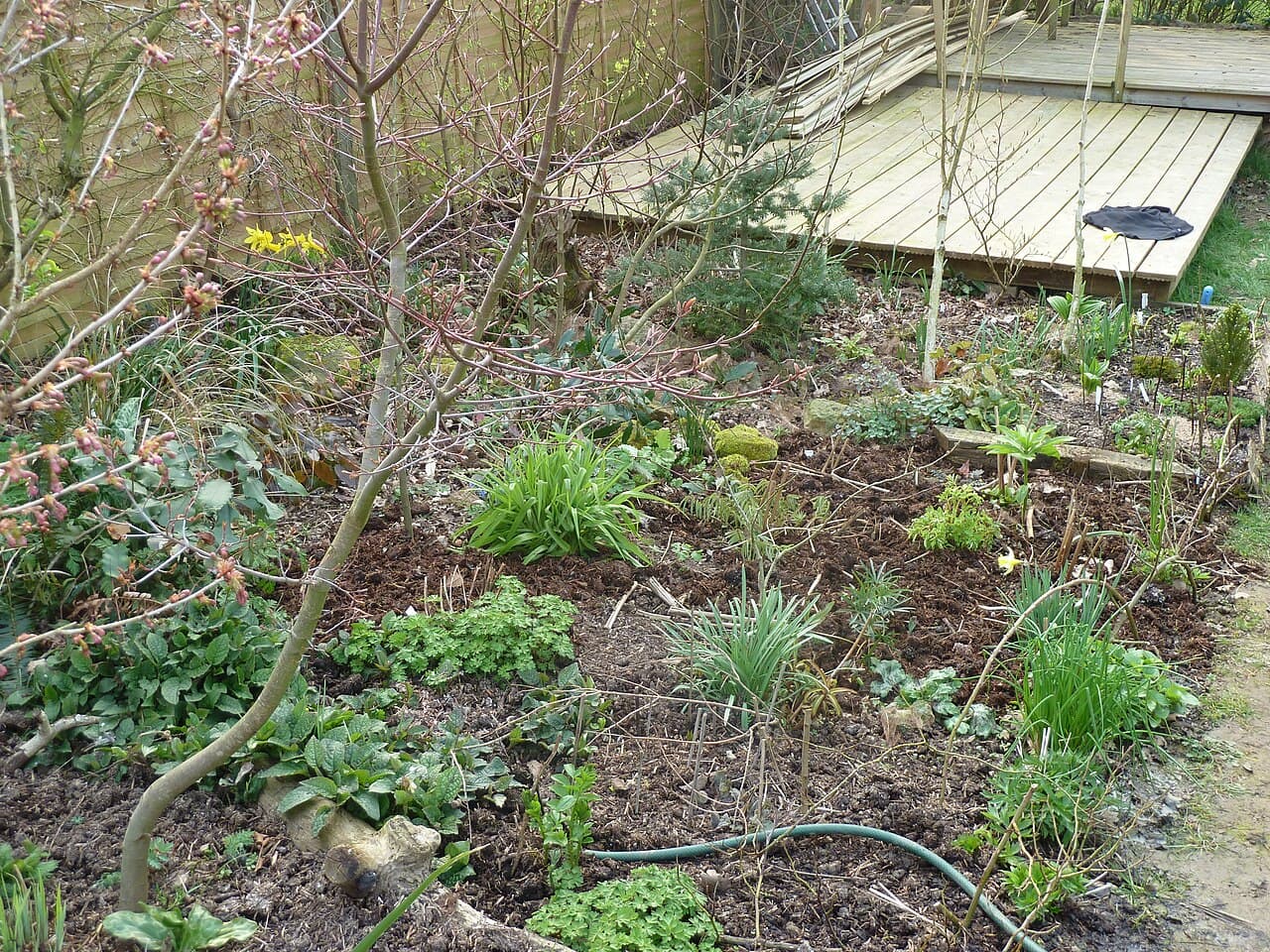
Start with where the yellow is
Look closely before you buy anything. The pattern points to the cause:
- Oldest leaves first, whole leaf pale. Nitrogen shortage shows as reduced growth and light-green to yellow foliage, with symptoms appearing first on older growth.[1]
- Oldest leaves, veins still green. Magnesium shortage turns older leaves yellowish, bronze or reddish while the veins stay green.[1]
- Newest leaves, veins still green. Iron shortage causes yellowing between the veins, mainly on young leaves, which may become white.[1] Often the iron is there and the plant cannot use it: iron deficiency may occur even if iron is in the soil when the soil is poorly drained, oxygen deficient or high in pH, among other causes.[1]
- New growth twisted or cupped. That is the signature of growth regulator herbicides, whose symptoms appear on new growth, not on leaves that were already mature, as downward bending, twisted stems and distorted new leaves.[11]
- The whole plant pale and wilting in wet soil. Look at drainage first.
Too much water, or too little air
Roots need air as much as water. A plant in waterlogged or compacted soil has a limited ability to absorb nutrients,[1] and roots in flooded soils cannot produce energy, and toxic substances build up.[9] Virginia Cooperative Extension notes that urban and suburban soils in Virginia that have been altered by construction tend to be heavily compacted, poorly aerated, poorly drained and low in organic matter.[8] Beds around a newly built house often sit in exactly that kind of soil.
Its drainage test is simple: if water in a planting hole has not drained in 24 hours, plant elsewhere.[7] Check whether a downspout or a slope is sending water into the bed.
New plants can also yellow from the opposite problem. The potting soil around a container-grown shrub holds only a day or two of water, so Extension says watering two to three times a week in summer dry spells is normal for them.[7] Keep mulch 2 to 3 inches deep and not piled against stems, because overly deep mulch promotes shallow roots, disease and pest injury.[7]
The wrong pH
A nutrient can be in the soil and still out of reach. If the soil pH is extremely high or very low, many nutrients become inaccessible to the plant.[1] Over-liming is a real problem here: the Virginia Tech Soil Testing Lab reports that more than a third of garden samples had too much lime added, creating an alkaline soil that can cause micronutrient deficiencies.[2]
Acid-loving plants show it first. Azaleas, blueberries, maples and rhododendrons need a pH of 4.5 to 6.0,[1] so lime spread on a nearby lawn may leave them yellow between the veins.
Not enough nitrogen
Vegetables and annual flowers use nitrogen fast, and rain washes it out. A soil test will not catch it: the routine test does not measure nitrogen, because its availability in soil changes too quickly.[4] Extension's guidance for gardens is that a nitrogen source should be applied each year for a successful garden.[6]
Shrubs are different. Extension says fertilizer is not recommended for healthy shrubs and trees with good green color,[5] but if leaves become paler and smaller than normal, or growth looks stunted, fertilizing may help.[5] It also says not to fertilize in late summer or fall, since tender late growth may be damaged in winter.[5]
Fertilizer and herbicide injury
More is not better. Extension reminds gardeners that fertilizers are salts that may damage plants during dry periods,[7] and NC State Extension adds that the salts in fertilizer can burn roots if there is inadequate moisture.[1]
Herbicides can arrive in the bed by surprise. Virginia Tech links growth regulator herbicides to contamination of straw, hay, grass clippings, manure and compost.[11] Do not use clippings from lawns treated within six weeks with 2,4-D, dichlorprop, dicamba, MCPP or triclopyr in vegetable gardens or ornamental beds.[11] The same publication lists grape, rose, tomato, potato, pepper, lettuce, peas, beans and spinach as especially sensitive.[11]
Confirm it with a soil test
If an established area shows abnormal growth or discoloration, take a soil sample right away.[4] Extension suggests you take separate samples from the poor area and a good one and compare the results,[4] while warning that drainage, compaction, insects and diseases can matter more than nutrients, and a soil test will not show them.[4]
The Virginia Tech lab listed its routine test at $10.00 for Virginia samples when we checked on October 26, 2026,[3] and it usually generates results within three working days of receiving a sample.[2] Your county Extension office can help read the report.
Stop and call a pro if
- A tree or large shrub is yellowing across its whole canopy, or losing branches.
- The yellowing comes with spots, cankers or fungus and is spreading from plant to plant.
- Water keeps collecting in the bed and the fix means regrading or moving a downspout's discharge.
- You are thinking about having the bed sprayed. Anyone who uses pesticides on someone else's property for pay must work for a company with a Pesticide Business License.[10]
To keep beds healthy from the start, see how to build a raised garden bed. Browse the lawn and landscaping answers, see garden bed and planting services or fertilization services, and if you want someone to look at the bed, describe the problem once and local businesses quote it.
Common questions
- Should I give a yellowing plant fertilizer?
- Not until you know the cause. Fertilizer will not fix soggy soil, a pH problem or herbicide injury, and fertilizer salts can make a stressed plant worse in dry weather. Test the soil first, then add only what the report recommends.
- Why are my azalea leaves yellow with green veins?
- Most often the soil is not acid enough. Azaleas, rhododendrons and blueberries are acid-loving plants that need a pH of 4.5 to 6.0.[^ncsu-soils] Iron can be out of reach when the soil pH is high, and iron shortage shows as yellowing between the veins on young leaves.[^ncsu-soils] Lime spread nearby can raise the pH. A soil test tells you the pH.
- Can overwatering turn leaves yellow?
- Yes. Roots need air, and in waterlogged or compacted soil a plant cannot absorb nutrients well even when they are present. If the soil is wet a few inches down days after rain, water less and fix the drainage before adding anything.
- Is it normal for some leaves to turn yellow?
- A few of the oldest, lowest leaves yellowing and dropping is often normal, especially in late summer and fall or after transplanting. Worry when the yellowing spreads up the plant, shows on new growth, or comes with stunting or distorted leaves.
- Why are my tomato leaves yellow and curled after I mulched with straw?
- Straw, hay and manure can carry residues of growth regulator herbicides, and Virginia Tech says these herbicides retain their activity even after composting.[^vce-herbicide-residue] Tomatoes are especially sensitive, and the damage shows on new growth as cupped, twisted leaves. Ask suppliers how the material was grown before you buy it.
Sources
- [1] Extension Gardener Handbook, Chapter 1: Soils and Plant Nutrients, NC State Extension. Checked October 26, 2026.
- [2] Virginia Tech Soil Testing Lab, Virginia Tech Soil Testing Laboratory. Checked October 26, 2026.
- [3] Sample Submission: Virginia Tech Soil Tests and Their Cost, Virginia Tech Soil Testing Laboratory. Checked October 26, 2026.
- [4] Soil Sampling for Residential Areas (452-129), Virginia Cooperative Extension, Virginia Tech. Checked October 26, 2026.
- [5] Soil Test Note 20: Home Shrubs and Trees (452-720), Virginia Cooperative Extension, Virginia Tech. Checked October 26, 2026.
- [6] Soil Test Note 19: Vegetable and Flower Gardens (452-719), Virginia Cooperative Extension, Virginia Tech. Checked October 26, 2026.
- [7] Shrubs: Functions, Planting, and Maintenance (426-701), Virginia Cooperative Extension, Virginia Tech. Checked October 26, 2026.
- [8] Fertilizing Landscape Trees and Shrubs (430-018), Virginia Cooperative Extension, Virginia Tech. Checked October 26, 2026.
- [9] Comparison of Raised Bed Methods, Materials, and Costs (SPES-425), Virginia Cooperative Extension, Roanoke County Office and Virginia Tech. Checked October 26, 2026.
- [10] Becoming a Certified Pesticide Applicator, Virginia Department of Agriculture and Consumer Services. Checked October 26, 2026.
- [11] Plant Injury From Herbicide Residue (PPWS-77), Virginia Cooperative Extension, Virginia Tech. Checked October 26, 2026.
Want a pro to handle it?
Describe the job once. Licensed local businesses send quotes, and you pay only when you book one.
Get a quote from a local pro