Should I repair or replace cracked concrete?
Repair it when the cracks are narrow, both sides sit level and the surface is sound or only lightly flaking. Consider replacing it when the slab is broken into loose pieces, sections have sunk or heaved, the surface is flaking away worse each winter, or rusting steel is pushing concrete off. A sunken but unbroken slab can often be lifted instead.
Free to ask. Local shops send quotes, and you pay only when you book one.
By Kasra Taheri, Founder, LoclisUpdated
Researched and drafted with AI, then checked claim by claim against the sources listed below before it was published. Prices and rules change; the dates beside each source say when it was last checked.
Step by step
Read when to stop and call a pro, further down this page, before you start.
Step 1: Check each crack for a step
Lay a straightedge or level across each crack and note any place where one side sits lower than the other.
Step 2: Look for rocking panels
Walk the slab and feel for sections that rock or sound different underfoot, which point to a void or soft base below.
Step 3: Tap for hollow spots
Tap the surface with a hammer and mark any area that sounds hollow, a sign of delaminated concrete.[1]
Step 4: Judge the surface loss
Note whether the flaking is light and shallow or deep and spreading, since only sound concrete can be resurfaced.[3]
Step 5: Look for rust
Check for brown stains or chips lifting off over steel, a sign that corroding reinforcement is cracking the concrete.[1]
Step 6: Watch where water goes
After a rain, look for puddles on the slab and water running toward the house, since a drainage problem will return after any repair.
Step 7: Ask for both prices
Ask each contractor to quote a repair and a replacement for the same area in writing, so you can compare the two side by side.
Step 8: Confirm the 811 call
If the slab is being replaced, confirm before digging starts that your contractor has contacted Virginia 811 to have buried utilities marked.[8]
Repair cracked concrete when the slab underneath is still sound: the cracks are narrow, both sides sit at the same height, and the surface is intact or only lightly worn. Replace it when the slab is broken into loose pieces, sections have sunk or heaved, the surface is coming apart worse every winter, or rusting steel is breaking the concrete from inside. Most slabs fall clearly on one side once you look closely.
Early cracks alone are rarely the reason
Concrete cracks, and a crack by itself is not a verdict. What matters is what it says about the slab: narrow cracks that have been there since the slab was young are a maintenance job, while cracks that are new, growing, stepped or paired with flaking point to a problem with the base or the concrete. FHWA lists coarse aggregate that is susceptible to freeze-thaw damage (D-cracking) among the factors behind deterioration along joints,[2] and the National Park Service names alkali-aggregate reactivity among the damage mechanisms a laboratory study can identify.[1] Both are in the stone, not the surface, and both need a professional diagnosis.
So a few narrow, level cracks are a maintenance job: clean them out and seal them, as described in how to fix cracks in a concrete driveway. A crack that is new in an old slab, or one that keeps growing, deserves a closer look before you decide.
When repair makes sense
- The cracks are narrow and level. Sealing keeps water out and slows further damage.
- The surface is worn or lightly flaking. Quikrete says spalled and pitted surfaces may be repaired with its Re-Cap resurfacer,[3] and that badly damaged areas must be repaired and levelled to the surrounding grade first.[3]
- A few spots are hollow or chipped. Delaminated spots, where the surface has separated parallel to the concrete below, are found by sounding with a hammer, and the loose concrete has to come off before a patch goes on.[1]
- A section has dropped but is still in one piece. Raising it can be cheaper than replacing it; see slab lifting and leveling.
Know the limits of a surface repair. Quikrete tells users to remove loose concrete before resurfacing,[3] so a resurfacer is only as good as the slab under it. It says the colour of Re-Cap varies with the water added, curing conditions and variations in the underlying concrete, and advises testing a small area first,[3] so expect a patch to show. Quikrete also warns that old cracks can reappear due to movement in the base concrete.[3] Resurfacing a slab that is still moving improves its looks for a while; it does not fix the movement.
When replacement makes sense
- The slab is broken into loose pieces that rock or shift underfoot.
- Sections have sunk, tilted or heaved and are also broken, so lifting would not bring them back level.
- The surface loss is severe or spreading. Quikrete's resurfacer is for spalled and pitted surfaces, and it requires badly damaged areas to be repaired and levelled first;[3] when most of the surface is gone and it gets worse each winter, there is little sound slab left to bond to.
- Rust is breaking the concrete. The National Park Service explains that rust takes up more space than the steel did, and the resulting expansive forces cause cracking and spalling of the adjacent concrete.[1]
- The slab sends water toward the house, and no repair will change its slope.
An offset like the one below, with one slab sitting higher than its neighbour, is a trip hazard and a sign that something under the slab has moved. Check whether the panels are still whole: whole panels may be lifted or levelled, broken ones usually come out.
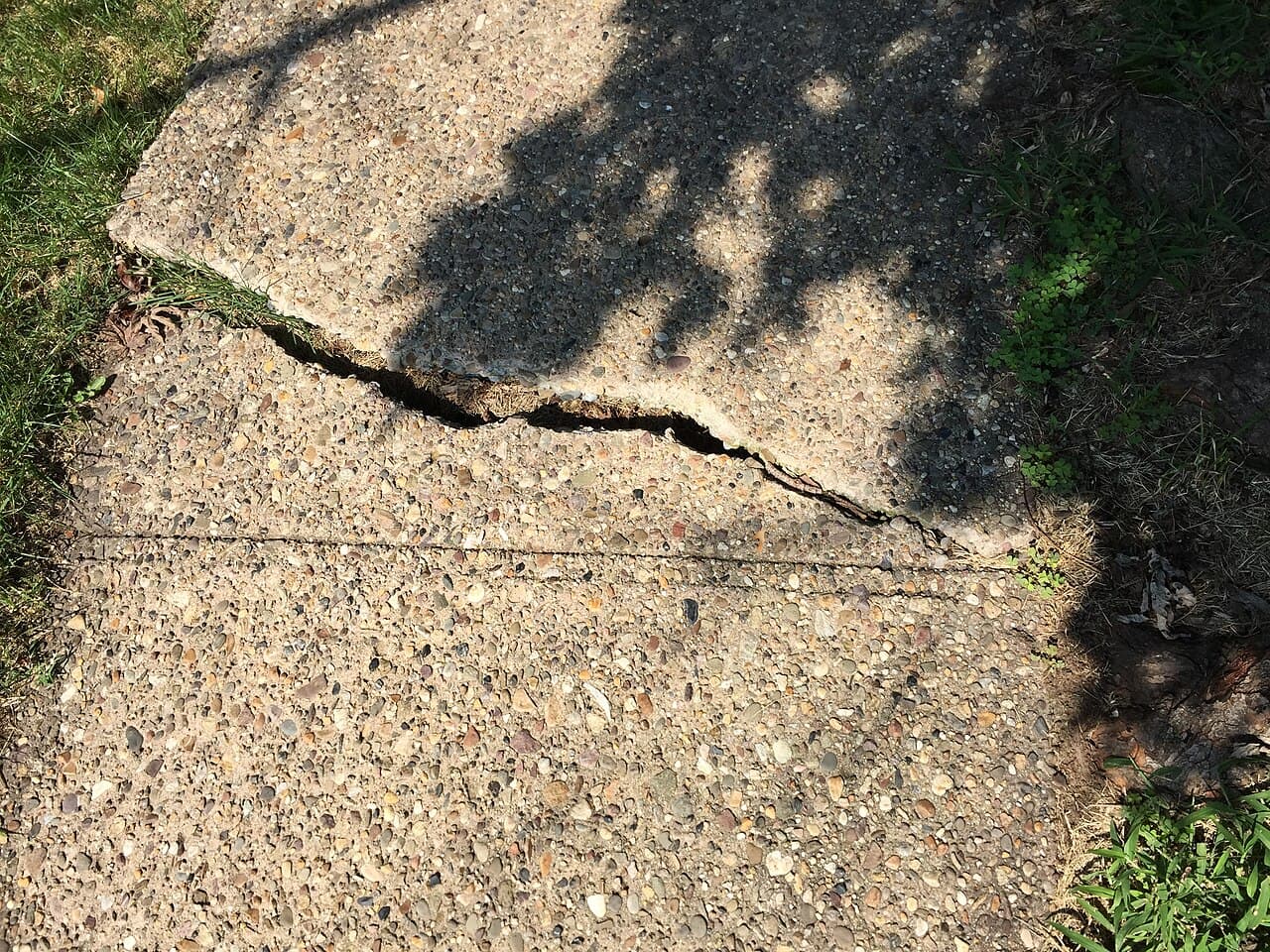
Many slabs are a mix: replace the two broken panels nearest the garage and seal the rest. A good contractor will price it that way if you ask. To tell spalling from scaling and find its cause, see why concrete spalls.
Testing it yourself
A hammer tells you a lot. The National Park Service lists sounding with a hand-held hammer as a basic way to identify areas of delamination,[1] so tap across the slab in a grid and mark any spot that sounds dull or hollow with chalk. A straightedge across each crack shows whether one side has dropped or risen. Then look again after the next hard rain to see where water stands.
Hiring for the work in Virginia
You can seal cracks on your own slab yourself. When you hire someone, the licence has to fit the contract: DPOR's consumer guide says a contractor's licence is needed for work valued at $1,000 or more,[7] and the Code of Virginia says Class C contractors work on single contracts over $1,000 but less than $30,000, and Class B contractors on contracts of $30,000 or more but less than $150,000.[5] Under the Board for Contractors' rules, the concrete contracting specialty (CEM) covers finishing, coloring, curing, repairing, sawing, grinding, sealing and waterproofing concrete,[4] and general building classifications can also do it.
The Board advises getting at least three written bids on the same plans and specifications.[7] For a repair-or-replace decision, ask each contractor to price both options for the same area, so the bids line up. For residential work, the Board requires a written contract that gives the start date and estimated completion date, the total cost, and the contractor's assurance that it will meet all local building permit, inspection and zoning requirements.[6]
Every Virginia locality is required to use the Uniform Statewide Building Code,[9] and your county or town's building office decides how that code applies to your job. Prince William County, for example, lists concrete patio slabs on grade that are not designed to support a future building addition among work that needs no building permit, while noting that zoning or watershed approval will be required.[9] Replacement means digging out the old base, and Virginia 811 puts the call on the contractor when you hire one, and the call must be made at least 3 working days before digging.[8] More hiring questions are in what to ask a concrete contractor before hiring them, and the cost drivers for each option are in what concrete repair costs in Virginia.
Stop and call a pro if
- One side of a crack is higher than the other, or a panel rocks when you step on it.
- Large areas sound hollow when tapped.
- You see rust stains or exposed steel.
- The slab is a stoop, step or garage floor attached to the house and is pulling away, or water is getting into the basement or crawlspace nearby.
- The damage keeps spreading from one winter to the next.
Getting help in Virginia
Loclis lists DPOR-licensed concrete businesses with their licence number and class. Look up concrete contractors in Blacksburg, browse concrete repair, or see all concrete and hardscaping answers.
Describe the damage once and licensed local concrete businesses quote the repair or the replacement.
Common questions
- Is a cracked driveway a reason to replace it?
- Not by itself. Concrete cracks, and narrow, level cracks in an otherwise sound slab are usually cleaned and sealed, not replaced. Cracks with a step across them, a slab broken into pieces, or cracking that keeps spreading point to something wrong under or inside the slab.
- Can I resurface concrete instead of replacing it?
- Often, when the slab underneath is sound and the damage is surface wear or light to moderate scaling. A resurfacer is only as strong as the concrete it is bonded to, and old cracks tend to come back through it if the slab moves or settles.
- What about a slab that has sunk but is not broken?
- That is often a candidate for slab lifting rather than replacement, which is a specialist job with its own equipment. If the slab is broken into small pieces, lifting is less likely to work.
- Who do I hire to repair or replace concrete in Virginia?
- For a job valued at $1,000 or more, a contractor licensed by the Virginia Board for Contractors, in a class that matches the contract price and a specialty or classification that covers concrete. The concrete contracting specialty covers repairing as well as placing and finishing concrete. Sealing narrow cracks in your own slab is a job many homeowners do themselves.
- Do I need a permit to replace a concrete patio or driveway?
- Every Virginia locality uses the same statewide building code, and your county or town's building office decides how it applies to your job. Prince William County, for example, lists concrete patio slabs on grade that are not designed to support a future building addition among work that needs no building permit, but notes that zoning or watershed approval is required. Your contractor's written contract should say it will meet local permit and zoning requirements.
- Will repaired concrete match the rest of the slab?
- Rarely exactly. Quikrete says the colour of its Re-Cap resurfacer varies with the water added, curing conditions and the underlying concrete, and tells users to test a small area first. A patched area usually shows; resurfacing the whole slab gives a more even look.
Sources
- [1] Preservation Brief 15: Preservation of Historic Concrete, National Park Service, U.S. Department of the Interior. Checked October 27, 2026.
- [2] Chemical Deicers and Concrete Pavement: Impacts and Mitigation (FHWA-HIF-17-008), Federal Highway Administration, U.S. Department of Transportation. Checked October 27, 2026.
- [3] Re-Cap Concrete Resurfacer, Product No. 1131-47 (data sheet), The QUIKRETE Companies. Checked October 26, 2026.
- [4] 18VAC50-22-30. Definitions of specialty services, Virginia Administrative Code (Board for Contractors). Checked October 26, 2026.
- [5] Code of Virginia § 54.1-1100. Definitions, Code of Virginia. Checked October 26, 2026.
- [6] 18VAC50-22-260. Filing of charges; prohibited acts, Virginia Administrative Code (Board for Contractors). Checked October 26, 2026.
- [7] What You Should Know Before You Hire a Contractor, Virginia Board for Contractors, DPOR. Checked October 26, 2026.
- [8] Homeowners FAQ, Virginia 811. Checked October 26, 2026.
- [9] Do I Need a Permit?, Prince William County Building Development Division. Checked October 26, 2026.
Want a pro to handle it?
Describe the job once. Licensed local businesses send quotes, and you pay only when you book one.
Get a quote from a local pro