Why is my concrete spalling?
Flaking on outdoor concrete that stays wet through freezing and thawing is called scaling, and deicing salt makes it worse, especially on new concrete. Other causes are a surface finished while water was still rising through it, steel rusting near the surface, and certain stone in the mix. Shallow flaking can be resurfaced; rust or hollow areas need a pro.
Free to ask. Local shops send quotes, and you pay only when you book one.
By Kasra Taheri, Founder, LoclisUpdated
Researched and drafted with AI, then checked claim by claim against the sources listed below before it was published. Prices and rules change; the dates beside each source say when it was last checked.
Step by step
Read when to stop and call a pro, further down this page, before you start.
Step 1: Measure how deep it goes
Check whether the damage is a thin flaking of the top layer or deeper chunks, and whether it follows a joint or a line.
Step 2: Tap for hollow spots
Tap around the damaged area with a hammer and mark anywhere that sounds hollow, which points to a layer that has separated.[2]
Step 3: Look for rust
Check the broken spots for brown stains or exposed steel, a sign that rusting reinforcement is pushing the concrete off.[2]
Step 4: Look at the joints
Look at the joints, since deterioration that starts at a joint points to trapped water and salt rather than a surface problem.[1]
Step 5: Think back on deicers
Note how old the concrete is and what deicer has been used on it, since new concrete is the most easily damaged by salt.[3]
Step 6: Watch for standing water
After rain or snowmelt, note any place where water or slush sits on the slab or in a joint, because salt water that does not drain increases the damage.[1]
Step 7: Rinse off salt in a thaw
On a mild winter day, hose off the salt residue cars leave on the driveway or garage slab.
Step 8: Plan to seal
Once repairs are done, cure and dry the surface as the product's data sheet directs and apply a breathable water-repellent sealer made for concrete.[4]
When outdoor concrete flakes, pits or breaks off in chips, there are a handful of possible causes. The one to check first is freezing and thawing in concrete that stays wet, which deicing salt makes worse. The others are a surface layer that was sealed off during finishing, steel rusting too close to the surface, and certain stone in the mix that reacts with water or freezing. Each leaves a slightly different pattern, so a close look usually tells you which one you have.
Freezing and thawing, helped along by salt
Water soaks into outdoor concrete, freezes, and expands. The Federal Highway Administration (FHWA) explains that chemical deicers amplify this freeze-thaw damage, partly because salt solutions leave the concrete more saturated, and that surface scaling has been the most common deicer damage on flatwork such as slabs.[1] If concrete freezes and thaws while critically saturated (above approximately 86 percent), damage occurs within even a single cycle, no matter how much air is in the mix.[1]
Entrained air is the main protection. The air bubbles are purposely formed in the fresh concrete, and the amount needed is tied to exposure, the most severe being where deicers are used.[1] Concrete finished and cured badly can lose that protection at the surface, which is why good finishing and adequate curing matter as much as the mix.[1]
New concrete is especially vulnerable. The Town of Berryville tells residents that concrete takes approximately a year to cure and is highly susceptible to chemical damage, especially from deicers, during that time, and asks them to avoid salt and other deicers on it for about a year.[3] It lists sand, sawdust, clean kitty litter and birdseed as less damaging options that improve traction.[3]
The product matters too. FHWA reports that calcium chloride, including the calcium chloride that forms from magnesium chloride deicers, can trigger a highly expansive reaction in the cement paste.[1] Cars carry road salt onto driveways, which is one reason flaking is often worst where a car parks. Water that sits on the surface or in joints makes everything worse: FHWA says the way to avoid freeze-thaw damage at joints is to keep water-salt solutions out of them and drain them away quickly.[1]
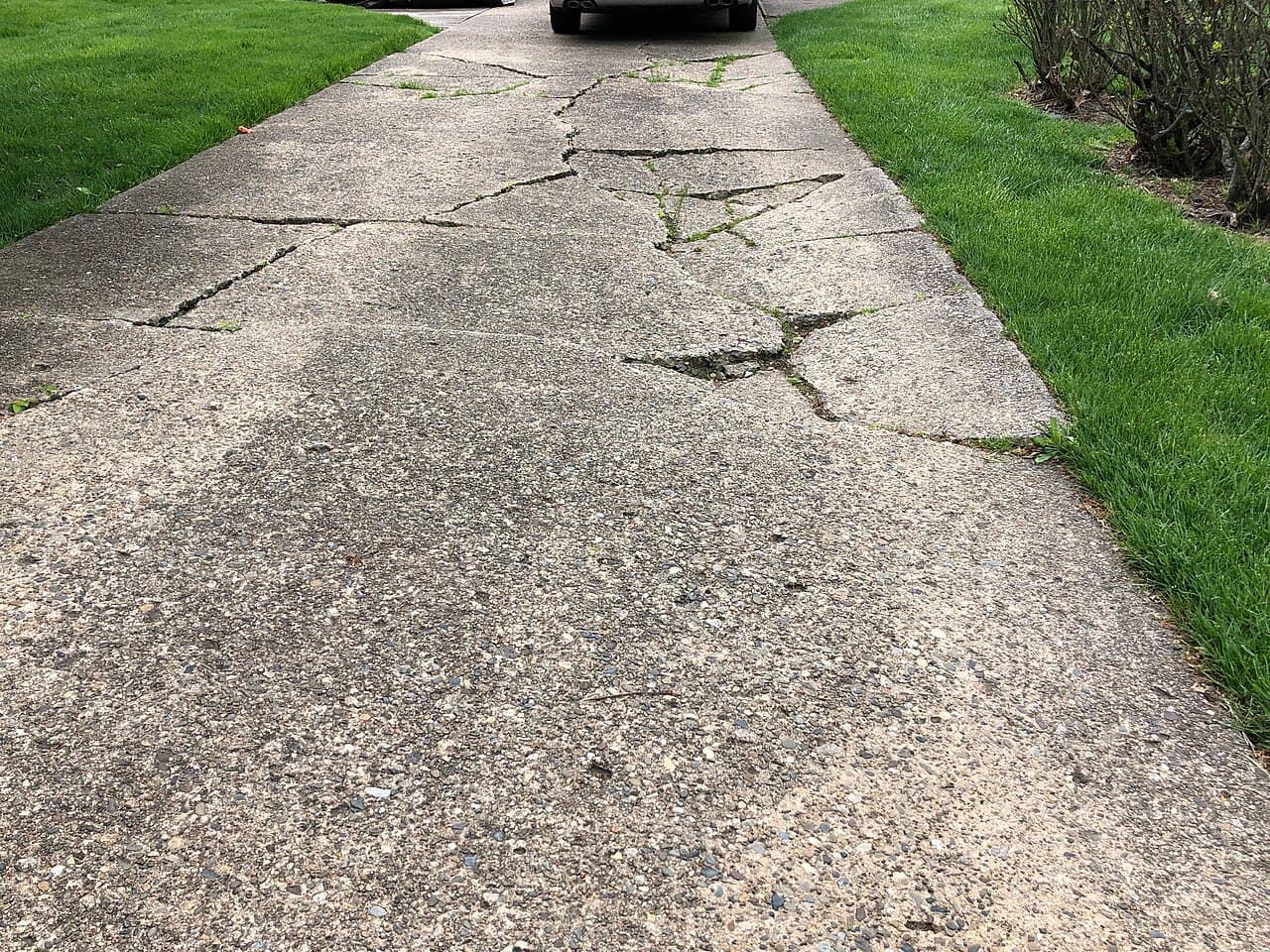
A surface layer that came loose
If the pieces coming off are thin, even sheets and the area around them sounds hollow, the cause may be delamination, a separation of the surface parallel to the concrete below. Tapping with a hammer is the standard first check for it.[2] The National Park Service notes that scaling can also come from improper finishing, when water-rich cement paste rises to the surface and leaves weak material that is vulnerable to thin-layer spalling.[2]
Rusting steel
If the spalls are deeper, follow a line, or show brown stains or bare steel, corrosion is the likely cause. Rust takes up more space than the steel it came from, and the expansion cracks and breaks off the concrete covering it; rust staining is often a precursor to spalling.[2] Deicing salts can start or speed up that corrosion.[2]
Problems in the stone
Some causes come from the aggregate and tend to appear years after the pour. FHWA names coarse aggregate that is susceptible to freeze-thaw damage (D-cracking) among the factors behind deterioration along joints, together with saturated concrete and aggressive deicer use.[1] Alkali-aggregate reactivity, a chemical reaction in the stone, is another mechanism that a laboratory study can identify.[2] Both need a professional diagnosis.
What to do about it
Quikrete says its Re-Cap resurfacer, mixed stiff enough to trowel, can repair spalled and pitted surfaces,[5] and the product is applied from a feather edge of 1/16 inch up to 1/2 inch thick.[5] Remove loose material first. Deeper damage, rust or large hollow areas are a different job; whether to repair or replace helps you decide, and what concrete repair costs covers the price drivers.
To keep it from coming back, cut down on deicers, rinse off salt, fix the drainage and seal the surface. Euclid describes its Baracade Silane 40 WB as a breathable, penetrating water repellent that protects concrete against water intrusion, deicing chemicals and freeze-thaw exposure, and its data sheet says to cure new concrete a minimum of 7 days and to apply only to a clean, dry surface that has dried at least 24 hours after rain.[4] How to keep concrete from cracking in winter covers each one.
Stop and call a pro if
- You see rust stains or exposed steel where concrete has broken away.
- Large areas sound hollow when you tap them.
- The damage is on steps, a stoop, a porch slab or a garage floor that is attached to the house or carries a load.
- Pieces are coming off deeper than the top layer, or along every joint.
- The damage is spreading each winter despite lighter salt use.
Getting help in Virginia
Loclis lists DPOR-licensed concrete businesses with their licence number and class. Look up concrete contractors in Blacksburg, browse concrete repair or sealing and resurfacing, or see all concrete and hardscaping answers.
Describe the damage once and licensed local concrete businesses quote the repair.
Common questions
- What is the difference between spalling and scaling?
- People use the words loosely. Scaling usually means thin flaking of the top surface from freezing and thawing; spalling usually means deeper pieces breaking off, often over rusting steel or along a joint. The causes overlap, which is why it helps to check how deep the damage goes.
- Why is my new driveway flaking after its first winter?
- The usual reasons are deicing salt on concrete that is still curing, a mix with too little entrained air, or a surface that was overfinished or poorly cured. The Town of Berryville tells residents that new concrete takes about a year to cure and asks them to avoid salt and other deicers on it for that long, using sand for traction.
- Is rock salt bad for concrete?
- Federal Highway Administration research treats deicers as the most severe freeze-thaw exposure for concrete, and finds that calcium chloride and magnesium chloride can also cause a chemical reaction that damages the cement paste. Use as little as you can, keep water from pooling on the slab and avoid all of it on new concrete.
- Can spalled concrete be repaired?
- Shallow surface damage usually can, with a bonded resurfacer once the loose material is removed. Damage caused by rusting steel or a large hollow layer needs a contractor to remove the unsound concrete, and widespread, progressing damage may mean replacing the slab.
- Will sealing concrete stop spalling?
- It helps on sound concrete. A breathable silane water repellent, applied to clean, dry concrete that has cured at least 7 days and following the manufacturer's directions, is made to resist deicing chemicals and freeze-thaw exposure. Sealing will not fix rusting steel or a weak surface layer.
Sources
- [1] Chemical Deicers and Concrete Pavement: Impacts and Mitigation (FHWA-HIF-17-008), Federal Highway Administration, U.S. Department of Transportation. Checked October 27, 2026.
- [2] Preservation Brief 15: Preservation of Historic Concrete, National Park Service, U.S. Department of the Interior. Checked October 27, 2026.
- [3] Notice Regarding New Concrete, Town of Berryville, Virginia. Checked October 27, 2026.
- [4] BARACADE SILANE 40 WB technical data sheet, The Euclid Chemical Company. Checked October 27, 2026.
- [5] Re-Cap Concrete Resurfacer, Product No. 1131-47 (data sheet), The QUIKRETE Companies. Checked October 26, 2026.
Want a pro to handle it?
Describe the job once. Licensed local businesses send quotes, and you pay only when you book one.
Get a quote from a local pro