How do I fix cracks in a concrete driveway?
Open the crack to at least 1/4 inch with a chisel, brush out the loose material, and fill it with a concrete crack sealant or repair caulk, using backer rod in deep cracks. Sealing keeps water and grit out; it does not fix the cause. A crack where one side has dropped, that keeps widening, or shows rust needs a pro.
Free to ask. Local shops send quotes, and you pay only when you book one.
By Kasra Taheri, Founder, LoclisUpdated
Researched and drafted with AI, then checked claim by claim against the sources listed below before it was published. Prices and rules change; the dates beside each source say when it was last checked.
Step by step
Read when to stop and call a pro, further down this page, before you start.
Step 1: Pick a dry, mild day
Check the sealant's label for its temperature range, such as 40 to 95 F for Quikrete's Advanced Polymer sealant, and skip days when rain is expected.[3]
Step 3: Open up the crack
Widen the crack to a minimum of 1/4 inch with a cold chisel and hammer, breaking away any loose concrete leaving the edges vertical or beveled in an inverted V.[1]
Step 5: Check the surface
Make sure the crack is sound, frost free and clear of oil, old sealant and loose debris before you fill it.[3]
Step 9: Keep cars off
Give the filler time to cure before it carries traffic, which is at least 3 days for Quikrete's Advanced Polymer sealant.[3]
Step 10: Check it after winter
Look at the repair again in spring; a bead that has split or pulled away from one side means the crack is still moving and needs a flexible sealant or a closer look.
Most driveway cracks can be sealed in an afternoon with a tube of crack sealant, a chisel and a wire brush. Sealing does not make the slab stronger. What it does is keep water, sand and weeds out of the crack, so the crack is not pried wider every winter. The repair only lasts if the crack has stopped moving, so start by working out what kind of crack you have.
First, read the crack
Narrow and level. A narrow crack with both sides at the same height is the kind crack sealants are made for. A narrow crack that has been there since the driveway was young is the usual one to seal yourself. A crack that is new in an old driveway, or that keeps growing between checks, deserves a closer look first; the Federal Highway Administration names coarse aggregate that is susceptible to freeze-thaw damage (D-cracking) among the factors behind deterioration along joints.[5]
One side lower than the other. Lay a straightedge or a level across the crack. If one edge has dropped, the ground under the slab has probably settled. Sealant fills the gap but does nothing about the sinking. See whether to repair or replace cracked concrete before you spend money on it.
Rust stains or flaking along the crack. A brown stain or a chip lifting off along a crack often means steel inside the slab is corroding. The National Park Service explains that rust takes up more space than the steel did, that the resulting expansive forces cause cracking and spalling of the adjacent concrete, and that rust staining is often a precursor to spalling.[6] That is a job for a pro, not a sealant.
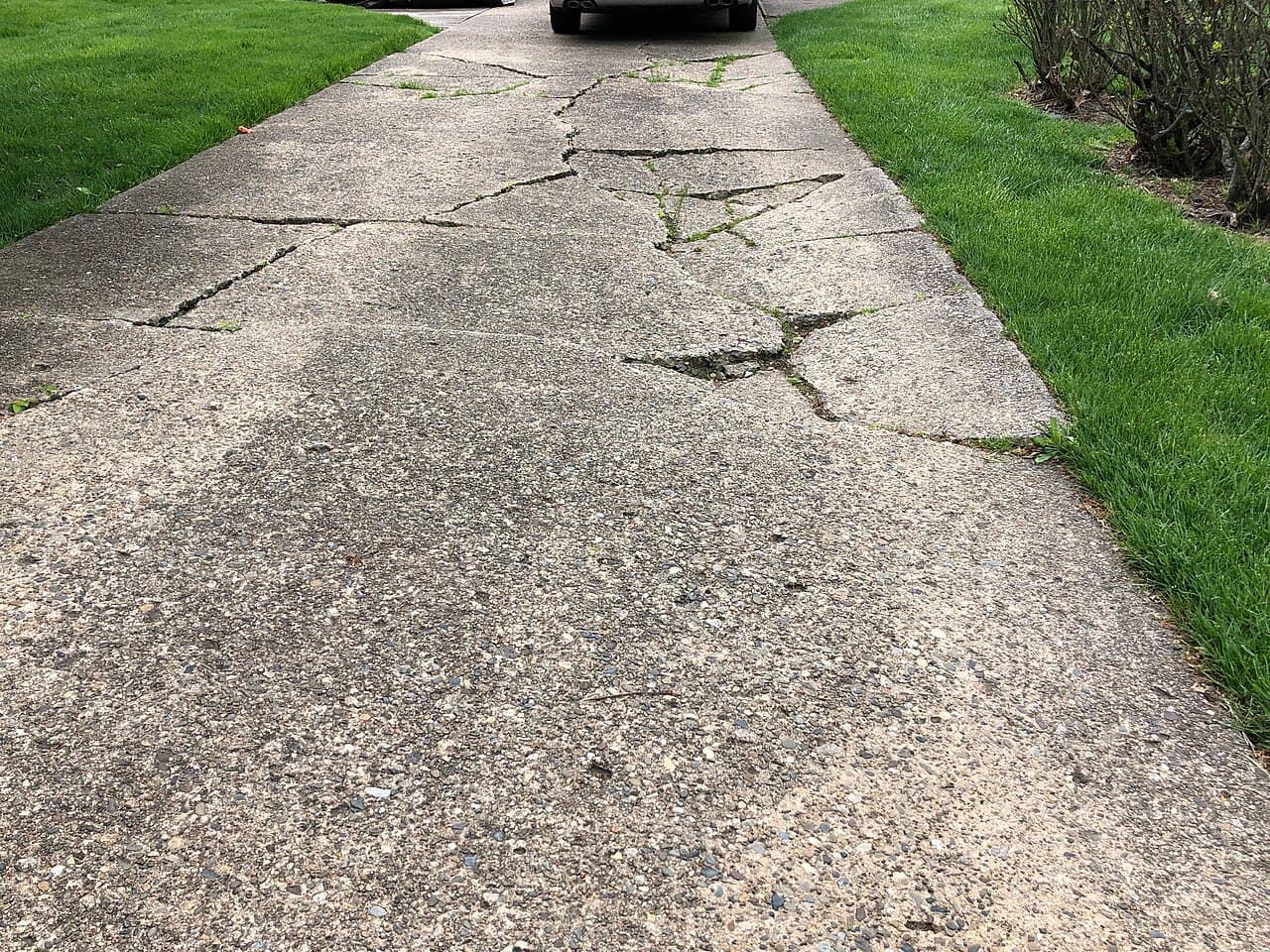
A web of cracks with broken pieces. A driveway like the one below, broken into loose chunks with weeds in every gap, has gone past crack filling.
Choose the filler
There are three common kinds of driveway crack filler, and the label tells you which crack each one is made for.
Pourable crack seal. Quikrete's Concrete Crack Seal is a pourable latex filler for cracks in horizontal concrete such as sidewalks, steps and patios.[2] It is not meant for cracks wider than 1/2 inch.[2] If the crack is deeper than 1/4 inch, Quikrete says to fill it with backer rod or sand to within 1/4 inch of the surface.[2] Use it between 45 and 100 F, not when rain is expected within 24 hours, and add a second coat after 24 hours if needed.[2] For planning, one quart fills a crack 1/4 inch wide and 1/2 inch deep for about 38 feet.[2]
Flexible polymer sealant. For a driveway crack that opens and closes with the seasons, a sealant that stretches is the safer bet. Quikrete's Advanced Polymer Concrete Crack Sealant is a flexible sealant for cracks and joints up to 1 inch wide,[3] rated for joint movement of plus or minus 25%.[3] Quikrete calls for a sealant bead no deeper than 1/2 inch and no thinner than 1/4 inch, about twice as wide as it is deep.[3] Apply it between 40 and 95 F, never to a frozen surface, and keep it free of traffic for at least 3 days.[3] Cooler temperatures and low humidity lengthen the cure.[3] A 10 oz tube fills about 12 feet of a joint 1/2 inch wide and 1/4 inch deep.[3]
Caulk-type concrete repair. A gray repair caulk in a tube is easy to tool flush with the surface. Quikrete notes its Concrete Repair caulk starts to skin over in about 20 to 40 minutes,[1] so smooth it right after you lay the bead.
If you plan to resurface later, choose the patch with that in mind. Quikrete's Re-Cap resurfacer calls for cracks to be widened, cleaned and filled with the resurfacer mixed to a trowelable consistency,[4] and says it should not go over acrylic or polyurethane crack fillers.[4]
Preparing the crack
The prep is most of the job. Quikrete calls for widening the crack to a minimum of 1/4 inch and breaking away deteriorating concrete, so the edges are vertical or beveled in an inverted V.[1] A cold chisel and a hand sledge are enough for most cracks. Then brush and vacuum out every bit of dust, because sealant bonds to clean concrete, not to grit.
Depth matters as much as width. Quikrete says for cracks or joints over 1/4 inch, put backer rod in before the self-leveling polyurethane sealant.[1] Backer rod is a round foam cord sold next to the sealant; buy it a little wider than the crack so it stays put when you push it in with a putty knife.
After the repair
A sealed crack in a moving slab may open again. Quikrete warns that old cracks can reappear when the base concrete moves.[4] Check your repairs each spring, reseal any bead that has split, and fix the drainage if water runs across the driveway or pools along one edge. How to keep concrete from cracking in winter covers deicers, sealing and drainage, and why new concrete cracks explains joints and early cracking.
Stop and call a pro if
- One side of the crack is higher than the other, or a whole section has sunk or tilted. Raising a slab is specialist work; see slab lifting and leveling.
- The crack is wider than the sealant is made for, or keeps getting wider between checks.
- You see rust stains, exposed steel or chunks lifting off along the crack.
- The cracks run into the garage floor, the house or the steps, or water is getting into the basement nearby.
- The driveway is broken into loose pieces, where patching will not last.
Getting help in Virginia
Loclis lists DPOR-licensed concrete businesses with their licence number and class. Look up concrete contractors in Blacksburg, browse concrete repair, or see all concrete and hardscaping answers.
Describe the crack once and licensed local concrete businesses quote the repair.
Common questions
- What is the right product for a driveway crack?
- For a crack that opens and closes with the seasons, a flexible sealant is the usual choice; Quikrete's Advanced Polymer Concrete Crack Sealant handles cracks and joints up to 1 inch wide. A pourable latex crack seal suits narrow cracks up to 1/2 inch in flat concrete. Use a cement-based patch instead if you plan to resurface the driveway later.
- Do I need to widen a hairline crack before sealing it?
- Quikrete calls for widening a crack to a minimum of 1/4 inch before filling it. A hairline crack that is not growing can simply be watched; if it widens, open it up and seal it.
- What is backer rod for?
- Backer rod is a round foam strip pushed into a deep crack so the sealant sits at the right depth instead of disappearing into the slab. Quikrete's polymer sealant should be no deeper than 1/2 inch, and its pourable crack seal should be filled to within 1/4 inch of the surface over backer rod or sand.
- How long before I can drive on a sealed crack?
- Follow the product's label. Quikrete says to keep traffic off its Advanced Polymer sealant for at least 3 days, and that cooler temperatures and low humidity lengthen the cure.
- Can I fix cracks in winter?
- Usually not well. Quikrete's Advanced Polymer sealant is applied between 40 and 95 F and never to a frozen surface, and its pourable Crack Seal between 45 and 100 F. Check the label of whatever filler you use, mark the cracks now, and seal them on a dry fall or spring day.
- When is a cracked driveway beyond patching?
- When the slab is broken into loose pieces, one side of a crack has sunk, the surface is flaking away over a large area, or rust is showing. Those point to the base, drainage or steel, and filling the cracks will not last.
Sources
- [1] Repairing & Sealing Cracks in Concrete (project instructions), The QUIKRETE Companies. Checked October 26, 2026.
- [2] Concrete Crack Seal, Product No. 8640 (data sheet), The QUIKRETE Companies. Checked October 26, 2026.
- [3] Advanced Polymer Concrete Crack Sealant, Product No. 8620-17 (data sheet), The QUIKRETE Companies. Checked October 26, 2026.
- [4] Re-Cap Concrete Resurfacer, Product No. 1131-47 (data sheet), The QUIKRETE Companies. Checked October 26, 2026.
- [5] Chemical Deicers and Concrete Pavement: Impacts and Mitigation (FHWA-HIF-17-008), Federal Highway Administration, U.S. Department of Transportation. Checked October 27, 2026.
- [6] Preservation Brief 15: Preservation of Historic Concrete, National Park Service, U.S. Department of the Interior. Checked October 27, 2026.
Want a pro to handle it?
Describe the job once. Licensed local businesses send quotes, and you pay only when you book one.
Get a quote from a local pro