What are the signs of transmission problems?
The usual signs are slipping gears, delayed or harsh shifts, noise or a burnt smell, red or brown fluid under the car, and a transmission warning light. A flashing transmission-related light is serious: one Honda manual says to avoid rapid acceleration and have it checked as soon as possible. Low fluid is a common cause, so a leak deserves attention. A shop should diagnose it.
Free to ask. Local shops send quotes, and you pay only when you book one.
By Kasra Taheri, Founder, LoclisPublished
Researched and drafted with AI, then checked claim by claim against the sources listed below before it was published. Prices and rules change; the dates beside each source say when it was last checked.
This is a job for a licensed pro in Virginia
This page explains what the work involves, the permits, what a licensed pro does and what drives the cost. It does not give step-by-step instructions, because this work needs a licence, a permit or both, and doing it wrong can injure someone. Before you hire, check the licence on Virginia's DPOR record.
The clearest signs of a transmission problem are gears that slip or will not engage, shifts that are late, harsh or erratic, a flashing transmission-related warning light on the dash, and red or brown fluid under the car. Any of them is worth having a shop look at soon. A flashing transmission-related light is the one to act on at once.
What to look and listen for
A warning light. An older Honda owner's manual says that if the S indicator light flashes while driving, in any gear range, it indicates a possible malfunction in the transmission, and that you should avoid rapid acceleration and have the transmission checked by an authorized Honda dealer as soon as possible.[1] Other makers and models word it differently, so read the warning-light page of your own manual.
Slipping. The engine speeds up but the car does not accelerate to match, or the engine revs jump between gears. This is the sign most often tied to worn internal parts or low fluid.
Delayed or rough engagement. A pause of a second or more after you move the lever from park to drive or reverse, or a clunk when it engages.
Harsh, late or hunting shifts. The car shifts with a jolt, holds a gear too long, or keeps changing up and down on a steady road. Cold-start behaviour that disappears when the car warms up is a different story from a problem that is there every time.
Noise and smell. Whining, humming or buzzing that changes with gear or speed, or a burnt smell, can point to a transmission that is running hot or short of fluid.
Leaks. A red or brown, oily spot under the front or middle of the car is worth checking. A few drops on the ground is a reason to look at the level; a puddle is a reason to book a shop visit.
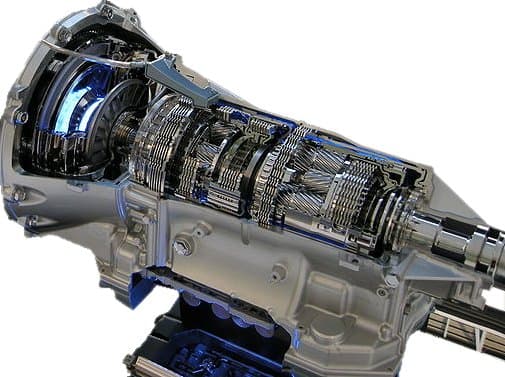
Not every symptom is the transmission
Misfires, a weak battery, a failing sensor, wiring faults and the engine computer can all make a car shift badly or throw a transmission warning. That is why a proper diagnosis comes before a quote for a rebuild. Write down when the symptom happens (cold or warm, which gear, under load or at a steady speed), what lights came on, and whether it has changed over time. That note saves a shop time and helps it reproduce the problem.
The fluid level is the one check an owner can make
On vehicles that have a dipstick, the fluid level is a useful clue. An older Honda manual says to check the fluid level with the engine at normal operating temperature, with the vehicle on level ground, and that it should sit between the upper and lower marks on the dipstick.[2] Many newer vehicles have a sealed transmission with no dipstick, so check your manual before looking, and leave a sealed unit to a shop.
If the level is low, the fluid went somewhere, so a leak is likely. Topping up is not a repair. It also matters which fluid goes in: An older Honda manual warns that a substitute fluid used as a temporary replacement can affect shift quality with continued use.[2] Use the fluid your manual specifies.
What to do next
If the indicator is flashing, the car is slipping badly or the shifts are violent, stop driving it hard and arrange a tow or a short, gentle trip to a shop. Driving on a failing transmission can turn a small repair into a large one. For a mild symptom, such as a slightly late shift, get it checked in the next week or two, and mention it if the car is under warranty.
Your rights when a shop diagnoses it
Virginia's Automobile Repair Facilities Act applies to any person who for profit diagnoses or corrects malfunctions of, or damage to, a motor vehicle.[3] On request, before any repair work for which you may be charged more than $25, the shop must give you a written statement of the estimated labor, the estimated parts, a description of the problem or work and the estimated completion time.[4] A shop may charge a reasonable fee for the estimate and related diagnostic work, but must disclose the condition when you ask, in writing or on a sign posted at the entrance.[4] Ask about the fee before you leave the keys.
When the work is done, you must get a written invoice that shows the work performed and the charges for parts and labor, separately stated.[5] For how the pieces add up, see how much transmission repair costs in Virginia and how often transmission fluid should be changed.
When to call a licensed pro
Diagnosing and repairing a transmission is work for a trained shop, not a driveway job: the unit is heavy, sits under the car, and the cause of a symptom is often outside the transmission itself. Ask for the written estimate described above and keep the invoice, which Virginia law requires the shop to give you.[5]
Browse automotive repair services or read more automotive repair answers.
To get quotes for your own car, describe the job once.
Common questions
- Is a flashing transmission light an emergency?
- Treat it as urgent. One Honda manual says a flashing S indicator while driving indicates a possible malfunction in the transmission, and advises avoiding rapid acceleration and having it checked as soon as possible. Check your own manual for how your make words it.
- Can low fluid cause shifting problems?
- Yes, low fluid is a common reason for slipping or late shifts, and it usually means a leak. Topping up is a stopgap, not a repair, and the fluid has to be the type your manual specifies.
- Is it safe to keep driving with a slipping transmission?
- It is a risk. Continued driving can add damage and cost. If it slips badly, shifts violently or the light flashes, have it towed or take it straight to a shop rather than waiting.
- What should I tell the shop?
- When it happens (cold or warm, which gear, under load or steady), any dash lights, any leaks you have seen, and recent work on the car. A problem the shop can reproduce is easier to fix.
- Can a shop start work without my approval?
- If you ask for a written estimate, Virginia law bars starting repair work, other than the diagnostic work needed for the estimate, until you have the estimate and authorize the work. Ask for it before you hand over the keys.
Sources
- [1] Warning and Indicator Lights (Honda owner's manual), American Honda Motor Co.. Checked October 28, 2026.
- [2] Transmission Fluid (Honda owner's manual), American Honda Motor Co.. Checked October 28, 2026.
- [3] Va. Code § 59.1-207.2, Definitions, Code of Virginia, Virginia General Assembly. Checked October 28, 2026.
- [4] Va. Code § 59.1-207.3, Written estimate for repair work required upon request, Code of Virginia, Virginia General Assembly. Checked October 28, 2026.
- [5] Va. Code § 59.1-207.5, Written invoice required upon completion of repair work, Code of Virginia, Virginia General Assembly. Checked October 28, 2026.
Want a pro to handle it?
Describe the job once. Licensed local businesses send quotes, and you pay only when you book one.
Get a quote for Automotive