What are Virginia's building code rules for stair railings?
Virginia's building code is applied by each locality, so check with yours. Fairfax County's published deck-stair details, written to the 2021 code, require a handrail on one side of stairs with four or more risers, set 34 to 38 inches above the step nosings, graspable and continuous, and a guard where the drop exceeds 30 inches.
Free to ask. Local shops send quotes, and you pay only when you book one.
By Kasra Taheri, Founder, LoclisPublished
Researched and drafted with AI, then checked claim by claim against the sources listed below before it was published. Prices and rules change; the dates beside each source say when it was last checked.
Step by step
Read when to stop and call a pro, further down this page, before you start.
Step 1: Count the risers
Count the vertical risers in the flight. Fairfax County's deck-stair details require a handrail on one side of stairs with four or more risers.[1]
Step 2: Measure the handrail height
Measure straight up from the nose of a step to the top of the handrail. Fairfax County's range for these stairs is 34 to 38 inches.[1]
Step 3: Test how the rail feels in your hand
Grip the rail along its length. It should be smooth, without sharp corners, and you should be able to close your hand around it.[1]
Step 4: Check that it runs the full flight
Follow the rail from over the lowest riser to over the highest. It should be continuous and return to the guard or wall at each end.[1]
Step 5: Measure the drop at open sides
Where a stair side is open, measure the total rise. Fairfax County requires stair guards when it is greater than 30 inches at a point 36 inches from the edge.[1]
Step 6: Check the gaps with a ball
Try a 4-inch ball between balusters. It should not pass through any opening in a guard.[1]
Step 7: Ask your building department
Call the code office for your locality before you change anything, and say whether the stair is inside or outside.
The short answer
Virginia's Uniform Statewide Building Code sets the rules, and your county or city building department enforces them. The detailed numbers sit in the residential code the state adopts, and we could not publish them straight from the code book. What we can show is what Fairfax County states in its own published guidance, written to the 2021 code, for stairs built with decks. Treat those figures as one Virginia locality's published requirements, and confirm them with your own building department.
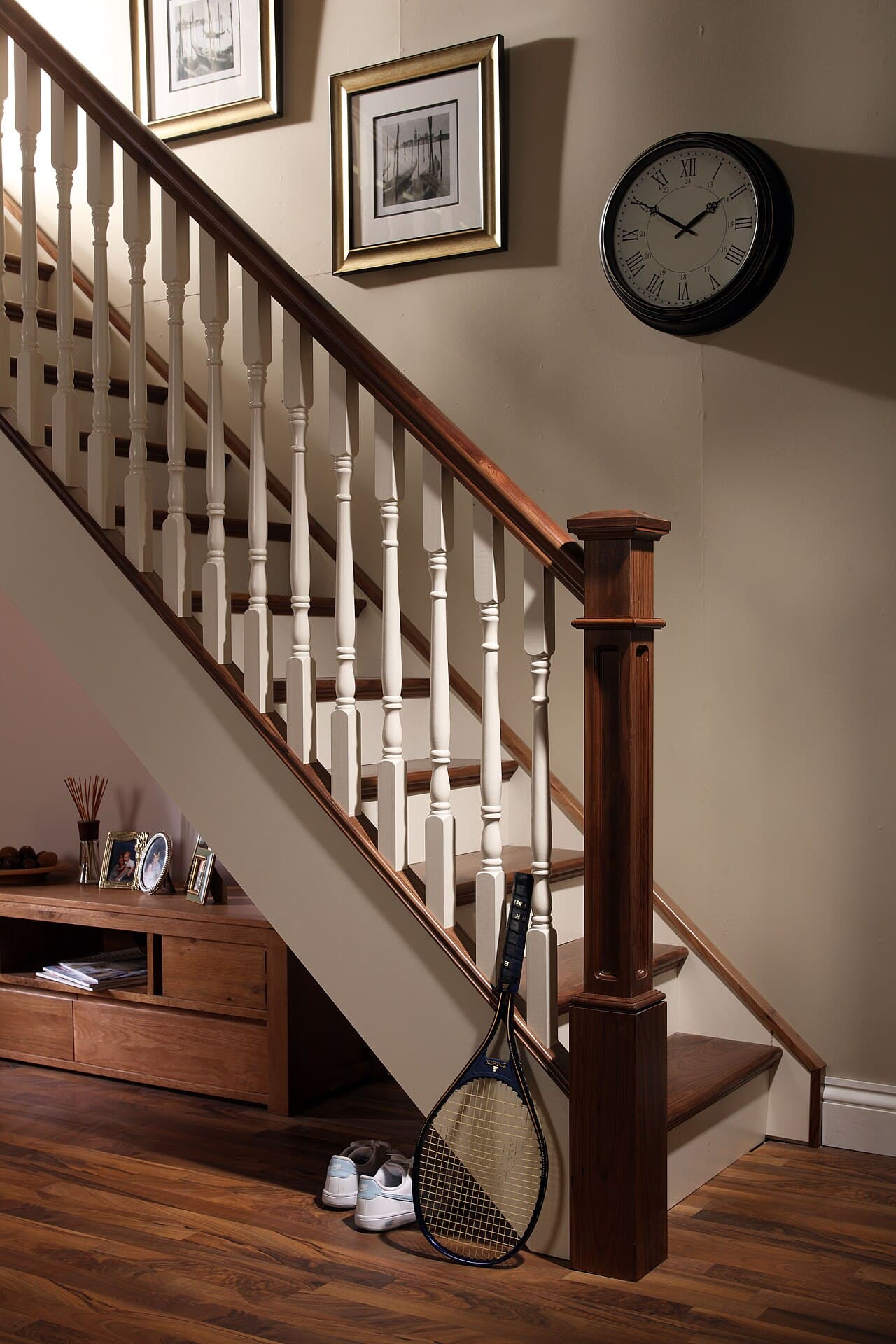
Handrails
Fairfax County's deck details say stairs with four or more risers shall have a handrail on one side at a height between 34 to 38 inches above the nosing of the step.[1] The nosing is the front edge of the tread, so you measure up from the line that touches the tips of the steps.
How it feels matters as much as where it sits. Handrails shall have a smooth surface with no sharp corners and shall be graspable.[1] A railing you cannot close your hand around is not doing the job, however high it is.
The rail must also be continuous: handrails shall run continuously from a point directly over the lowest riser to a point directly over the highest riser and shall return to the guard or wall at each end.[1] The return keeps a sleeve or a pocket from catching on the end. Outdoors, handrail and connecting hardware material shall be decay and corrosion resistant.[1]
Guards and gaps
A guard is the barrier at an open side. Fairfax County requires stair guards when the total rise of the stair is greater than 30 inches at a point 36 inches from the edge of the stair.[1] Guards shall be constructed to restrict the passage of a 4-inch diameter sphere through any opening,[1] so balusters must be close enough that a small child cannot slip through.
The steps themselves
The same publication says the minimum width of a stairway is 36 inches,[1] and that treads, risers and nosing dimensions shall not deviate at each step by more than ⅜ inches.[1] Even small differences from step to step matter, so measure before you decide a stair is fine.
Old stairs, repairs and permits
The Virginia Maintenance Code, which governs existing buildings, says buildings, structures, and systems shall be maintained and kept in good repair,[3] so a loose rail is a repair you owe the house, not an upgrade. See how to fix a squeaky stair for small stair fixes.
A permit is a separate question. Virginia's code requires one before work involving any structural component, or the alteration of any required means of egress system.[2] Tightening a rail's fasteners is routine. Moving a stair, cutting the stringers or replacing the posts that hold a guard is not, so ask before you start.
Stop and call a pro if
- The handrail or guard moves when you lean on it. A rail that pulls out of its post or wall needs structural fastening.
- A post is rotted or loose at the base. The framing it bolts to may be damaged.
- The steps are uneven, or the stair is narrower than 36 inches. That is a rebuild, not a repair.
- You are adding a rail where none exists or changing a flight. Ask the building department about a permit first.
- You are not sure which code applies. Your locality can tell you for your house.
Who to hire in Virginia
Finish carpentry in the Board for Contractors' regulations means the installation, repair, and finishing of cabinets, sash casing, door casing, wooden flooring, baseboards, countertops, and other millwork.[4] A framing contractor handles the construction, removal, repair, or improvement to any framing or rough carpentry necessary for the construction of framed structures.[4] For rails that attach to the structure, ask for the licence number and whether the permit is in the quote.
For costs, read how much stair repair costs in Virginia. Browse home repair answers or stair businesses.
When you are ready, describe the railing once and licensed local carpenters quote it.
Common questions
- How high must a stair handrail be in Virginia?
- Fairfax County's published details for deck stairs, written to the 2021 code, set it between 34 and 38 inches above the nosing of the step. Other localities apply the same state code, but check the figure for your stair, indoors or out, with your own building department.
- Does every staircase need a handrail?
- Under Fairfax County's deck-stair details, stairs with four or more risers need a handrail on one side. For any other stair in your house, ask your building department what applies, since the answer can depend on when it was built.
- When does a stair need a guard as well as a handrail?
- Fairfax County requires stair guards when the total rise of the stair is greater than 30 inches at a point 36 inches from the edge of the stair, and says openings in guards must not pass a 4-inch sphere.
- Do I have to upgrade an old railing to current code?
- Not automatically. Virginia's Maintenance Code says no provision of that code requires alterations to an existing building unless conditions meet the definition of an unsafe structure, but it requires buildings to be maintained and kept in good repair. A railing that is loose or missing is a repair issue regardless.
- Does installing a new stair railing need a permit?
- It depends on the work and the locality. Virginia's building code requires a permit before work involving any structural component or the alteration of any required means of egress system. Ask the building department before you start.
Sources
- [1] Typical Deck Details, Version 2021.0 (1/5/2024), Fairfax County Land Development Services. Checked October 27, 2026.
- [2] 13VAC5-63-80. Section 108 Application for permit (Virginia Uniform Statewide Building Code), Virginia Administrative Code, Virginia General Assembly. Checked October 27, 2026.
- [3] 13VAC5-63-470, Virginia Maintenance Code, Section 103 Application of code, Virginia Administrative Code, Virginia General Assembly. Checked October 27, 2026.
- [4] 18VAC50-22-30, Definitions of specialty services (Board for Contractors Regulations), Virginia Administrative Code, Virginia General Assembly. Checked October 27, 2026.
Want a pro to handle it?
Describe the job once. Licensed local businesses send quotes, and you pay only when you book one.
Get a quote for Home Repair