What does an electrician do to fix a ceiling fan?
An electrician finds which part has failed and repairs only that. The visit covers the power and wall or remote controls, the connections in the canopy, the box and hanging hardware, and the blades and balance. Then the electrician either repairs the fan or tells you it is cheaper to replace it. Anyone paid to do this work in Virginia must hold an electrical tradesman licence.
Free to ask. Local shops send quotes, and you pay only when you book one.
By Kasra Taheri, Founder, LoclisPublished
Researched and drafted with AI, then checked claim by claim against the sources listed below before it was published. Prices and rules change; the dates beside each source say when it was last checked.
This is a job for a licensed pro in Virginia
This page explains what the work involves, the permits, what a licensed pro does and what drives the cost. It does not give step-by-step instructions, because this work needs a licence, a permit or both, and doing it wrong can injure someone. Before you hire, check the licence on Virginia's DPOR record.
An electrician fixing a ceiling fan works out which part has failed, makes sure the box and wiring above it are sound, and then repairs or replaces only what is needed. Much of the time the answer is in the controls, the connections or the hanging hardware rather than the motor. The visit usually ends with a clear choice between a repair and a new fan.
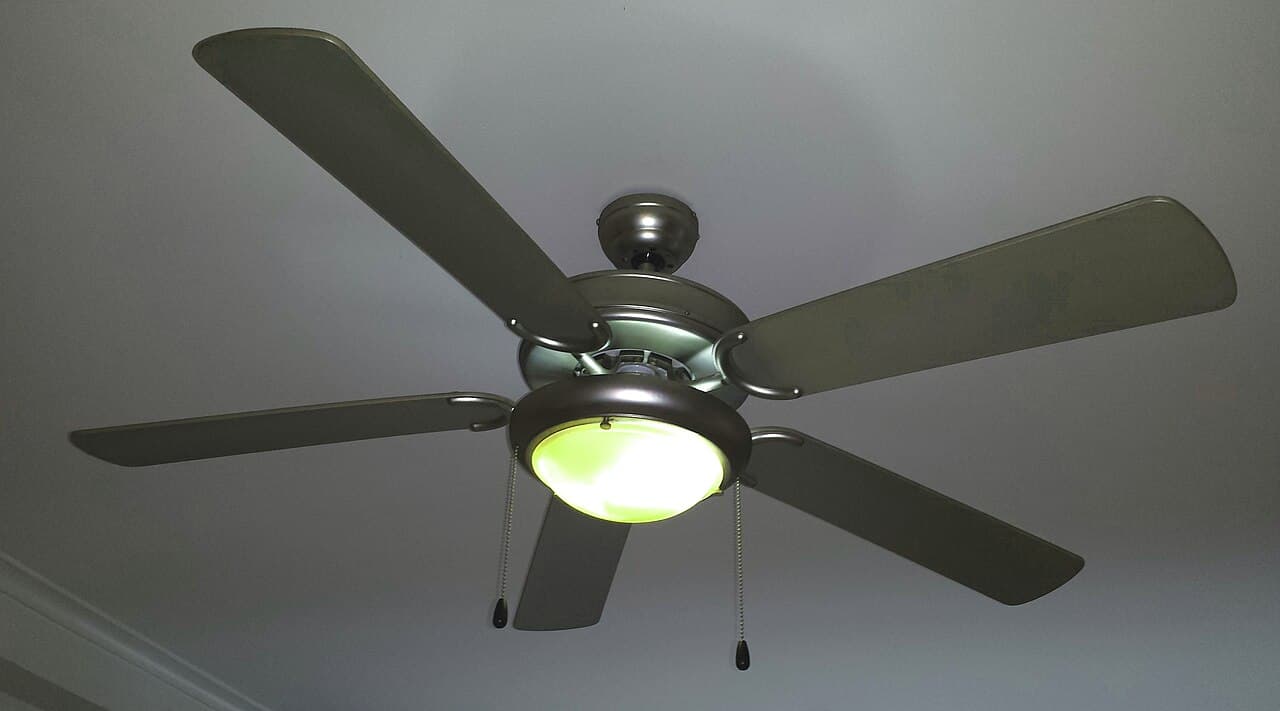
What the diagnosis covers
The electrician starts with what you describe: nothing happens, the fan works but the light does not, it runs on one speed only, it is noisy, or it wobbles. Hunter's troubleshooting table, which is a fair guide to how a technician thinks, lists these probable causes when a fan does not move: power turned off, fuse blown or circuit breaker tripped; loose wire connections or wrong connections; a motor reversing switch not engaged; a pull chain switch not "on"; and shipping bumpers still in place.[1] A technician works through that kind of list from the supply end towards the motor.
The supply and the controls. Is the circuit live, and does the wall switch or remote do its job? Controls matter more than people expect. Hunter lists using a non-approved speed control as a cause of noisy operation,[1] and ENERGY STAR says controls need to match the fan: maximum amps, number of speeds, total lamp wattage, and brand.[4] A wrong control, a failed remote receiver or a dead pull-chain switch is a quick fix compared with a new motor.
The connections in the canopy. Loose or wrong connections are a common cause of a fan that does nothing, and the same manual points to a loose switch housing as another noise source.[1] The electrician lowers the canopy and checks the splices and the plug connection in the switch housing.
The box and the hanging hardware. This is the part that makes a fan different from a light. ENERGY STAR advises using a UL-listed metal box marked "For Use With Ceiling Fans" and warns that ceiling fans can weigh as much as 50 pounds.[3] Hunter's warning says to mount a fan directly from building structure and/or an outlet box marked acceptable for fan support of 70 lbs.[2] A fan that wobbles, ticks or drifts may be hanging from a box that was never made for the load, and a pro will say so.
The blades and balance. For wobble, ENERGY STAR says to first make sure that all connections are properly aligned and tightly fastened, then check blade alignment, and use a balancing kit to pinpoint the culprit if the blades are aligned.[3] Hunter's table lists unbalanced blades, loose blades or blade irons, and a fan not secure on its hanger assembly as causes of excessive wobbling.[1] Our answer on whether a ceiling fan can go where there is only a light fixture shows why the box is such a common issue.
What the repair itself can be
Depending on what the diagnosis finds, the work is typically one of these:
- replacing a switch, remote receiver, wall control or pull-chain switch
- re-making a loose connection and re-seating the canopy
- tightening or replacing blade brackets and blades, and balancing the fan
- replacing a fan-rated box or support brace when the existing one is not adequate
- replacing the whole fan when the motor has failed or parts are not available
The last one is a judgment call, and the repair or replace decision turns on the fan's age and what the fix would cost.
Safety and permits
Electricians de-energise the circuit before opening anything. Hunter's own warning reads: "To avoid possible electrical shock, before installing or servicing your fan, disconnect the power by turning off the circuit breakers to the outlet box and associated wall switch location."[2] It adds that if you cannot lock the breakers off, a prominent warning device, such as a tag, should be fastened to the service panel.[2]
On permits, Virginia's building code lists replacement of luminaires and ceiling (paddle) fans among ordinary repairs, in Group R-2 where serving a single dwelling unit and in Groups R-3, R-4, and R-5.[5] A like-for-like swap on the existing box and wiring is normally that kind of job. Work that adds a fan where there was none, a new circuit or a new switch run is different, so ask the electrician whether a permit applies.
When to call a licensed pro
Whenever someone is paid to do it. Virginia defines a tradesman as any individual who engages in, or offers to engage in, work for the general public for compensation in the trades of electrical, plumbing and heating, ventilation and air conditioning.[7] The Code says no individual may engage in, or offer to engage in, work as a tradesman unless licensed.[8] The Board for Contractors also warns that if you contract with someone who does not hold a licence, it may not be able to help you resolve a complaint, so check the licence first.[6]
Call right away, and leave the fan off, if you see smoke, a burning smell, scorch marks at the canopy, a hot or buzzing switch, or a fan that has come loose from the ceiling. Hunter's manual advises, if you are unfamiliar with wiring, to contact a qualified electrician.[2]
Find help
Browse electrical repair on Loclis or read more electrical repair answers. To see what a visit costs, read how much ceiling fan repair costs in Virginia.
Describe your ceiling fan problem and licensed local electricians quote it.
Common questions
- Can an electrician fix a ceiling fan that will not turn on?
- Usually, once the cause is found. Hunter's troubleshooting table lists a tripped breaker, loose or wrong connections, a reversing switch not engaged, a pull chain switch not on, and shipping bumpers left in place as probable causes of a fan that does not move. A failed control or connection is much cheaper to fix than a failed motor.
- Why does a ceiling fan wobble?
- The usual culprits are unbalanced blades, loose blades or blade irons, and a fan not secure on its hanger assembly, according to Hunter's manual. ENERGY STAR notes that ceiling fans can weigh as much as 50 pounds, so an inadequate box is another reason a pro may need to look.
- Does fixing a ceiling fan need a permit in Virginia?
- Replacement of ceiling (paddle) fans and luminaires is listed among the ordinary repairs that need no permit application in the residential groups the code names. New wiring, a new circuit or a fan where none existed is different, so ask the electrician whether a permit applies.
- Does the electrician have to be licensed?
- Yes, if you are paying for the work. Virginia's Code says no individual may offer to work as a tradesman in electrical work for the general public for compensation unless licensed.
- Should I turn the fan off if I smell something burning?
- Yes. Leave it off and have a licensed electrician look at it. Smoke, a burning smell, scorch marks at the canopy or a fan that has come loose are reasons to call at once.
Sources
- [1] Installation and Operation Manual for Hunter Ceiling Fans (41459-01, 2001), Hunter Fan Company. Checked October 27, 2026.
- [2] Ristrello Ceiling Fan Installation Manual (PG3865, 2021), Hunter Fan Company. Checked October 27, 2026.
- [3] Ceiling Fan Installation and Usage Tips, ENERGY STAR, U.S. Environmental Protection Agency. Checked October 27, 2026.
- [4] Ceiling Fan Accessories and Purchasing Choices, ENERGY STAR, U.S. Environmental Protection Agency. Checked October 27, 2026.
- [5] 13VAC5-63-80, Virginia Uniform Statewide Building Code, Section 108 Application for permit, Virginia Administrative Code, Legislative Information System. Checked October 27, 2026.
- [6] What You Should Know Before You Hire a Contractor, Virginia Board for Contractors, DPOR. Checked October 27, 2026.
- [7] Code of Virginia § 54.1-1128, Definitions, Code of Virginia, Legislative Information System. Checked October 27, 2026.
- [8] Code of Virginia § 54.1-1129, Necessity for licensure, Code of Virginia, Legislative Information System. Checked October 27, 2026.
Want a pro to handle it?
Describe the job once. Licensed local businesses send quotes, and you pay only when you book one.
Get a quote for Electrical Repair