Why is my ceiling fan wobbling?
Most wobble comes from blades that are out of balance, loose blades or blade irons, or a fan that is not seated properly on its hanger. A weak or wrong ceiling box can also be behind it, which is the reason to have a licensed electrician look rather than keep running a fan that shakes the ceiling.
Free to ask. Local shops send quotes, and you pay only when you book one.
By Kasra Taheri, Founder, LoclisPublished
Researched and drafted with AI, then checked claim by claim against the sources listed below before it was published. Prices and rules change; the dates beside each source say when it was last checked.
This is a job for a licensed pro in Virginia
This page explains what the work involves, the permits, what a licensed pro does and what drives the cost. It does not give step-by-step instructions, because this work needs a licence, a permit or both, and doing it wrong can injure someone. Before you hire, check the licence on Virginia's DPOR record.
A ceiling fan wobbles for one of a few reasons: the blades are out of balance, something has worked loose, the fan is not seated correctly on its hanger, or the box and mount above the ceiling are not holding it well. The first three are small fixes. The last one is why a wobbling fan is worth a professional look instead of months of putting up with it.
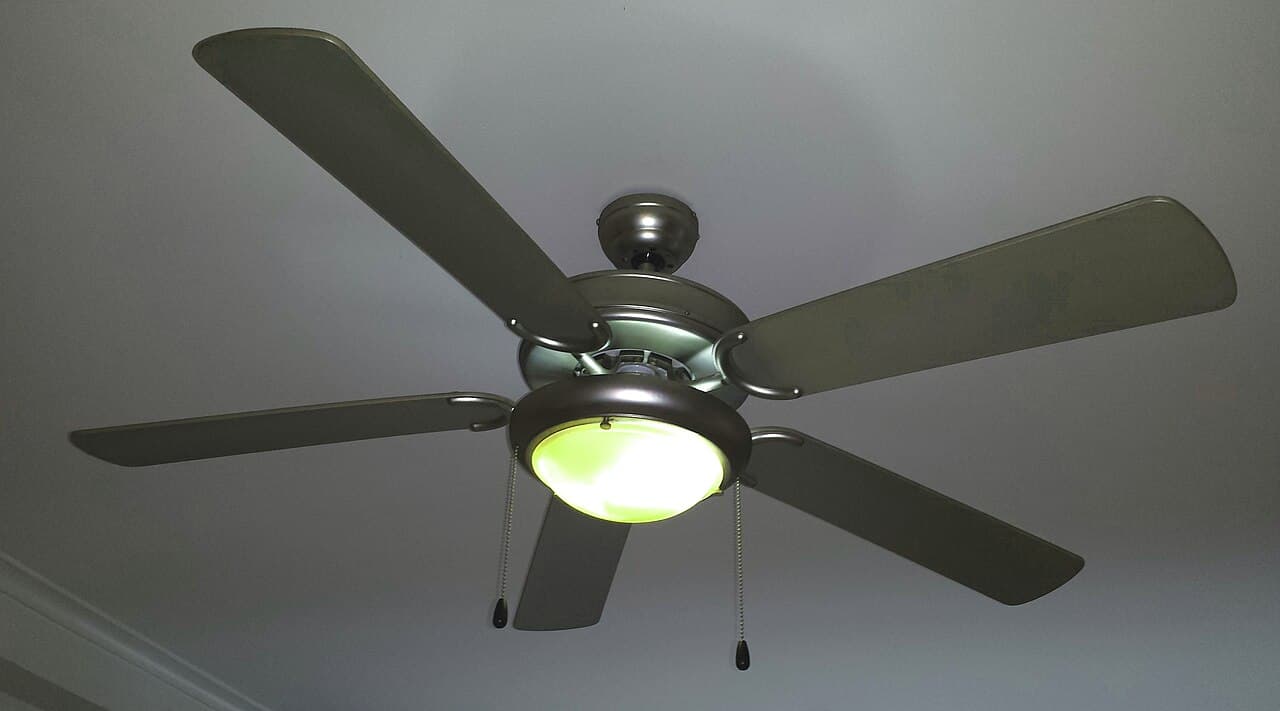
The usual causes
Hunter's troubleshooting table for excessive wobbling lists four: unbalanced blades, loose blades or blade irons, a fan not secure on its hanger assembly, and a fan hanger ball not seated in canopy tabs.[1] They show up in two patterns.
Since day one. A fan that has shaken since it was hung usually points to installation: a hanger ball not seated, a canopy hung wrong, blades not properly installed. ENERGY STAR notes that all fan blades should be balanced prior to shipment,[3] so a new fan that wobbles is more often a fitting problem than a factory one.
It started later. Fans shake themselves loose over time. Screws that held blades and blade irons back off, and the wobble grows slowly enough that you stop noticing. A cracked blade is another thing to rule out: Hunter's guidance in its noisy-operation checks is to check if any of the blades are cracked and, if so, replace all of the blades.[2]
One thing is normal. Hunter's manual says that when switching from medium to low speed, you may notice some fan wobble, and when the fan stabilizes at low speed, wobble will disappear.[1] A wobble that carries on at a steady speed is something else.
What an electrician looks at
A visit for a wobble moves from the cheap fixes to the structural ones.
Blades and brackets. The pro checks that every blade and blade iron is tight and that the blades sit in line with each other. ENERGY STAR describes the order: connections and blade alignment first, and once the blades are aligned, a balancing kit can then be used to pinpoint the culprit.[3] A technician also judges whether a bent blade holder can be straightened or the part should be replaced.
The hanger and canopy. The fan hangs from a ball and socket inside the canopy, and a ball that is not seated or a canopy that was fitted crooked shows up as a sway. Fixing it means taking the weight of the fan, which is why the work is done with the power off.
The box and the mount. This is the check that matters most for safety. ENERGY STAR advises the appropriate UL-listed metal box, marked "For Use With Ceiling Fans," and notes ceiling fans can weigh as much as 50 pounds.[3] It also says a fan should, if possible, be anchored to a ceiling joist.[3] Hunter's installation warning is to mount a fan directly from building structure and/or an outlet box marked acceptable for fan support of 70 lbs.[2] A fan that went onto a plain light-fixture box, or a fan-rated box that has loosened in the ceiling, will wobble however well the blades are balanced. Replacing or bracing that box is electrical work, not a tightening job. Our answer on putting a fan where a light fixture hangs now explains why this comes up so often.
What to do in the meantime
Switch the fan off if the shaking is more than slight, or if you hear clicking, see the canopy moving against the ceiling, or notice the fan sitting off-centre. Do not hang from it, push on it or run it on high to see what happens. Before anyone opens the fan, the power has to come off at the breaker. Hunter's warning is to disconnect the power by turning off the circuit breakers to the outlet box and associated wall switch location before servicing.[2]
If the fan is old, the repair or replace decision is worth making at the same visit, and what an electrician does to fix a ceiling fan walks through a full call.
When to call a licensed pro
Call one for any wobble that does not settle on its own, and straight away for a fan that shakes hard, has come partly loose, or sits on a box you do not know to be fan-rated. In Virginia the person you pay must hold a licence: the Code says no individual may engage in, or offer to engage in, work as a tradesman unless licensed.[4] The Board for Contractors also warns that if you contract with someone who does not hold a licence, it may not be able to help you resolve a complaint,[5] so check the licence first.
For what the visit costs, see how much ceiling fan repair costs in Virginia.
Find help
Browse electrical repair on Loclis or read more electrical repair answers.
Describe your wobbling fan and licensed local electricians quote it.
Common questions
- Is a wobbling ceiling fan dangerous?
- It can be. A mild wobble is usually a balance or tightness problem, but ceiling fans can weigh as much as 50 pounds, so a fan that shakes hard, clicks or drifts sideways may be hanging from a loose or inadequate mount. Turn it off, and have a licensed electrician look at it before it runs again.
- Why did my ceiling fan start wobbling after it ran fine for years?
- Something has loosened or changed. Hunter's manual lists loose blades or blade irons, a fan not secure on its hanger assembly, and a hanger ball not seated in the canopy tabs. A cracked blade is another cause, and Hunter says to replace all of the blades if any is cracked.
- Do balancing kits fix a wobbly fan?
- Often, when the cause is blade weight. ENERGY STAR says that once connections and blade alignment are checked, a balancing kit can be used to pinpoint the culprit. If balancing does not stop the shake, the problem is more likely the mount, which is an electrician's job.
- Is a little wobble on low speed normal?
- Sometimes. Hunter notes that when switching from medium to low speed you may see some wobble that disappears once the fan settles at low speed. A wobble that continues at a steady speed is not that.
- Who can fix a wobbling ceiling fan in Virginia?
- If you pay someone, a licensed electrical tradesman. Virginia's Code says no individual may offer to work as a tradesman unless licensed. Check the licence on DPOR's lookup before you agree to a visit.
Sources
- [1] Installation and Operation Manual for Hunter Ceiling Fans (41459-01, 2001), Hunter Fan Company. Checked October 28, 2026.
- [2] Ristrello Ceiling Fan Installation Manual (PG3865, 2021), Hunter Fan Company. Checked October 28, 2026.
- [3] Ceiling Fan Installation and Usage Tips, ENERGY STAR, U.S. Environmental Protection Agency. Checked October 28, 2026.
- [4] Code of Virginia § 54.1-1129, Necessity for licensure, Code of Virginia, Legislative Information System. Checked October 28, 2026.
- [5] What You Should Know Before You Hire a Contractor, Virginia Board for Contractors, DPOR. Checked October 28, 2026.
Want a pro to handle it?
Describe the job once. Licensed local businesses send quotes, and you pay only when you book one.
Get a quote for Electrical Repair