What does repiping a house involve?
Repiping replaces a home's water supply pipes, usually old galvanized steel, polybutylene or failing copper, with new PEX or copper. A licensed plumbing contractor assesses the system, gets a permit, runs new lines from the main shutoff to each fixture through openings in walls and ceilings, has the work inspected, and switches the house over before the openings are patched.
Free to ask. Local shops send quotes, and you pay only when you book one.
By Kasra Taheri, Founder, LoclisUpdated
Researched and drafted with AI, then checked claim by claim against the sources listed below before it was published. Prices and rules change; the dates beside each source say when it was last checked.
This is a job for a licensed pro in Virginia
This page explains what the work involves, the permits, what a licensed pro does and what drives the cost. It does not give step-by-step instructions, because this work needs a licence, a permit or both, and doing it wrong can injure someone. Before you hire, check the licence on Virginia's DPOR record.
The short version
Repiping means replacing the pipes that carry drinking water through your house, from the main shutoff to every faucet, toilet, shower and appliance. A licensed plumbing contractor looks at what you have, writes up a scope, gets a permit, runs new pipe (usually PEX or copper) through small openings in walls, floors and ceilings, connects each fixture, and has the new system inspected. The old pipe is then cut out of service and the openings are patched.
It is a bigger job than fixing a leak, but it is rarely a full gut renovation. Most of the time spent is in finding routes for the new pipe, not in the pipe itself.
Why houses get repiped
A whole-house repipe usually follows a pattern of problems rather than one leak:
- Old galvanized steel. Virginia Cooperative Extension notes that rusting iron or galvanized steel pipes can put iron into household water,[1] which shows up as rusty or brown water. It adds that iron building up inside pipes is often linked to lower water pressure.[1] Our page on why tap water looks rusty helps you tell pipe rust from other causes.
- Polybutylene. This older plastic supply pipe is on public agencies' replacement lists: the City of Thousand Oaks, California, describes polybutylene service lines as "prone to degradation from chlorine exposure, microfracturing, and sudden failures."[4] See whether you need to replace polybutylene pipes.
- Copper eaten by corrosive water. Repeated small leaks and stains are the usual signs. Extension says an example of the nuisance problems corrosive water causes is blue-green staining on sinks, tubs or laundry from dissolved copper.[2] If that is the cause, test and treat the water too, because a new pipe material does not make the water any less corrosive.[2]
- Lead. The EPA says "Lead pipes are more likely to be found in older cities and homes built before 1986."[3] It adds: "Among homes without lead service lines, the most common problem is with brass or chrome-plated brass faucets and plumbing with lead solder."[3]
The assessment and the written scope
A good repipe quote starts with a walk-through. The plumber should look at the pipe material and its condition, the main shutoff valve, the water heater connections, every fixture, and how the pipes can be reached: an open basement or crawlspace is much easier than finished ceilings or a slab.
The scope should also say where the job starts. Many repipes begin at the main shutoff inside the house and leave the service line from the street alone. If your service line may be lead or galvanized, find out before you sign. The EPA suggests asking your water utility, or a licensed plumber if the utility has no record, whether your service line is lead.[3]
The permit
Virginia's building code requires a permit before installations or alterations involving a building's water supply and distribution system.[6] The exemption for ordinary repairs covers replacing plumbing fixtures only when there is no alteration of the water supply and distribution system,[6] so a repipe is permit work. For emergency construction, alterations or equipment replacement, the application must be submitted by the end of the first working day after the work starts.[6]
The contractor should pull the permit. Under the same section, the permit applicant must either give the building official satisfactory proof that they are licensed or certified as a contractor to do the work, or file a written statement that they are not subject to contractor licensure.[6] The Board for Contractors advises: "Do not allow work to start until the contractor gives you copies of the officially issued permit(s), as required."[10] The minimum inspections the building official conducts, where applicable, include plumbing materials, equipment and systems before they are concealed,[7] and the permit holder has to notify the building official when the work reaches a stage that needs an inspection.[7] Ask the contractor when that inspection is booked, so no wall or ceiling is closed up before it.
Choosing the pipe
Most repipes use PEX or copper.
PEX is flexible plastic tubing that bends around corners and snakes through walls with fewer fittings and fewer openings. It is sold in copper tube sizes: Viega says its PureFlow PEX tubing follows standard copper tube size (CTS) dimensions,[5] which is why it can connect to the same fixtures and valves. PEX is rated for chlorine resistance and sunlight, and the rating is printed on the tubing. For example, a PEX 5306 tube is "Rated to NSF-pw (CL5) chlorine resistance for use in continuous domestic hot water circulation systems (up to a 140°F water temperature)"[5] and "Rated to the highest UV resistance rating (6 months) according to ASTM F2657."[5] That second figure is the weakness on site: PEX is meant to be kept out of sunlight, so tubing that sat outside on a job trailer for weeks is a fair thing to ask about.
Copper is rigid tube joined with soldered or mechanical fittings. It is long proven, but it suffers in acidic water. Extension notes that corrosive water turns up most often in the Blue Ridge and parts of the Piedmont,[2] and low pH (below 6.5) is the more common problem in private water systems.[2]
Whatever the material, it should be lead-free. Changes to the Safe Drinking Water Act in 2011 reduced the maximum lead content that counts as lead-free to a weighted average of 0.25 percent across the wetted surfaces of pipes, fittings and fixtures, and 0.2 percent for solder and flux.[3] For how long each material tends to last and what shortens it, see how long copper and PEX pipes last.
Ask too about layout. Some plumbers run a main trunk with branches to each room; others run PEX from a central manifold with a separate line to each fixture. Either can work well; the quote should say which and why.
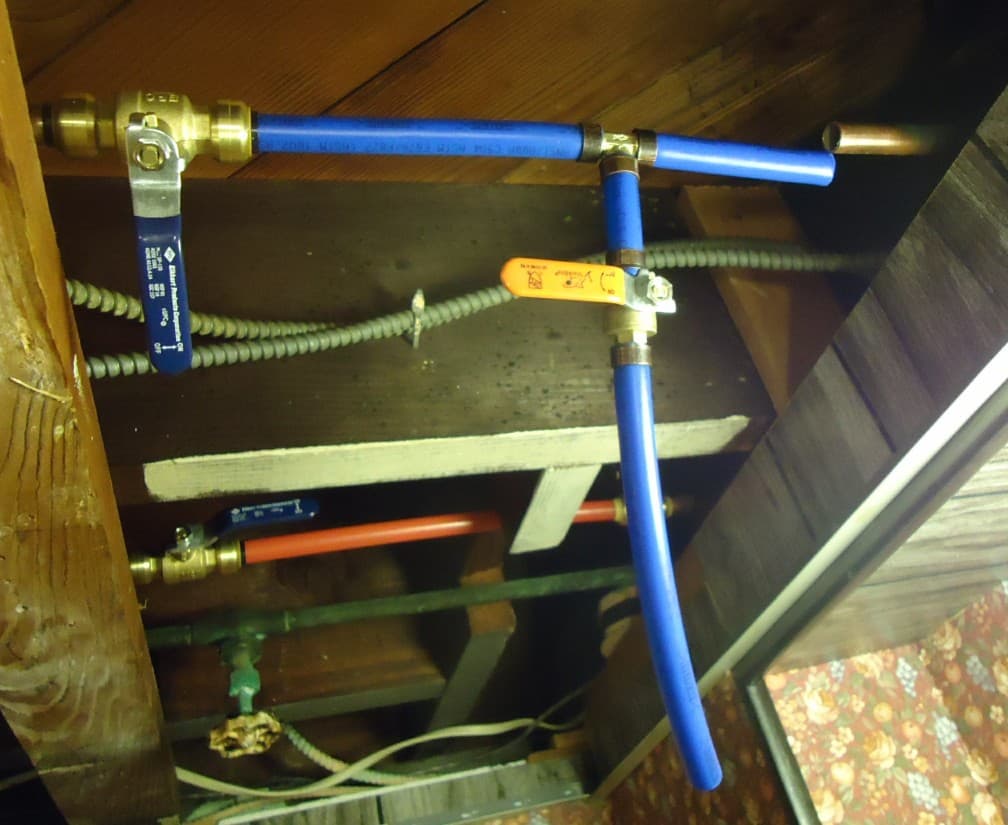
What the work looks like in your house
Expect the crew to protect floors and furniture, then open small holes in drywall near fixtures and along the planned routes. Pipe is run through basements, crawlspaces, attics and walls, and each fixture and the water heater is connected to the new lines. The new system is pressure tested and inspected, the house is switched over, and the old supply pipe is taken out of service.
In many homes the water stays on for much of the job and is off while connections are made, so ask for a day-by-day plan. The openings then have to be patched; whether that includes texture and paint is one of the most common gaps between quotes. What drives the price is covered in what it costs to repipe a house in Virginia.
Who can do it
Virginia's plumbing contractor (PLB) classification covers the installation, alteration and removal of piping in connection with water supply systems within or adjacent to a building,[8] and for that classification the Board for Contractors requires the firm's qualified individual to hold a master plumber tradesman licence issued by the Board.[9] Check the licence yourself: the Board warns that "A license number in an advertisement or on a business card does not necessarily mean the contractor's license is valid."[10] Our guide to checking a contractor's licence in Virginia shows how.
When to call a licensed pro
Call a licensed plumbing contractor for any repipe, and call sooner rather than later if you see repeated leaks, rusty or blue-green stained water, falling pressure at several fixtures, or polybutylene or galvanized pipe in a house you plan to keep. Repiping is permit work on the system that supplies your drinking water, it runs through walls near wiring and framing, and it is inspected before it is closed up. A single burst pipe is an emergency for a plumber today; the repipe can be planned once the water is under control.
Find a licensed plumber
Loclis lists licensed businesses from Virginia's DPOR register with their licence number and class. Browse repiping services, look up plumbers in Blacksburg, or read more plumbing answers. When you are ready, describe the job once and licensed local businesses quote it.
Common questions
- Do I need a permit to repipe a house in Virginia?
- Yes. The Uniform Statewide Building Code requires a permit before work that alters a building's water supply and distribution system, and the ordinary-repair exemption only covers swapping fixtures without altering that system. Your plumbing contractor should apply for it in its own name and give you a copy before work starts.
- Will I have water while the house is repiped?
- Usually for most of the job. New lines are typically run while the old ones still work, and the water is off when the plumber connects fixtures and switches the house over. Ask the contractor how many days you will be without water and when.
- Should I choose PEX or copper?
- Both are common choices for the water lines in a home. PEX is sold in copper tube sizes and carries a printed chlorine and sunlight rating, but it has to be kept out of sunlight. Copper is the traditional choice. If your water is acidic, fix the water as well, because new copper will corrode in it too.
- Does repiping include the line from the street?
- Not always. Many quotes cover only the pipes inside the house, from the main shutoff onward. If your service line is old galvanized steel or lead, ask your water utility what it owns and replaces, and get the service line priced separately on the quote.
- Who patches the walls after a repipe?
- It depends on the contract. Some plumbing contractors patch the openings, some leave them for a drywall and painting contractor. Ask exactly what is included, down to texture and paint, and get it in writing.
Sources
- [1] Household Water Quality: Iron and Manganese in Household Water (442-656), Virginia Cooperative Extension, Virginia Tech. Checked October 26, 2026.
- [2] Virginia Household Water Quality Program: Corrosive Household Water (442-665), Virginia Cooperative Extension, Virginia Tech. Checked October 26, 2026.
- [3] Basic Information about Lead in Drinking Water, U.S. Environmental Protection Agency. Checked October 26, 2026.
- [4] Polybutylene Service and Valve Replacements (CI 5688 & CI 5689), City of Thousand Oaks, California, via CEQAnet. Checked October 27, 2026.
- [5] TD-PF: Viega PureFlow PEX Tubing technical data, Viega LLC. Checked October 27, 2026.
- [6] 13VAC5-63-80, Virginia Uniform Statewide Building Code: Section 108 Application for permit, Virginia Administrative Code, Legislative Information System. Checked October 26, 2026.
- [7] 13VAC5-63-130, Virginia Uniform Statewide Building Code: Section 113 Inspections, Virginia Administrative Code, Legislative Information System. Checked October 27, 2026.
- [8] 18VAC50-22-20, Board for Contractors Regulations: Definitions of license classifications, Virginia Administrative Code, Legislative Information System. Checked October 26, 2026.
- [9] 18VAC50-22-61, Board for Contractors Regulations: Qualifications for classifications and specialties, Virginia Administrative Code, Legislative Information System. Checked October 27, 2026.
- [10] What You Should Know Before You Hire a Contractor, Virginia Board for Contractors, DPOR. Checked October 26, 2026.
Want a pro to handle it?
Describe the job once. Licensed local businesses send quotes, and you pay only when you book one.
Get a quote for Plumbing Repair