Why does my tap water look rusty?
Rusty tap water is usually iron. It comes from one of four places: corroding galvanized steel or iron pipes in the house, a water heater rusting inside, iron dissolved in well water, or sediment stirred up in the public mains. Whether it shows in hot water only, at every tap, or only after the water sits narrows down which one.
Free to ask. Local shops send quotes, and you pay only when you book one.
By Kasra Taheri, Founder, LoclisPublished
Researched and drafted with AI, then checked claim by claim against the sources listed below before it was published. Prices and rules change; the dates beside each source say when it was last checked.
This is a job for a licensed pro in Virginia
This page explains what the work involves, the permits, what a licensed pro does and what drives the cost. It does not give step-by-step instructions, because this work needs a licence, a permit or both, and doing it wrong can injure someone. Before you hire, check the licence on Virginia's DPOR record.
The short answer
Rusty, brown or orange tap water is usually iron. The EPA lists the signs of too much iron as "rusty color; sediment; metallic taste; reddish or orange staining".[2] The EPA's secondary, or nuisance, standard for iron is 0.3 milligrams per liter,[2][1] a guideline for appearance and taste rather than a health limit.
The iron comes from one of four places: the public water mains, your water heater, the pipes in your house, or, on a private well, the groundwater itself. Where and when the color shows tells you which.
Narrow it down by where it shows
- Hot water only. If the cold taps run clear, look at the water heater. ENERGY STAR says "rust in the water is usually a sign that the interior of the water heating system is corroding and breaking down."[3] Not every brown tint is rust, though: A. O. Smith says brown discolored water from the hot water faucet is a sign of non-harmful bacteria in the tank, and that it may come with a sulfur-like smell.[4] Our page on why water smells like rotten eggs covers that case.
- Every tap, hot and cold, all at once. This points to the public system, especially after a water main break, nearby construction or hydrant flushing. Prince William Water, for example, flushes its mains each spring by briefly opening fire hydrants,[5] and explains: "Sometimes, the flushing process causes short-term cloudiness in water mains by stirring minerals and sediments. Please run cold water from your tap until the cloudiness goes away if you have this problem."[5] Hold off on laundry until it clears, and call your utility if it does not.
- Cold taps too, worst first thing in the morning or after a trip. This usually means the house's own pipes. "Corroding iron or galvanized steel pipes may also be a source of iron in household water."[1] Prince William Water notes that "Older plumbing might have a metallic aftertaste due to copper and iron corrosion."[6] and that "Hot water, poor plumbing, or stagnant water conditions (as when a house is closed for lengthy periods of time) can accelerate plumbing corrosion."[6] That is why the first water of the day from old galvanized pipe is often the worst.
- One or two taps only. A single rusty fixture may have an old galvanized section or fitting on its branch, while the rest of the house has been replaced.
On a private well
On a well, the iron may come from the rock the water passes through. A clear glass of water left to stand helps tell the forms apart. Water that comes out clear but forms rust-colored particles that settle when it stands has dissolved iron in it,[1] while water that is already red, brown or yellow when it comes out of the tap carries iron in particles,[1] which can come from the groundwater or from corroding pipes and equipment.[1] And red-brown slime in a toilet tank points to iron bacteria.[1]
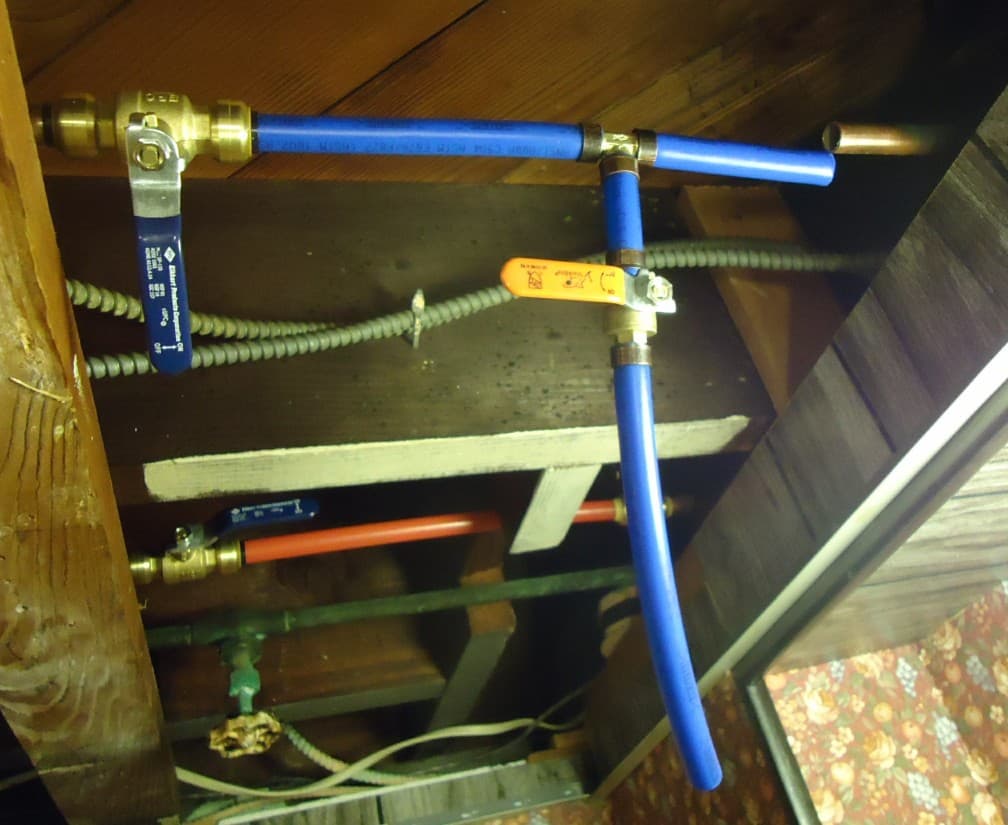
Corrosive, acidic well water makes everything worse, because it eats metal pipe from the inside. See how long copper and PEX pipes last for what that does to plumbing.
Is it safe?
Iron itself is mostly a nuisance. Extension says "Typically, neither iron nor manganese presents a health risk to humans when present in a household water supply",[1] although people with hemochromatosis may be especially sensitive to iron in drinking water.[1] It is hard on laundry: iron stains on laundry and fixtures are generally not easily removed by soaps and detergents, and chlorine bleach can make them worse.[1]
The more important question is what else the corrosion is releasing. The EPA says "Lead pipes are more likely to be found in older cities and homes built before 1986."[8] Extension recommends testing for metals like lead and copper when household water is corrosive.[7] If your house is older and the water looks rusty, have it tested for lead as well as iron.
Get the water tested
A lab test turns a guess into a plan. "Measurement of iron and manganese is most accurately made by a certified laboratory."[1] Your utility can often tell you whether it has had complaints in your area. On a well, your local Extension office can point you to certified labs.
What fixes it
The fix depends on the source:
- Utility sediment usually clears on its own once the mains settle.
- A water heater that is rusting inside may be near the end of its life; a licensed plumber can tell you whether it needs replacing. See how often a water heater should be flushed for upkeep.
- Iron in well water is treated, not piped away. Extension says an ion exchange water softener can usually remove iron and manganese at a combined 5 mg/L or less,[1] and an oxidizing filter can treat combined concentrations up to 15 mg/L.[1] Our guide to what water treatment system you need walks through the choice.
- Corroding galvanized pipe does not get better. A filter can catch the particles, but the pipe keeps rusting from the inside, and pressure often falls as it does. The lasting fix is replacing the pipe; see what repiping a house involves.
Virginia's maintenance code also sets the floor for the condition of the system: "All water supply systems shall be free from obstructions, defects, and leaks."[9]
When to call a licensed pro
Call a licensed plumber when the rust is in the hot water only, when cold taps keep running rusty, when pressure is dropping or pipes are leaking, or when a lab test shows lead. Water heater work involves gas or electrical connections and a pressure vessel, and pipe replacement is permit work; Virginia's plumbing contractor (PLB) classification covers piping, fixtures and appliances in connection with hot water heaters and water supply systems.[10] If every tap went brown at once, call your water utility first.
Find a licensed plumber
Loclis lists licensed businesses from Virginia's DPOR register with their licence number and class. Browse repiping services, look up plumbers in Blacksburg, or read more plumbing answers. When you are ready, describe the job once and licensed local businesses quote it.
Common questions
- Is rusty tap water safe to drink?
- Iron itself is a nuisance rather than a health risk for most people: the EPA's standard for it is for color, taste and staining. People with hemochromatosis may be more sensitive. The bigger question is what else corroding pipes release, so in an older home test for lead too.
- Why is only my hot water rusty?
- When the cold water is clear and only the hot is brown or rusty, the water heater is the likely source. Rust can mean the tank is corroding inside; brown water with a sulfur smell can mean bacteria in the tank. Have a licensed plumber look at it, especially if the heater is old.
- Why is my water rusty after the city worked on the main?
- Work on the mains and hydrant flushing stir up sediment. Prince William Water, for one, advises running the cold tap until cloudiness clears and contacting its customer service if it persists. Avoid doing laundry until the water runs clear.
- Can a water filter fix rusty water?
- Sometimes. Particles from corroding pipes can be caught by a particle filter, and dissolved iron in well water can be treated with a softener or an oxidizing filter depending on the level. A filter does not fix pipes that are rusting away, and treatment should follow a lab test.
- Do rusty pipes mean I need to repipe?
- Not by themselves, but persistent rusty water at several cold taps in a house with galvanized steel supply pipe is a common reason homes are repiped, especially when pressure is falling too. A licensed plumber can confirm the pipe material and its condition.
Sources
- [1] Household Water Quality: Iron and Manganese in Household Water (442-656), Virginia Cooperative Extension, Virginia Tech. Checked October 26, 2026.
- [2] Secondary Drinking Water Standards: Guidance for Nuisance Chemicals, U.S. Environmental Protection Agency. Checked October 26, 2026.
- [3] ENERGY STAR Heat Pump Water Heater fact sheet, ENERGY STAR, U.S. EPA and DOE. Checked October 26, 2026.
- [4] Water Heater Temperature Setting, A. O. Smith. Checked October 26, 2026.
- [5] Annual Water Distribution System Flushing Program, Prince William Water. Checked October 26, 2026.
- [6] Water Quality: How To, Prince William Water. Checked October 26, 2026.
- [7] Virginia Household Water Quality Program: Corrosive Household Water (442-665), Virginia Cooperative Extension, Virginia Tech. Checked October 26, 2026.
- [8] Basic Information about Lead in Drinking Water, U.S. Environmental Protection Agency. Checked October 26, 2026.
- [9] 13VAC5-63-530, Virginia Uniform Statewide Building Code, Part III Maintenance: Chapter 5 Plumbing requirements, Virginia Administrative Code, Legislative Information System. Checked October 26, 2026.
- [10] 18VAC50-22-20, Board for Contractors Regulations: Definitions of license classifications, Virginia Administrative Code, Legislative Information System. Checked October 26, 2026.
Want a pro to handle it?
Describe the job once. Licensed local businesses send quotes, and you pay only when you book one.
Get a quote for Plumbing Repair