How much does it cost to repipe a house in Virginia?
There is no single Virginia price for repiping a house, and a quoted average would mislead you. The cost follows the number of bathrooms and fixtures, how easily the plumber can reach walls and ceilings, the pipe chosen, and whether the permit, the service line and wall patching are included. Compare written quotes from licensed plumbing contractors built on the same scope.
Free to ask. Local shops send quotes, and you pay only when you book one.
By Kasra Taheri, Founder, LoclisUpdated
Researched and drafted with AI, then checked claim by claim against the sources listed below before it was published. Prices and rules change; the dates beside each source say when it was last checked.
This is a job for a licensed pro in Virginia
This page explains what the work involves, the permits, what a licensed pro does and what drives the cost. It does not give step-by-step instructions, because this work needs a licence, a permit or both, and doing it wrong can injure someone. Before you hire, check the licence on Virginia's DPOR record.
The short answer
There is no fair single number for repiping a house in Virginia. Two houses of the same size can be priced far apart because one has an open basement and the other has finished ceilings over a slab. What you can control is the quality of the quotes: get two or three licensed plumbing contractors to price the same scope, in writing, after they have looked at the house.
If you are still deciding whether you need a repipe at all, start with what repiping a house involves.
What drives the price
- Number of fixtures and bathrooms. Every sink, toilet, tub, shower, hose bib, washer box, ice maker and the water heater is a connection to make. More bathrooms means more pipe and more connections.
- Access. An unfinished basement or a roomy crawlspace lets the crew run pipe along open joists. Finished ceilings, plaster walls, tight crawlspaces or a slab foundation mean more openings, more time and more patching.
- Number of floors. Getting pipe up to a second or third floor usually means more wall openings and longer runs.
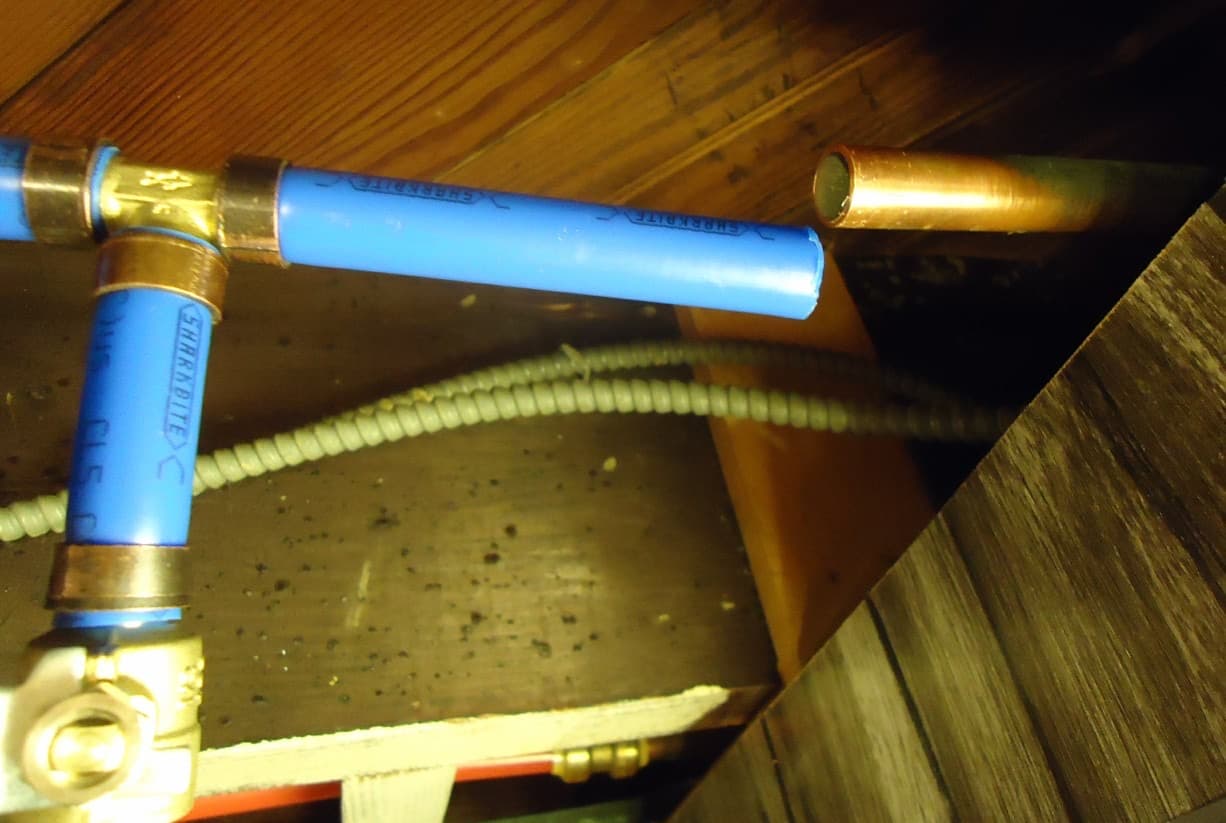
- Pipe material. PEX and copper are priced differently, and the labor differs too. Flexible PEX bends around corners instead of needing an elbow at each turn, so it can often be fished through walls with fewer openings. Copper has more fittings and joints.
- Layout. A manifold with a separate line to each fixture uses more tubing than a trunk-and-branch layout but fewer fittings. Ask which one the quote assumes.
- Valves and extras. A new main shutoff valve, individual shutoffs at fixtures, a pressure-reducing valve or an expansion tank may or may not be in the base price.
- Patching and finish work. Some quotes include drywall patching, texture and paint; many do not.
- The permit. Every repipe needs one. Virginia's building code requires a permit before installations or alterations involving a building's water supply and distribution system,[1] and the fee depends on your county or city.
Permit fees
Permit fees are set locally. As one example, when we checked Montgomery County's fee schedule on October 26, 2026, it listed a residential plumbing trade permit at $0.03 per square foot with a $45 minimum.[2] The county bases its fees on Gross Building Area unless it says otherwise, adds a Virginia state levy of 2% of each fee and a technology fee of 2% with a $10 minimum on top of application fees, and notes that the building official may assess other or additional fees.[2] The full schedule is the place to work out a total. Other localities charge differently, so ask for the fee to appear as its own line on the quote.
The Board for Contractors is clear about who should handle it: "The contractor should apply for and obtain any necessary building permits."[6] The same guide warns that if the contract does not spell this out, "you may be held legally responsible for failure to obtain any required permits."[6]
Costs that sit outside a typical repipe quote
The service line. Many repipes start at the main shutoff inside the house. The pipe from the meter or the well to the house is a separate job with digging involved. If it may be lead or galvanized, ask your water utility first; the EPA notes that some states and utilities pay for water testing or lead service line replacement.[4]
Water treatment. If your copper failed because of acidic water, a repipe alone will not fix the cause. Extension warns that a new pipe material does not make the water any less corrosive,[3] and that untreated corrosive water keeps corroding the metal parts of water heaters and other water-using appliances.[3] Budget for a water test and, if needed, treatment; see what water treatment system you need.
Hidden damage. Old leaks can leave rotten subfloor or mold behind a wall. A good contract says how the crew will handle what they find and how it will be priced.
Comparing quotes
Virginia law requires all licensed contractors to provide a written contract for residential work.[6] For a repipe, make sure each quote states:
- the pipe material, layout and brand, and where the new system starts and ends;
- every fixture and appliance being reconnected, and any new shutoff valves;
- who pulls the permit and what the fee is;
- how many days the job takes and when the water will be off;
- whether patching, texture and paint are included, and to what standard;
- what happens if the crew finds rot, mold or a failing service line;
- the warranty on the pipe and on the work.
If you plan to hire a painter or do the patching yourself, say so: "If you intend to do some of the work yourself or hire another contractor to do it, this also should be written into the contract."[6] On payment, the Board's rule of thumb is a first deposit of no more than 10% of the total price or $1,000, whichever is less.[6]
A much lower quote often leaves something out: the permit, the patching, or a few fixtures. Line the quotes up against the list above before you compare totals.
When to call a licensed pro
Repiping is licensed, permitted work. Virginia's plumbing contractor (PLB) classification covers the installation, alteration and removal of piping in connection with water supply systems within or adjacent to a building,[5] so get your quotes from licensed plumbing contractors and check each licence before you sign; our guide to checking a contractor's licence shows how. Call promptly if you are seeing repeated leaks or rusty water, because water damage in walls and ceilings adds to the bill. If a pipe has burst, have it repaired first; the repipe can be planned afterwards. Our page on what fixing a water leak costs covers the repair side.
Get quotes
Loclis lists licensed businesses from Virginia's DPOR register with their licence number and class. Browse repiping services, look up plumbers in Blacksburg, or read more plumbing answers. When you are ready, describe the job once and licensed local businesses quote it.
Common questions
- Is PEX cheaper than copper for a repipe?
- It can be. PEX needs fewer fittings and can often be fished through walls with fewer openings, which can save labor and patching. Ask each contractor to price both if you are undecided, on the same layout, so you can see the real difference for your house.
- Does the repipe price include fixing the drywall?
- Sometimes. Some plumbing contractors patch the openings, others leave them for a drywall and painting contractor. It is one of the largest differences between quotes, so ask whether patching, texture and paint are included and put the answer in the contract.
- How much is the permit for a repipe?
- It depends on your county or city. As one example, when we checked Montgomery County's fee schedule on October 26, 2026, a residential plumbing trade permit was charged per square foot of gross building area with a $45 minimum, plus a state levy and a technology fee, and the building official may assess other fees. Check the county's full schedule, and ask your contractor to show the permit fee on the quote.
- Can I save money by repiping only part of the house?
- Sometimes, if the problem is confined to one area or one material. But a partial repipe leaves old pipe in service, and the leaks may simply move. Ask the plumber to explain in writing why a partial job is or is not sensible for your system.
- Will a new water heater be part of the job?
- Only if you ask for it. A repipe reconnects the existing water heater to the new lines. If yours is old, it may make sense to price a replacement at the same visit, but have it priced as a separate line item and ask the contractor whether your building department needs a separate permit for it.
Sources
- [1] 13VAC5-63-80, Virginia Uniform Statewide Building Code: Section 108 Application for permit, Virginia Administrative Code, Legislative Information System. Checked October 26, 2026.
- [2] Permit & Inspection Fees, Montgomery County, Virginia, Building Permits & Inspections. Checked October 26, 2026.
- [3] Virginia Household Water Quality Program: Corrosive Household Water (442-665), Virginia Cooperative Extension, Virginia Tech. Checked October 26, 2026.
- [4] Protect Your Tap: A Quick Check for Lead, U.S. Environmental Protection Agency. Checked October 26, 2026.
- [5] 18VAC50-22-20, Board for Contractors Regulations: Definitions of license classifications, Virginia Administrative Code, Legislative Information System. Checked October 26, 2026.
- [6] What You Should Know Before You Hire a Contractor, Virginia Board for Contractors, DPOR. Checked October 26, 2026.
Want a pro to handle it?
Describe the job once. Licensed local businesses send quotes, and you pay only when you book one.
Get a quote for Plumbing Repair