How long do copper and PEX pipes last?
Neither has a fixed lifespan. PEX is rated by its maker for chlorine and sunlight resistance and for the temperature and pressure it can take, and it lasts when it stays inside those limits. Copper has no comparable rating; it lasts as long as the water lets it, and acidic, corrosive water shortens its life. Very hot water, high pressure and sunlight shorten the life of PEX.
Free to ask. Local shops send quotes, and you pay only when you book one.
By Kasra Taheri, Founder, LoclisUpdated
Researched and drafted with AI, then checked claim by claim against the sources listed below before it was published. Prices and rules change; the dates beside each source say when it was last checked.
This is a job for a licensed pro in Virginia
This page explains what the work involves, the permits, what a licensed pro does and what drives the cost. It does not give step-by-step instructions, because this work needs a licence, a permit or both, and doing it wrong can injure someone. Before you hire, check the licence on Virginia's DPOR record.
The short answer
Neither copper nor PEX comes with an expiry date. PEX is rated by its maker for how much chlorine, heat, pressure and sunlight it can take, and it lasts when the house stays inside those limits. Copper has no equivalent rating. It can serve for a very long time in balanced water and fail early in acidic water.
Either way, how long your pipes last depends less on the label than on four things you can manage: water chemistry, water pressure, water temperature, and protection from sunlight and freezing.
PEX: what the ratings mean
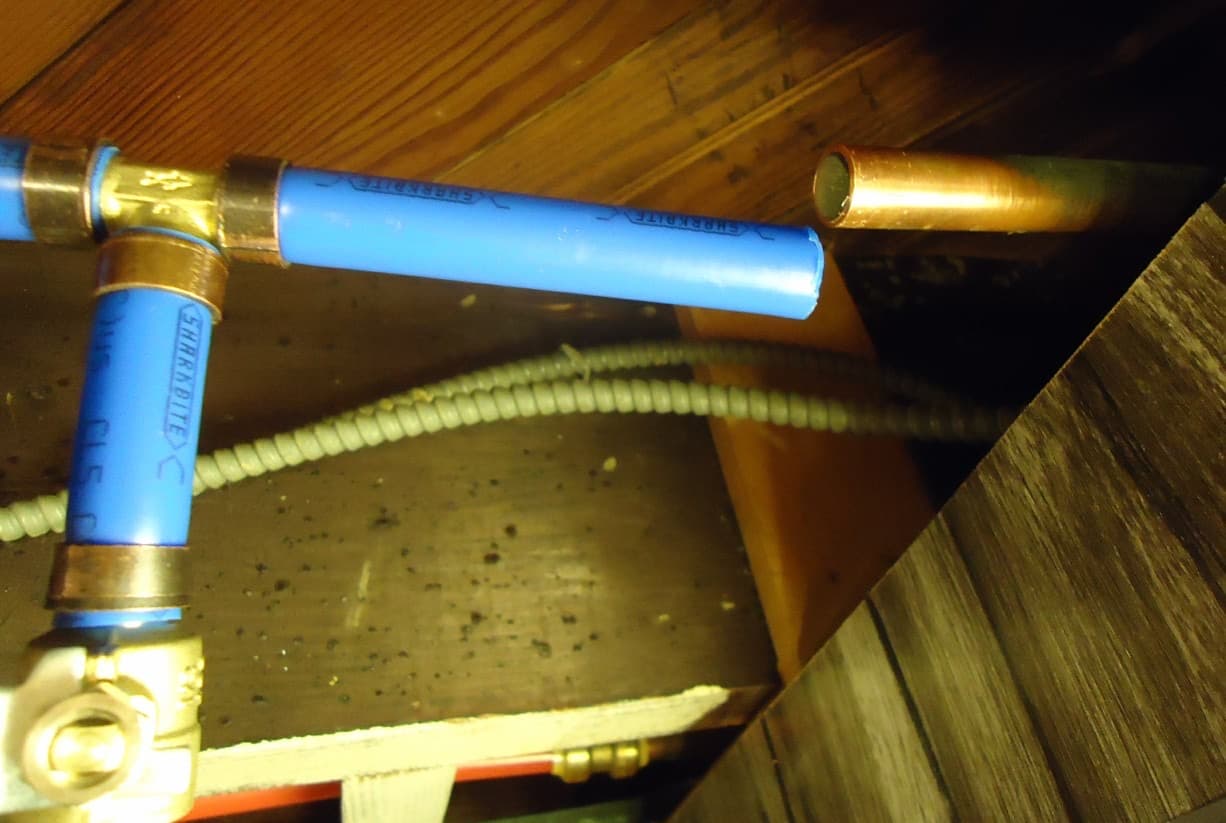
PEX does not carry a lifespan; it carries ratings. One major maker, Viega, says the antioxidant blend and UV stabilizers within the resin are responsible for ensuring that the tubing will not lose its physical strength or its long-term chlorine/ORP resistance,[1] as long as it is used within its limits. Its PureFlow tubing is marked with a plastic tubing material designation code,[1] and PEX 5306 is an example. Read the code like this:
- First digit, chlorine resistance. The 5 means the tubing is "Rated to NSF-pw (CL5) chlorine resistance for use in continuous domestic hot water circulation systems (up to a 140°F water temperature)".[1] A house with a recirculation loop needs tubing rated for it.
- Second digit, sunlight. The 3 means the tubing is "Rated to the highest UV resistance rating (6 months) according to ASTM F2657."[1] Six months is the allowance for storage and installation, not for permanent daylight.
- Pressure and temperature. Design temperature and pressure ratings for Viega PureFlow PEX are 160 psi at 73°F, 100 psi at 180°F, and 80 psi at 200°F.[1] Household plumbing sits well inside those numbers.
What shortens PEX life:
- Running it too hot or too hard. Tubing is only rated for the temperature and pressure on its label, and a recirculation pump running around the clock or a hot setting on the water heater uses up that margin.
- Sunlight. Because the UV allowance is measured in months, PEX should not run where daylight reaches it, such as under a deck or through a window well. Brands differ, so read the markings on your tubing.
Copper: it depends on your water
Copper does not wear out on a schedule; it corrodes when the water attacks it. Virginia Cooperative Extension says that while several factors make water corrosive, the primary determining factor is the water's pH.[2] On wells, in private water systems low pH (below 6.5) is the more common problem,[2] and corrosive water turns up most often in the Blue Ridge and parts of the Piedmont.[2] For reference, "The EPA recommends that drinking water be noncorrosive, within a pH range of 6.5 to 8.5."[2]
The early signs of copper under attack are easy to see. Extension describes "blue-green staining on sinks, tubs, or laundry caused by dissolved copper",[2] and Prince William Water notes that "Older plumbing might have a metallic aftertaste due to copper and iron corrosion."[3] Small leaks in more than one place can follow.
Older copper has a second issue: what holds it together. The EPA says that in homes without lead service lines, "the most common problem is with brass or chrome-plated brass faucets and plumbing with lead solder."[4] and that "Lead pipes are more likely to be found in older cities and homes built before 1986."[4] If your copper is from that era, have the water tested for lead.
Keeping either kind going longer
Know your water. On a well, a lab test for pH, hardness, copper and lead tells you whether your copper is at risk. If the water is corrosive, the usual fix is treatment such as acid-neutralizing filters, typically installed where the water enters the house.[2] Switching to PEX protects the pipes, but a new pipe material does not make the water any less corrosive,[2] so the water heater and other metal parts still suffer. Our guide to what water treatment system you need helps with the choice.
Keep pressure in range. High pressure strains every joint and fixture. A. O. Smith says household water pressure should be 50-60 PSI and no higher than 80 PSI.[5] A plumber can check it with a gauge and fit or adjust a pressure-reducing valve if it runs high.
Keep hot water at a sensible setting. PEX recirculation ratings top out at 140°F water. A very hot setting or a recirculation pump running around the clock is worth discussing with your plumber.
Protect pipes from freezing. Freezing is one of the quickest ways to end a pipe's life early. The Department of Energy advises that pipes placed in exterior walls be insulated, with insulation installed behind them and the wall cavity air-sealed.[6] Unheated crawlspaces and garages deserve the same attention.
Look once a year. Check exposed pipes for green crust, drips or stains, and watch the water meter with every fixture off to catch hidden leaks. Our once-a-year leak check walks through it.
When to call a licensed pro
Call a licensed plumber when you see leaks in more than one place, blue-green stains or a metallic taste, a sudden change in pressure, or green crusting on copper fittings; when a water test shows low pH, copper or lead; or when your pressure reads above 80 PSI. Changing pipe, valves or a pressure regulator is licensed work: Virginia's plumbing contractor (PLB) classification covers the installation, maintenance, extension, alteration and removal of piping in connection with water supply systems.[7] If the system is failing, read what repiping a house involves and what it costs in Virginia.
Find a licensed plumber
Loclis lists licensed businesses from Virginia's DPOR register with their licence number and class. Browse repiping services, look up plumbers in Blacksburg, or read more plumbing answers. When you are ready, describe the job once and licensed local businesses quote it.
Common questions
- How long does PEX last?
- There is no single number. PEX is rated for chlorine resistance, sunlight exposure, temperature and pressure, and it lasts when your house stays within those limits. Your water, pressure, hot water temperature and installation decide the real result. Ask your plumber which rated tubing they are installing.
- Does copper last longer than PEX?
- It can, in the right water. Copper has a long record in homes with balanced water, but acidic water corrodes it, while PEX does not corrode. Ask a plumber which suits your water, and have the water tested first.
- What are the signs that copper pipes are failing?
- Blue-green stains on sinks and tubs, a metallic taste, small leaks at more than one spot, and green crusting on pipes or fittings. Have the water tested for pH, copper and lead, and have a licensed plumber look at the pipes.
- Can PEX be used outdoors or in sunlight?
- Keep PEX out of sunlight. Makers rate their tubing for a limited number of months of UV exposure, and a brand's rating is on its markings and data sheet. Ask your plumber which product they are installing and where.
- What is the code printed on PEX tubing?
- It is the material designation code, such as PEX 5306. The first digit is the chlorine resistance category, and the second is the UV resistance rating. A plumber can match the rating to how your hot water system runs.
Sources
- [1] TD-PF: Viega PureFlow PEX Tubing technical data, Viega LLC. Checked October 27, 2026.
- [2] Virginia Household Water Quality Program: Corrosive Household Water (442-665), Virginia Cooperative Extension, Virginia Tech. Checked October 26, 2026.
- [3] Water Quality: How To, Prince William Water. Checked October 26, 2026.
- [4] Basic Information about Lead in Drinking Water, U.S. Environmental Protection Agency. Checked October 26, 2026.
- [5] Water Heater Not Working? Common Problems and Fixes, A. O. Smith. Checked October 26, 2026.
- [6] Pipes in Exterior Walls, U.S. Department of Energy, Building America Solution Center. Checked October 26, 2026.
- [7] 18VAC50-22-20, Board for Contractors Regulations: Definitions of license classifications, Virginia Administrative Code, Legislative Information System. Checked October 26, 2026.
Want a pro to handle it?
Describe the job once. Licensed local businesses send quotes, and you pay only when you book one.
Get a quote for Plumbing Repair