What does replacing a gas or electric water heater involve?
A replacement means shutting off the fuel or power and water, draining and hauling away the old tank, setting the new one, reconnecting the water lines with a new relief valve, then either the gas line and vent or the electrical circuit, and filling it before it fires. In Virginia it is licensed trade work, and a gas heater gets no automatic permit exemption, even like for like.
Free to ask. Local shops send quotes, and you pay only when you book one.
By Kasra Taheri, Founder, LoclisPublished
Researched and drafted with AI, then checked claim by claim against the sources listed below before it was published. Prices and rules change; the dates beside each source say when it was last checked.
This is a job for a licensed pro in Virginia
This page explains what the work involves, the permits, what a licensed pro does and what drives the cost. It does not give step-by-step instructions, because this work needs a licence, a permit or both, and doing it wrong can injure someone. Before you hire, check the licence on Virginia's DPOR record.
Replacing a water heater is a job for a licensed plumber or HVAC technician, and it follows the same pattern for gas and electric models. The old tank is drained, disconnected and carried out; the new one is set in place, connected to the water lines with a new relief valve, then connected to its fuel (a gas line and vent, or an electrical circuit), filled, started and checked. Virginia's building code gives a gas heater no automatic permit exemption, even like for like, while an electric swap may be exempt.[7]
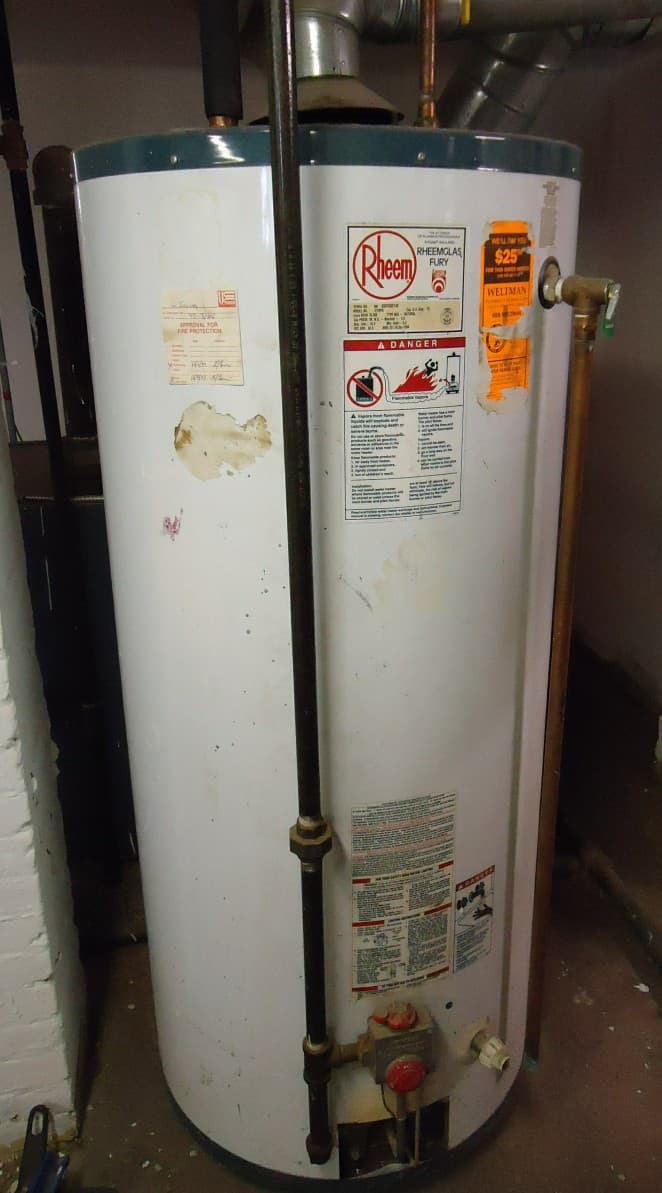
What happens on replacement day
Knowing the sequence helps you read a quote and spot a shortcut.
- The old heater comes out. The installer shuts off the fuel or power and the water, lets the tank cool, drains it and disconnects it. Sediment in the bottom of the tank can keep it from draining fully,[1] which is one reason an old, never-flushed tank can take longer to remove. Hauling it away should be in the price.
- The new heater goes in. It is set level, often in a metal drain pan, and connected to the hot and cold lines.[1]
- Safety parts are new, not reused. Both gas and electric tank heaters have a temperature and pressure (T&P) relief valve, a safety device that opens if the tank is over-pressurized.[3] A. O. Smith's rule is to "never reuse a T&P relief valve"; a new heater should come with its own.[1] Many homes also need an expansion tank, which A. O. Smith says you must have if there is a check valve or pressure-reducing valve on the water line.[2]
- The tank is filled before it fires. For electric models, A. O. Smith says: "Never turn on an empty electric water heater, as this can damage the heating elements."[1] After filling, an electric heater typically takes 1 to 2 hours to heat its first tank.[1]
- Gas units are leak-tested and lit. On a gas heater, the installer checks every gas fitting for leaks, then lights the burner.[1]
Gas and electric: what changes
Gas. A. O. Smith says: "Gas connections require careful attention since improper installation can create serious safety risks."[1] Beyond the gas line itself, the venting has to carry exhaust gases such as carbon monoxide safely outside,[1][2] and A. O. Smith notes that the right vent depends on the type of gas heater,[2] so a different model can mean different venting. Switching from electric to gas where there is no gas line means a professional gas fitter has to run one.[1]
Electric. No vent, but the circuit has to match the new heater. A. O. Smith notes that an older home may need electrical updates to handle the new unit's voltage and amperage.[1] That is electrical work, and the Code's definition of a tradesman includes the electrical trade.[9]
Heat pump (hybrid electric). ENERGY STAR says certified models are "up to four times more efficient than conventional water heaters",[6] and they need room. ENERGY STAR says heat pump water heaters should go in interior spaces that stay between 40° and 90° F year-round with 1,000 cubic feet of air space around them.[5] Because they burn nothing, they do not need venting to remove exhaust gases.[6] If you are considering one, plan ahead: your installer may need time to order the right model.[5]
Choosing the replacement
Start with the capacity of the heater you have, which is printed on its nameplate or yellow EnergyGuide sticker.[5] If that size has been running short, look at the first hour rating as well as gallons. In A. O. Smith's words, "The first hour rating tells you how much hot water a tank can deliver during the first hour of heavy use starting with a full tank."[4] Our guide to why hot water runs out so fast covers sizing problems in more detail.
Age decides whether to replace before failure. ENERGY STAR says: "If your water heater is 10 years old or older, chances are it is heating water inconsistently, or worse—going to altogether fail and flood your home."[6] Replacing on your schedule gives you time to compare quotes and models.
Permits and the inspection
Virginia's Uniform Statewide Building Code requires a permit before work on mechanical systems, fuel supply systems, water supply and distribution systems and any equipment the code regulates.[7] It exempts "Replacement of mechanical appliances provided such equipment is not fueled by gas or oil"[7] in Groups R-3, R-4 and R-5, and in Group R-2 where the equipment serves a single-family dwelling. Because of that gas or oil exclusion, a gas heater gets no automatic exemption, even when the new one matches the old. Fairfax County says: "Gas appliances are not exempt from permit requirements."[8] Fairfax asks for a residential plumbing permit instead of its household appliance permit when new gas piping goes in with the heater.[8]
An electric swap may fall inside the exemption, but your building official decides. For an emergency equipment replacement, the code lets the permit application be filed by the end of the first working day after the work starts.[7] Our water heater permit answer goes through the rules.
When to call a licensed pro
Every part of a replacement is trade work. Under Virginia law, no individual may work as a tradesman without a licence, and the Code's definition of a tradesman covers electrical, plumbing and heating, ventilation and air conditioning work done for the public for pay.[10][9] Water heaters sit with plumbing and HVAC specifically. The Code's liquefied petroleum gas fitter definition reads "excluding hot water heaters, boilers and central heating systems which require a heating, ventilation and air conditioning or plumbing certification", and its natural gas fitter provider definition leaves out "new installation of gas piping for hot water heaters".[9]
Before you sign, check the business's licence. Virginia's Board for Contractors adds: "Virginia law requires all licensed contractors to provide a written contract for residential work."[11] It also advises that the contractor should apply for and obtain the building permits, and that the permit holder takes on responsibility for the job as its general contractor.[11]
Call right away, before any replacement is scheduled, if the old heater is leaking from the tank, the relief valve is discharging, or you smell gas. For a gas smell, leave the house first. Columbia Gas of Virginia tells its customers to "go outside and call 911 and then call us at 1-800-544-5606 (24/7)."[12] If another company supplies your gas, use its emergency number.
Getting it quoted
For what drives the price, see what water heater replacement costs in Virginia, and to keep the new one going, how often a water heater should be flushed. Loclis lists DPOR-licensed businesses with their licence number and class: look up plumbers in Blacksburg or browse more plumbing answers.
Describe your water heater replacement and licensed local plumbers quote it.
Common questions
- How long does a water heater replacement take?
- A like-for-like swap in an easy-to-reach spot is the simplest case. Moving the heater, changing fuel, adding venting or upgrading the electrical service adds work, and a heat pump model may need to be ordered ahead. After the tank is filled, an electric heater typically takes 1 to 2 hours to heat its first tank.
- Do I need a permit to replace a gas water heater in Virginia?
- Usually, yes. Virginia's building code exempts replacing mechanical appliances only when they are not fueled by gas or oil, so a gas water heater gets no automatic exemption, even like for like. An electric swap may be exempt. Your local building department makes the call, so ask before work starts.
- Can I replace a gas water heater with an electric one?
- Often, yes, but the job changes. The old gas line has to be dealt with safely, and the electric heater needs a circuit sized for it, which may mean an electrical upgrade in an older home. Ask for both changes, and who does each, in the quote, and ask about a heat pump model if you have the space.
- Should the new water heater be the same size as the old one?
- The old heater's capacity, printed on its nameplate or EnergyGuide sticker, is a good starting point. If you have been running out of hot water or your household has grown, compare first hour ratings rather than gallons alone.
- What should be replaced along with the water heater?
- The temperature and pressure relief valve comes new with the heater and should never be reused. Depending on your plumbing and local code, a quote may also include an expansion tank, a drain pan, new water connectors and, on a gas unit, venting or gas connector work. Ask which apply and why.
- Who should I hire to replace a water heater in Virginia?
- A licensed plumber or HVAC technician. Virginia law requires a licence for anyone working for pay as a plumbing, HVAC or electrical tradesman, and the Code places water heaters with the plumbing and HVAC trades rather than gas fitters alone. Check the licence on DPOR's lookup and get a written contract that says who pulls the permit.
Sources
- [1] Water Heater Installation Guide: How Do I Install a Gas Water Heater?, A. O. Smith. Checked October 26, 2026.
- [2] Water Heater Replacement Cost, A. O. Smith. Checked October 26, 2026.
- [3] Water Heater Maintenance, A. O. Smith. Checked October 26, 2026.
- [4] Water Heater Sizing Guide, A. O. Smith. Checked October 26, 2026.
- [5] Heat Pump Water Heaters, ENERGY STAR, U.S. Environmental Protection Agency. Checked October 26, 2026.
- [6] ENERGY STAR Certified Heat Pump Water Heaters fact sheet, ENERGY STAR, U.S. Environmental Protection Agency. Checked October 26, 2026.
- [7] 13VAC5-63-80, Virginia Uniform Statewide Building Code, Section 108 Application for permit, Virginia Administrative Code, Legislative Information System. Checked October 26, 2026.
- [8] Household Appliance (HAPL) permit, Residential, Fairfax County Land Development Services. Checked October 26, 2026.
- [9] Va. Code § 54.1-1128, Definitions, Code of Virginia, Virginia General Assembly. Checked October 26, 2026.
- [10] Va. Code § 54.1-1129, Necessity for licensure, Code of Virginia, Virginia General Assembly. Checked October 26, 2026.
- [11] What You Should Know Before You Hire a Contractor, Virginia Board for Contractors, DPOR. Checked October 26, 2026.
- [12] Natural Gas Safety, Columbia Gas of Virginia. Checked October 26, 2026.
Want a pro to handle it?
Describe the job once. Licensed local businesses send quotes, and you pay only when you book one.
Get a quote for Plumbing Repair