Why is my hot water running out so fast?
Usually one of four things: the household now uses more hot water than the tank can deliver, winter has made the incoming water colder, sediment has built up in an ageing tank, or a part has failed, such as a broken dip tube or, on an electric heater, a heating element. A sudden change points to a failed part; a gradual one to sediment or age.
Free to ask. Local shops send quotes, and you pay only when you book one.
By Kasra Taheri, Founder, LoclisPublished
Researched and drafted with AI, then checked claim by claim against the sources listed below before it was published. Prices and rules change; the dates beside each source say when it was last checked.
This is a job for a licensed pro in Virginia
This page explains what the work involves, the permits, what a licensed pro does and what drives the cost. It does not give step-by-step instructions, because this work needs a licence, a permit or both, and doing it wrong can injure someone. Before you hire, check the licence on Virginia's DPOR record.
Hot water that runs out fast usually comes down to four causes: the house is asking for more hot water than the tank can deliver, the incoming water is colder (winter does this every year), sediment in an ageing tank has taken up space, or a part has failed. A broken dip tube can cause it, and so can a failed heating element on an electric heater.[3][2] The pattern of the problem is your best clue: sudden points to a part, seasonal to cold water, gradual to sediment and age.
Start with when it started
It changed overnight. A heater that worked well last week and now gives a short shower has usually lost a part, not suddenly become too small. A. O. Smith makes the same point about undersizing: "if it's been working fine before now, you can typically rule this out as an underlying cause."[3]
It gets worse every winter. That is usually the incoming water. GE says: "The colder inlet water takes longer to heat."[2] It lists long runs of exposed pipe or hot water piping on an outside wall as another cause.[2]
It has crept up over years. Sediment and age are the likely pair. ENERGY STAR notes that "as hot water tanks age, sediment can build up in a way that reduces capacity of the tank".[7] A. O. Smith adds: "A malfunctioning thermostat or sediment buildup inside the tank can happen over time."[3]
It started when the household changed. A new baby, a teenager's long showers, a relative moving in or a new bathroom can outgrow a heater that was fine before.
Is the tank simply too small?
A tank holds a fixed amount and then needs time to reheat. A. O. Smith's rule of thumb: "A standard shower uses roughly 20 gallons, so a 50 gallon tank can generally support two to three consecutive showers before running low."[4] Laundry or the dishwasher running at the same time shortens that.
Recovery time matters too. A. O. Smith suggests planning showers around it: "gas tanks need 30-40 minutes, electric tanks need 60-90 minutes."[5] When you replace, compare the first hour rating, which A. O. Smith describes as how much hot water a tank can deliver during the first hour of heavy use starting with a full tank,[4] rather than gallons alone.
Parts that fail
- The lower heating element (electric). Most electric tank heaters have two elements, an upper and a lower,[6] and A. O. Smith says: "A failed heating element on an electric water heater can cause you to have some hot water, but not enough."[3] A. O. Smith's technician test for this complaint checks the lower element and the dip tube.[1]
- The dip tube. This tube carries cold water to the bottom of the tank. When it cracks or breaks, cold water mixes into the hot water near the top. GE lists a damaged dip tube as a cause of not enough hot water and sends owners to their installer or a plumbing contractor for it.[2]
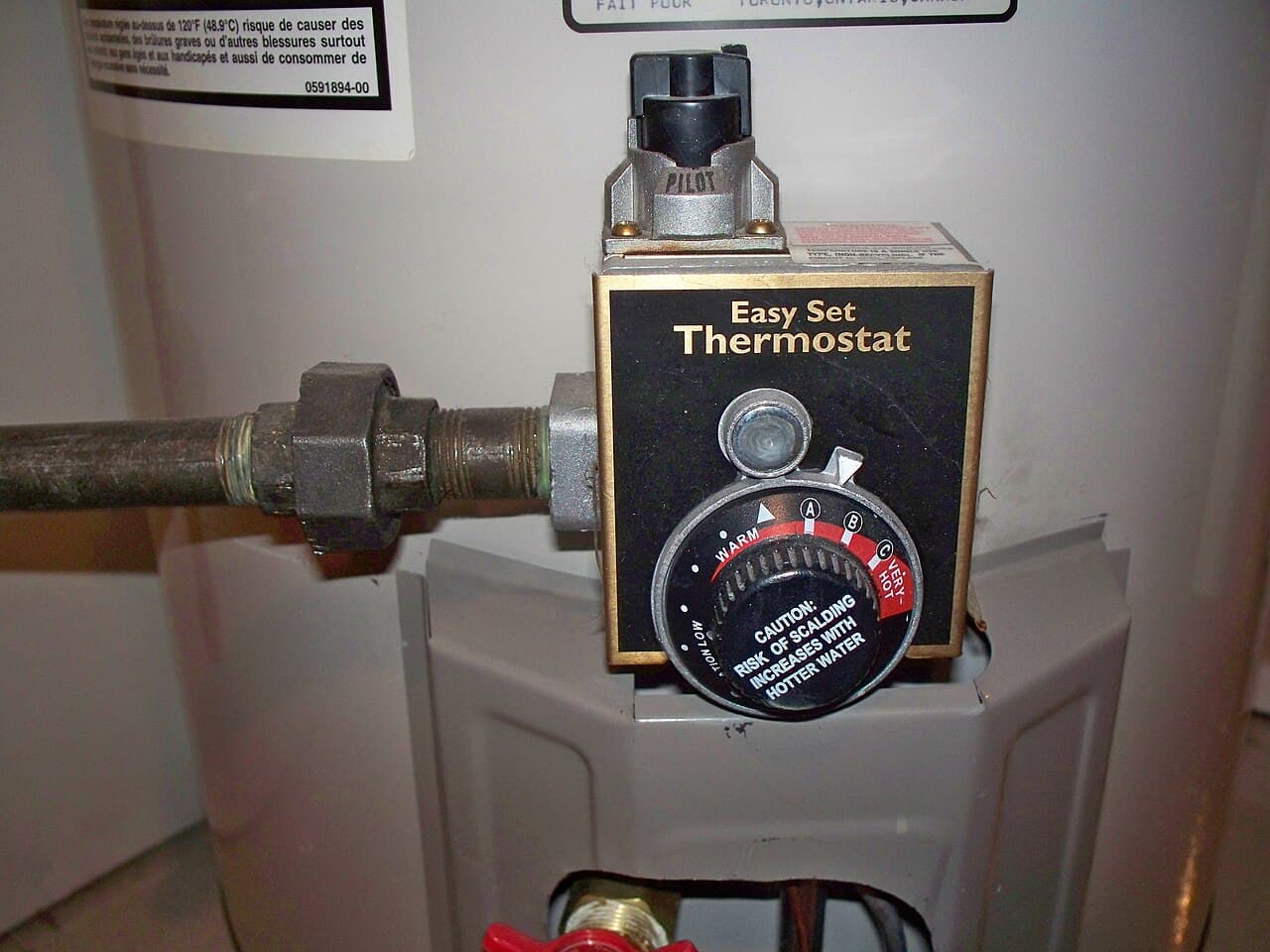
- The thermostat. A. O. Smith lists a malfunctioning thermostat, along with sediment, among the causes that build up over time.[3] On gas heaters the dial is on the gas control valve, as in the photo above.
A. O. Smith also notes a change in newer heaters: they are factory preset at a lower temperature and inlet tubes have been shortened, and both affect the amount of hot water a water heater can supply.[1] A new heater the same size as the old one can feel smaller.
Other things a technician will rule out
GE's checklist includes a leaking or open hot water faucet, water connections reversed at the heater, and interference from a recirculating system.[2] It also names, on a model with an integrated mixing valve, the capacity setting.[2] Reversed connections would show up right after an installation.
Why not just turn it up
Raising the temperature stretches the hot water, but it raises the scald risk. The U.S. Consumer Product Safety Commission urges lowering water heaters to 120 degrees Fahrenheit,[8] and warns: "Burns will also occur with a six-second exposure to 140 degree water or with a thirty second exposure to 130 degree water."[8] A. O. Smith notes that thermostatic mixing valves can control the temperature at the faucet and can increase the amount of usable hot water.[6] If you need more hot water at a safe temperature, ask a plumber about one.
Repair or replace
Age often decides it. Most A. O. Smith water heaters last between 8 and 12 years,[3] and ENERGY STAR warns: "If your water heater is 10 years old or older, chances are it is heating water inconsistently, or worse—going to altogether fail and flood your home."[7] On a younger heater, ask what the failed part costs to replace. On an older one, or a tank that is also leaking or rusting, ask for both quotes. Our guides cover what a replacement involves and what it costs in Virginia, and regular flushing helps keep sediment from coming back.
When to call a licensed pro
Testing elements, thermostats and dip tubes means opening the heater. On an electric model, A. O. Smith warns that water heater components remain live even when the unit isn't actively heating,[5] and on a gas model the burner and control valve are gas work. Under Virginia law, no individual may work as a tradesman without a licence, and the Code's definition of a tradesman covers electrical, plumbing and heating, ventilation and air conditioning work done for the public for pay.[10][9] Check the business on DPOR's License Lookup[11] before it starts.
Call promptly if the short supply comes with rusty water, water around the base or a dripping relief valve. If you smell gas, leave the house first: Columbia Gas of Virginia tells its customers to "go outside and call 911 and then call us at 1-800-544-5606 (24/7)."[12] If another company supplies your gas, use its emergency number.
What you can safely do before the visit: note when the problem started, how many showers you get before it runs cold, the heater's age and size from its label, and whether any hot water tap is dripping. That lets a technician bring the right parts.
Getting it fixed
Loclis lists DPOR-licensed businesses with their licence number and class. Look up plumbers in Blacksburg, or read more plumbing answers.
Describe what your water heater is doing and licensed local plumbers quote the repair.
Common questions
- Why does my hot water run out faster in winter?
- The water coming into the tank is colder, so the same heater takes longer to bring it up to temperature. GE treats this as normal. Long runs of exposed pipe or hot water lines on an outside wall make it worse.
- What is a dip tube, and how do I know it has failed?
- The dip tube carries incoming cold water to the bottom of the tank so it does not mix straight into the hot water at the top. When it breaks, cold water mixes in early and the hot water seems to run out fast. A technician confirms it; GE sends owners to their installer or a plumbing contractor for this.
- My electric water heater gives only a short shower. What is wrong?
- A failed heating element is one possible cause: A. O. Smith says a failed element can leave you with some hot water, but not enough. A. O. Smith's technician test checks the lower element and the dip tube. The elements sit behind panels next to live wiring, so that test is a job for a licensed technician.
- Should I just turn the water heater up?
- Not without thinking about scalds. CPSC urges a setting of 120 degrees Fahrenheit, and says burns will also occur with a thirty second exposure to 130 degree water. If you need more hot water, a bigger heater or a thermostatic mixing valve fitted by a pro is safer than a hotter tank.
- How long should a water heater take to recover?
- A. O. Smith's rule of thumb is 30 to 40 minutes for a gas tank and 60 to 90 minutes for an electric one. If yours takes much longer than that, mention it when you book a technician.
- Is it time to replace my water heater?
- If it is 10 years or older and running short, very possibly. ENERGY STAR warns that heaters that age often heat inconsistently or fail, and most A. O. Smith tanks last 8 to 12 years. Ask for a repair quote and a replacement quote at the same visit.
Sources
- [1] Technical Bulletin #36: Not Enough Hot Water, Electric, A. O. Smith. Checked October 26, 2026.
- [2] Water Heater: Not Enough or No Hot Water, GE Appliances. Checked October 26, 2026.
- [3] When to Repair or Replace a Water Heater, A. O. Smith. Checked October 26, 2026.
- [4] Water Heater Sizing Guide, A. O. Smith. Checked October 26, 2026.
- [5] Water Heater Not Working? Troubleshooting Guide, A. O. Smith. Checked October 26, 2026.
- [6] Water Heater Temperature Setting, A. O. Smith. Checked October 26, 2026.
- [7] ENERGY STAR Certified Heat Pump Water Heaters fact sheet, ENERGY STAR, U.S. Environmental Protection Agency. Checked October 26, 2026.
- [8] Avoiding Tap Water Scalds (CPSC document 5098), U.S. Consumer Product Safety Commission. Checked October 26, 2026.
- [9] Va. Code § 54.1-1128, Definitions, Code of Virginia, Virginia General Assembly. Checked October 26, 2026.
- [10] Va. Code § 54.1-1129, Necessity for licensure, Code of Virginia, Virginia General Assembly. Checked October 26, 2026.
- [11] License Lookup, Virginia Department of Professional and Occupational Regulation. Checked October 26, 2026.
- [12] Natural Gas Safety, Columbia Gas of Virginia. Checked October 26, 2026.
Want a pro to handle it?
Describe the job once. Licensed local businesses send quotes, and you pay only when you book one.
Get a quote for Plumbing Repair