How often should a water heater be flushed?
At least once a year for most tank water heaters, and more often if you have hard water or found a lot of sediment at the last flush. Your heater's manual has the schedule for that model. Tankless heaters are descaled rather than flushed. A yearly service is also the time to check the relief valve and the anode rod.
Free to ask. Local shops send quotes, and you pay only when you book one.
By Kasra Taheri, Founder, LoclisPublished
Researched and drafted with AI, then checked claim by claim against the sources listed below before it was published. Prices and rules change; the dates beside each source say when it was last checked.
This is a job for a licensed pro in Virginia
This page explains what the work involves, the permits, what a licensed pro does and what drives the cost. It does not give step-by-step instructions, because this work needs a licence, a permit or both, and doing it wrong can injure someone. Before you hire, check the licence on Virginia's DPOR record.
Once a year is the standard for a tank water heater. A. O. Smith says: "Most types of tank water heaters require flushing at least once per year."[1] A. O. Smith advises flushing more often with hard water, older pipes, or a lot of buildup at the yearly flush.[2] Rheem adds: "Annual flushing is one of the most effective forms of water heater maintenance."[5] Your heater's manual has the final word, since the right interval depends on the heater's type and model.[3]
Tankless water heaters don't need flushing because they have no tank, though many need descaling.[1] The rest of this page is about tank heaters, gas and electric.
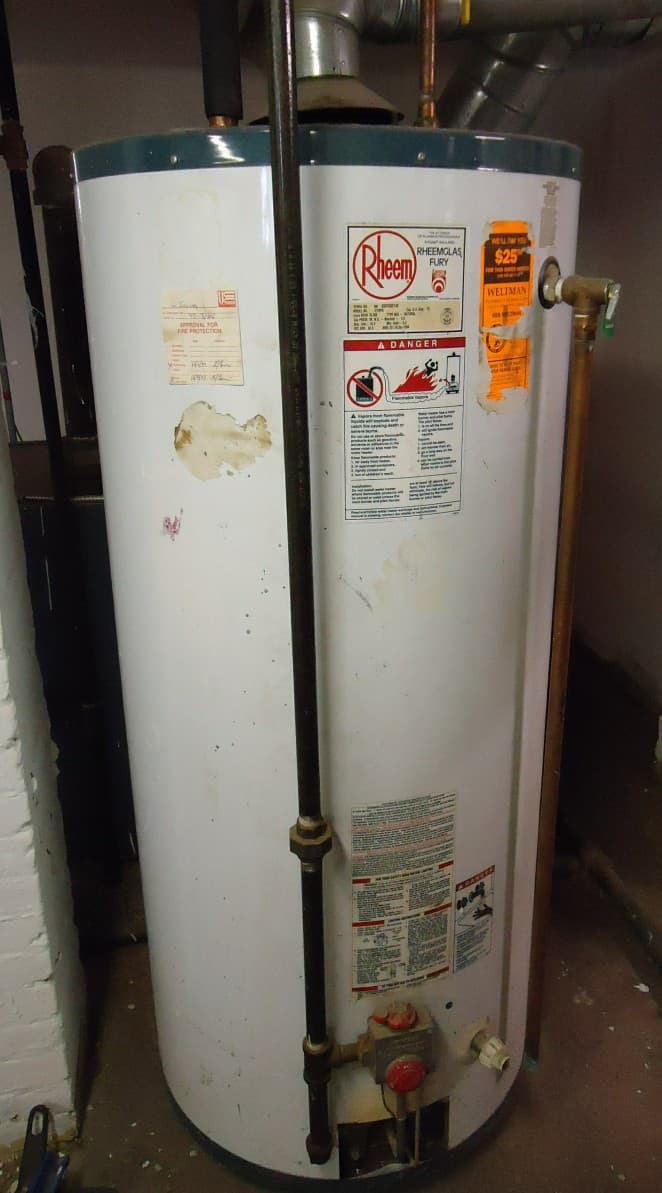
Why the tank needs flushing
Water carries dissolved minerals, and heating it makes them settle. The Department of Energy's Building America guide explains that sediment can collect in the tank over time, leaving mineral deposits on the heating element and reducing its effectiveness in transferring heat to the water.[6] A. O. Smith adds: "Sediment buildup in the tank can reduce your water heater's energy efficiency and also clog your water lines."[1]
You can often hear it. In Rheem's words: "Over time, minerals settle at the bottom of tank-style units, causing the water heater to make a popping noise or rumble as water heats beneath the debris."[5] Our answer on why a water heater makes popping noises covers those sounds. Sediment also takes up room in the tank, one reason hot water can run out faster as a heater ages.
Hard water in Virginia: how to know if you need more
Virginia Cooperative Extension says: "Hard water can also reduce the efficiency and life span of water heaters."[7] And: "Mineral scaling in water heaters can increase heating costs by reducing their efficiency."[7]
How hard your water is depends on where it comes from. If you are on a public system, your water provider can tell you. On a private well, a lab test answers it; Extension says hardness levels less than 7.0 grains per gallon or 120 mg/L generally do not require treatment.[7] If your water tests harder than that and the heater keeps scaling up, plan on flushing more than once a year, and ask about Extension's suggestion to "consider softening only water that is to be heated".[7]
Signs the schedule is too long for your water: popping or rumbling soon after a flush, a lot of sediment coming out at each service, or hot water running short again within months.
A simple habit that helps
A. O. Smith notes that setting the thermostat at 120 degrees Fahrenheit reduces sediment buildup,[4] and that setting also lowers scald risk. If your heater is set hotter, ask the technician about turning it down at the next service.
What a yearly service should include
A flush is the main job, but the same visit is the right time for the other checks the manufacturers recommend:
- The temperature and pressure (T&P) relief valve. A. O. Smith says the valve should be inspected "once a year by the consumer and every 5 years by a professional",[1] per the instructions on the valve's label,[1] and explains why it matters: "If the valve doesn't operate correctly, the tank can over-pressurize and explode."[1] Testing it releases water that A. O. Smith warns "can be very hot",[1] so if you would rather not handle that, ask the technician to include it in a yearly service.
- The anode rod. This rod corrodes so the tank does not. A. O. Smith recommends inspecting the anode rod once a year,[1] and says anode rods usually last only about 5 years and can go sooner depending on the water.[2]
- Heat pump models. ENERGY STAR notes that heat pump water heaters may also need annual maintenance, including changing air filters.[8]
- A look for leaks, rust and venting problems while the heater is open.
If the heater has gone years without a flush, say so when you book. Rheem notes that "in cases of extreme buildup, a professional has the tools to perform a more thorough flush and cleaning,"[5] and A. O. Smith warns that sediment can clog the drain valve and keep the tank from draining.[3]
When to call a licensed pro
A flush means shutting down the heater, draining it and bringing it back into service, and each stage has its hazard. The Building America guide warns that "the water coming out of the tank will be hot."[6] A. O. Smith cautions: "Serious damage to the water heater or components can occur is the water heater is turned on without a full tank."[1] And the same federal guide says a gas heater has to be brought back on by the manufacturer's instructions, because accidentally turning off the pilot light could allow gas to leak into your home.[6] For those reasons Loclis treats water heater service as a job for a licensed pro.
In Virginia, no individual may work as a tradesman without a licence, and the Code's definition of a tradesman covers electrical, plumbing and heating, ventilation and air conditioning work done for the public for pay.[10][9] Check any business on DPOR's License Lookup[11] before it starts.
Call promptly, not at the next annual visit, if water is pooling around the base, the relief valve is dripping or discharging, or the hot water is rusty. If you smell gas, leave the house first: Columbia Gas of Virginia tells its customers to "go outside and call 911 and then call us at 1-800-544-5606 (24/7)."[12] If another company supplies your gas, use its emergency number. If the heater is old, ask for a replacement quote at the same time; see what a replacement involves.
Book the yearly flush
Loclis lists DPOR-licensed businesses with their licence number and class. Look up plumbers in Blacksburg or browse more plumbing answers.
Request a water heater flush and service and licensed local plumbers quote it.
Common questions
- Do I really need to flush my water heater every year?
- A. O. Smith says most tank water heaters need flushing at least once a year, and Rheem calls annual flushing one of the most effective kinds of water heater maintenance. Your manual is the final word for your model.
- How often should I flush with hard water?
- More often than once a year. A. O. Smith advises extra flushes with hard water, older pipes or a lot of buildup at the yearly flush. A water test tells you how hard your water is; Virginia Cooperative Extension treats under 7.0 grains per gallon as generally not needing treatment.
- What happens if a water heater is never flushed?
- Sediment builds up on the bottom of the tank. It can make the heater pop or rumble, coat electric elements, cut efficiency and take up space, so hot water runs out sooner. Heavy buildup can also clog the drain valve, and a technician may need to clean the tank more thoroughly.
- Do tankless water heaters need flushing?
- Not in the same way. A. O. Smith says tankless heaters have no tank to flush, but many need descaling to remove mineral scale from the heat exchanger. The manual gives the interval.
- What else should be checked when the heater is flushed?
- The temperature and pressure relief valve, which A. O. Smith says should be inspected once a year by the owner and every 5 years by a professional, and the anode rod, which it suggests inspecting yearly. Heat pump models may also need their air filter changed.
- Who should flush my water heater?
- A licensed plumber or HVAC technician, especially on a gas heater, an old tank whose drain valve may be clogged, or any heater you have not serviced before. The water comes out hot, an electric tank must be full before its power comes back on, and a gas heater has to be relit correctly.
Sources
- [1] Water Heater Maintenance, A. O. Smith. Checked October 26, 2026.
- [2] Water Heater Making a Noise? Here's What It Means, A. O. Smith. Checked October 26, 2026.
- [3] How to Drain and Flush a Water Heater, A. O. Smith. Checked October 26, 2026.
- [4] Water Heater Temperature Setting, A. O. Smith. Checked October 26, 2026.
- [5] The Ultimate Guide to Water Heater Noises: What's Normal (and What Isn't), Rheem Manufacturing Company. Checked October 26, 2026.
- [6] Flush Water Heater Tank, Building America Solution Center, Pacific Northwest National Laboratory (U.S. Department of Energy). Checked October 26, 2026.
- [7] Virginia Household Water Quality Program: Hardness in Household Water (publication 442-664), Virginia Cooperative Extension, Virginia Tech. Checked October 26, 2026.
- [8] Heat Pump Water Heaters, ENERGY STAR, U.S. Environmental Protection Agency. Checked October 26, 2026.
- [9] Va. Code § 54.1-1128, Definitions, Code of Virginia, Virginia General Assembly. Checked October 26, 2026.
- [10] Va. Code § 54.1-1129, Necessity for licensure, Code of Virginia, Virginia General Assembly. Checked October 26, 2026.
- [11] License Lookup, Virginia Department of Professional and Occupational Regulation. Checked October 26, 2026.
- [12] Natural Gas Safety, Columbia Gas of Virginia. Checked October 26, 2026.
Want a pro to handle it?
Describe the job once. Licensed local businesses send quotes, and you pay only when you book one.
Get a quote for Plumbing Repair