What does a well technician check when a pump stops working?
A good well technician works from the top of the system down: the power and voltage reaching the pump, the pressure switch and control box, the pressure tank and check valves, then electrical tests on the motor and its cable from the surface. Only when those point into the well does the pump come out, so you do not pay to pull a pump that was fine.
Free to ask. Local shops send quotes, and you pay only when you book one.
By Kasra Taheri, Founder, LoclisPublished
Researched and drafted with AI, then checked claim by claim against the sources listed below before it was published. Prices and rules change; the dates beside each source say when it was last checked.
This is a job for a licensed pro in Virginia
This page explains what the work involves, the permits, what a licensed pro does and what drives the cost. It does not give step-by-step instructions, because this work needs a licence, a permit or both, and doing it wrong can injure someone. Before you hire, check the licence on Virginia's DPOR record.
The short version
When a well pump stops, a technician's job is to find the one failed part before spending your money on the expensive one. A careful diagnosis starts where the work is cheapest, with the power supply and the controls in your basement or pump house, and moves down the well only when the readings point there. What follows is the order a good technician usually works through.
Power reaching the pump
The first question is whether the pump is getting the electricity it needs: the voltage at the line terminals must be within 10% of the motor's rated voltage.[1] If it is not, the fix is a call to the power company, not a new pump.[1]
Next come the fuses or breaker for the pump circuit, including loose, dirty or corroded connections in the fuse holder or the wiring.[1] Then the pressure switch. "Improper contact of switch points can cause voltage less than line voltage",[1] so the motor can see too little power even though the breaker is on. If that is the fault, the switch is cleaned or replaced.[1]
The control box
Single-phase, three-wire submersible motors require the use of control boxes,[1] usually mounted on a wall near the tank. Control boxes contain starting capacitors, a starting relay, and, in some sizes, overload protectors, running capacitors, and contactors.[1] Any of those can fail and leave a healthy motor unable to start.
The technician will also confirm the parts belong together, because the control box and motor must match in horsepower and voltage,[1] which matters in an older system where an earlier repair may have mixed parts.
Two things a homeowner rarely hears about but should. First, component tests have limits: a capacitor may test good (not open, not shorted) but may have lost some of its capacitance and no longer be able to perform its function.[1] Second, current readings fill that gap. On a three-wire motor, the current in the start lead should jump briefly and then drop within one second.[1] A failed relay or switch keeps that current high and trips the overload.[1]
These voltage and current checks at the control box are made on live equipment: "Power must be on for these tests. Do not touch any live parts."[1] This is not something to try with a borrowed meter.
Tests on the motor and cable from the surface
If the controls check out, the suspicion moves to the motor and the cable that runs down to it, and the testing still happens at the surface: "Complete these tests before removing the motor from the well".[1] The tests are line-to-line voltage, the current on every motor wire, the insulation resistance from each motor lead to ground, and the winding resistance between leads.[1]
The readings tell a clear story. Measured through the drop cable, a motor in good condition reads 0.5 to 2.0 megohms, and a reading below 0.5 megohm means the insulation is damaged and has to be found and repaired.[1] For winding resistance, "If any one value is less than normal, the motor is shorted",[1] while a higher value means an open winding or cable, or a poor cable joint or connection.[1] A pump that will not turn shows up too: a sand-bound or misaligned pump draws 3 to 6 times its normal current until the overload trips.[1]
The tank, the valves and the well itself
Not every "stopped" pump is dead. Sometimes it runs but delivers little or nothing, or it starts and stops constantly. A motor that starts too often points to a waterlogged tank, a check valve stuck open, a leak, or the pressure switch itself.[1] On the valve: a damaged or defective check valve will not hold pressure.[1] Our guide to a pump that keeps turning on and off covers that pattern.
For a pump that runs without stopping, the causes include low water in the well, where the pump may be drawing more than the well can supply.[1] A technician checks the static and drawdown water levels from the wellhead[1] to tell a weak well from a weak pump, and that distinction is not always easy: the symptoms of a worn pump are similar to those of a leak in the drop pipe or a low water level.[1] Other causes include a blocked intake screen, a check valve stuck closed, or a loose coupling or broken motor shaft.[1]
Your paperwork helps here. In Virginia, if your well was constructed after 1992, a Uniform Water Well Completion Report should be on file with your local health department office, and it lists the total depth of the well and the static water level.[3] With it, a technician knows how much water should be standing above the pump.
When the pump has to come out
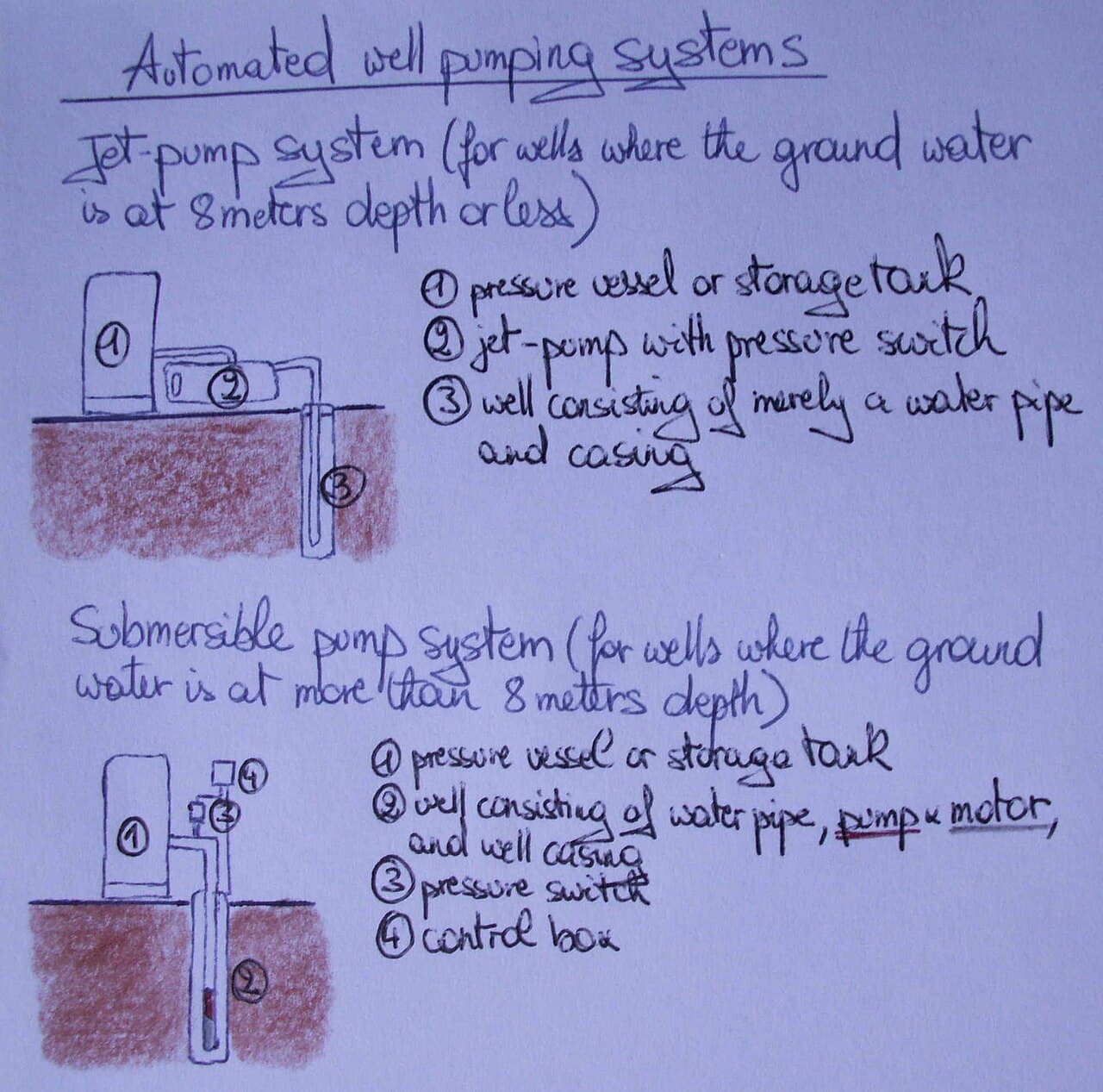
If the tests point into the well, the type of pump decides the size of the job. If repairs are needed, a submersible pump must be pulled from the well,[2] along with its pipe and cable. By contrast, a jet pump sits above ground, where it is easy to get at for repairs,[2] with one exception: "The deep-well jet must be removed from the well for service."[2] Jet pumps have their own failure: An air leak in the suction pipe or a water leak in the drop pipes will cause a jet pump to lose its prime.[2]
Once the system is back together, expect a conversation about water quality. Virginia Cooperative Extension recommends shock chlorination after any maintenance or repair of a private water supply system,[3] and the EPA says to test your well immediately when you replace or repair any part of the well system.[4] Before you pay a lab, ask: your local health department may provide private well testing for free.[4]
What to note before the technician arrives
You can shorten the diagnosis without touching any equipment:
- what the pump was doing before it stopped: running nonstop, clicking on and off, or simply going quiet
- whether there was a storm, lightning or a power outage just before
- the reading on the pressure gauge near the tank, if there is one
- whether the water was cloudy, sandy or spitting air beforehand
- the age of the pump and tank, and any records from earlier repairs
When to call a licensed pro
Call as soon as you lose water, the pump runs without shutting off, or the breaker for the pump trips. Virginia's private well regulations are direct: "Persons engaged in the construction, repair, or alteration of a private well shall be licensed and certified".[5] The Board for Contractors' water well and pump specialty covers the installation of the well pump and tank, including pipe and wire, up to and including the point of connection to the plumbing and electrical systems,[6] and the same rule does not exclude licensed plumbing, electrical or HVAC contractors from installing pumps and tanks.[6] Building the well itself is narrower: "No other classification or specialty service provides for construction of water wells."[6] As Virginia Cooperative Extension reminds well owners: "Your water pump is electric."[3]
Check the business before you book. A license number in an advertisement or on a business card does not necessarily mean the contractor's license is valid,[7] so look it up the way our guide to checking a contractor's licence shows. For background on the parts being tested, read how a well pump works, and if it comes to replacement, what drives the cost.
Get it diagnosed
Loclis lists licensed businesses from Virginia's DPOR register with their licence number and class. Browse well pump services, find plumbers in Blacksburg, or read more plumbing repair answers. When you are ready, describe what the pump is doing once and licensed local businesses quote the visit.
Common questions
- Can a technician tell whether a submersible pump is dead without pulling it?
- Usually they can narrow it down a long way. The standard tests measure voltage, current, insulation resistance and winding resistance from the surface, before the motor is removed from the well. Those readings show whether the motor or its cable has failed, or whether the fault is above ground.
- Why did the technician replace the control box parts when they tested fine?
- Because a passing test is not always proof. Control box component tests are not conclusive: a capacitor can test good and still have lost enough capacitance to stop doing its job. Ask the technician to explain what they measured and why they changed the part.
- What should I have ready when the technician arrives?
- What the pump was doing before it stopped, any recent storm or power outage, the age of the pump and tank if you know them, and your well's paperwork. For a Virginia well built after 1992, the completion report on file with the local health department lists the well's depth and static water level.
- Do I need to disinfect the well after a pump repair?
- It is recommended. Virginia Cooperative Extension advises shock chlorination after any repair to a private water supply system, and the EPA says to test the well right after any part of it is repaired or replaced. Ask whether the contractor's price includes disinfection, and ask your local health department about testing.
- Can a plumber work on my well pump, or does it have to be a well contractor?
- In Virginia, either can do pump and tank work if properly licensed. The Board for Contractors' water well and pump specialty covers pumps and tanks, and the same rule does not exclude licensed plumbing, electrical or HVAC contractors from installing them. Constructing the well itself is reserved for the water well specialty.
Sources
- [1] AIM Manual, 60 Hz Submersible Systems: Application, Installation, Maintenance, Franklin Electric. Checked October 26, 2026.
- [2] Private Drinking Water Wells: The Distribution System (G2152), University of Nebraska-Lincoln Extension. Checked October 26, 2026.
- [3] Virginia Household Water Quality Program: Shock Chlorination, Disinfecting Private Household Water Supply Systems (442-663), Virginia Cooperative Extension, Virginia Tech. Checked October 26, 2026.
- [4] Private Wells: Protect Your Home's Water, U.S. Environmental Protection Agency. Checked October 26, 2026.
- [5] 12VAC5-630-80, Private Well Regulations: Relationship to the Department of Professional and Occupational Regulation, Virginia Administrative Code, Legislative Information System. Checked October 26, 2026.
- [6] 18VAC50-22-30, Board for Contractors Regulations: Definitions of specialty services, Virginia Administrative Code, Legislative Information System. Checked October 26, 2026.
- [7] What You Should Know Before You Hire a Contractor, Virginia Board for Contractors, DPOR. Checked October 26, 2026.
Want a pro to handle it?
Describe the job once. Licensed local businesses send quotes, and you pay only when you book one.
Get a quote for Plumbing Repair