Why does my well pump keep turning on and off?
Four things can cause it: a pressure switch set wrong or failing, a check valve stuck open so it no longer holds pressure, a pressure tank that has lost its air cushion and become waterlogged, or a leak somewhere in the system. Rapid cycling can overheat the motor, damage its bearings and shorten the life of its controls, so have a licensed well and pump contractor diagnose it soon.
Free to ask. Local shops send quotes, and you pay only when you book one.
By Kasra Taheri, Founder, LoclisUpdated
Researched and drafted with AI, then checked claim by claim against the sources listed below before it was published. Prices and rules change; the dates beside each source say when it was last checked.
This is a job for a licensed pro in Virginia
This page explains what the work involves, the permits, what a licensed pro does and what drives the cost. It does not give step-by-step instructions, because this work needs a licence, a permit or both, and doing it wrong can injure someone. Before you hire, check the licence on Virginia's DPOR record.
The short version
A well pump that keeps turning on and off is starting more often than it should. A submersible motor that starts too often has four likely causes: the pressure switch, a check valve stuck open, a waterlogged tank, or a leak in the system.[1] Each is covered below.
This is worth fixing soon, not someday. Excessive cycling shortens the life of the control components and can damage the motor's splines and bearings or overheat it.[1] For a sense of the margin, Franklin Electric's recommended maximum for its encapsulated single-phase motors of 1 to 5.5 horsepower is 100 starts in 24 hours, and 300 for its motors up to 0.75 horsepower.[1] Franklin Electric motors should also run at least one minute each time they start, so the heat built up by the starting current can dissipate.[1] A pump that clicks on and off every few seconds is far outside both.
A waterlogged pressure tank
The tank is supposed to hold a cushion of air. When water is pumped into a tank containing air, the air is compressed, putting the water under pressure.[2] The tank also builds up a reserve of water so the pump starts and stops less often, prolonging the life of the pump.[2]
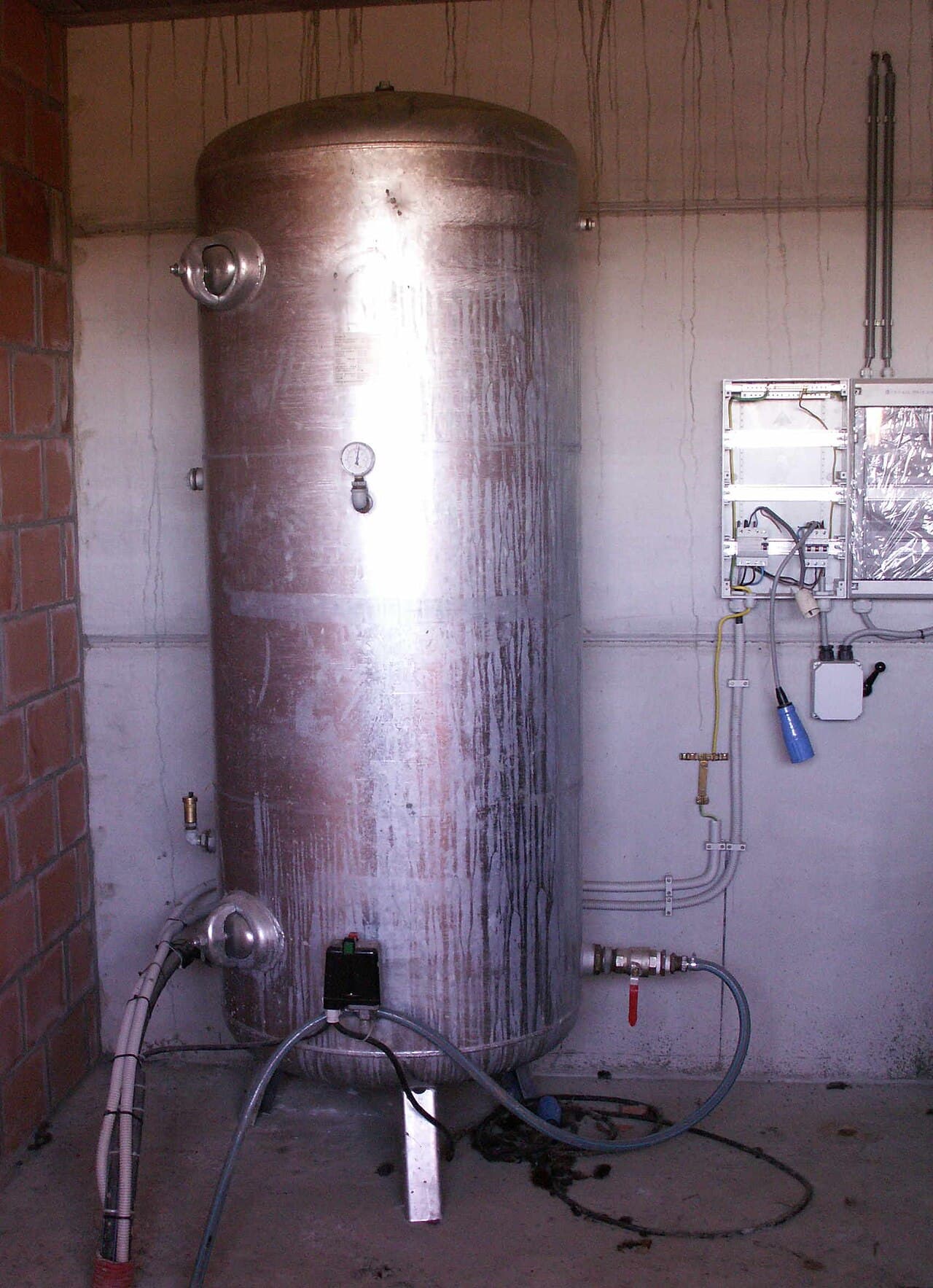
A waterlogged tank causes rapid cycling.[1] The cushion can be lost in two ways, depending on the tank:
- Older steel tanks. In an old galvanized steel tank, air and water are in direct contact, and the water slowly absorbs the air.[2] If the air is not replaced, the tank becomes waterlogged and the pump runs nearly every time water is used.[2]
- Bladder and diaphragm tanks. Since 1970, most private water systems have used diaphragm or bladder-type pressure tanks,[2] which keep air and water apart. They still depend on a cushion of air on the far side of the bladder. A waterlogged tank of either kind is diagnosed by checking its air charge, and the remedy is to clean or replace it.[1]
Signs that point to the tank: the pump starts the moment you open a tap, the pressure gauge swings quickly between its high and low readings, and the flow at a faucet surges and fades. When rapid cycling trips the motor's overload, pressure drops sharply while the motor is off.[1]
The pressure switch
The pressure switch, usually at or near the pressure tank, is the brain of the system: it determines the pressures at which the pump starts and stops.[2] A normal setting leaves a healthy gap between the two, typically shutting off at 40 to 60 psi and starting again at 20 to 40 psi.[2] If the settings are wrong or the contacts are worn, the switch can turn the pump on and off erratically even when the tank is fine.
The switch passes the pump's line voltage through its contacts,[1] so this is not a part to open up yourself.
A check valve that will not hold
Check valves hold pressure in the system when the pump stops.[1] A damaged or defective check valve will not hold pressure.[1] Water drains back toward the well, pressure falls, and the pump starts again even though nobody is using water. A pump that cycles in the middle of the night, with every tap closed, is a strong hint of a check valve or a leak.
A leak somewhere in the system
Any leak lets pressure bleed off between cycles. It might be obvious, such as a dripping hose bib or a wet spot on the basement floor, or hidden, such as a toilet that runs quietly or a split in the buried line between the well and the house. On a submersible system, a leak in the drop pipe inside the well cannot be seen at all.
If the pump runs and will not stop
That is a different problem. A pump that runs and will not stop points elsewhere: a failed pressure switch, a leak, a worn pump, or a pump drawing more than the well can supply.[1] Call a contractor rather than waiting to see whether it stops.
What to note before you call
You can save diagnostic time just by watching, without touching any equipment:
- how often the pump starts, and whether it cycles when no water is running
- the high and low readings on the pressure gauge, if there is one near the tank
- whether the faucets surge, sputter air or run cloudy
- any wet spots, a running toilet or a recent change, such as a power outage, storm or new fixture
When to call a licensed pro
Virginia's private well regulations say: "Persons engaged in the construction, repair, or alteration of a private well shall be licensed and certified".[3] Installing the well pump and tank is part of the Board for Contractors' water well and pump specialty,[4] For a cycling pump, call a licensed well and pump contractor.
Call promptly if the pump cycles every few seconds, runs without stopping, trips its breaker, or the water turns cloudy or sandy. After the repair, ask about disinfection: Virginia Cooperative Extension recommends shock chlorination following any maintenance or repair of a private water supply system.[5] Before you hire, check the contractor's licence, and read how a well pump works if you want the background.
Get it diagnosed
Loclis lists licensed businesses from Virginia's DPOR register. Browse well pump services, find plumbers in Blacksburg, or see more plumbing answers. When you are ready, describe what the pump is doing and licensed local businesses quote the visit.
Common questions
- Is it normal for a well pump to turn on and off?
- Yes, within limits. The pump should start when pressure falls to the switch's cut-in setting and run until it reaches cut-out, often for a minute or more. What is not normal is a pump that starts every time you open a tap, or clicks on and off every few seconds.
- Can short cycling damage my well pump?
- Yes. Excessive cycling shortens the life of the control components and can damage the motor's splines and bearings or overheat it. The longer it goes on, the more likely a tank or switch repair becomes a pump replacement.
- Why does my pump cycle when no water is running?
- Pressure is leaking away somewhere. The usual suspects are a check valve that no longer holds, a leak in the pipe between the well and the house, or a fixture such as a toilet that runs quietly. A contractor can isolate which by watching the pressure gauge with the system shut off in stages.
- Can I just add air to the tank myself?
- It is better left to a contractor. A waterlogged tank may need cleaning or replacing rather than more air, the tank's charge has to suit the pressure switch settings, and the switch beside it carries line voltage. A licensed well and pump contractor can check the tank, the switch and the pump together.
- Does a constant-pressure pump turn on and off too?
- Much less. A variable-speed system slows the pump down as demand drops instead of switching it on and off, so it runs longer with fewer starts. If one of these is cycling hard, the controller settings, the small tank or a leak are the things to check.
Sources
- [1] AIM Manual, 60 Hz Submersible Systems: Application, Installation, Maintenance (2026 edition), Franklin Electric. Checked October 26, 2026.
- [2] Private Drinking Water Wells: The Distribution System (G2152), University of Nebraska-Lincoln Extension. Checked October 26, 2026.
- [3] 12VAC5-630-80, Relationship to the Department of Professional and Occupational Regulation, Virginia Administrative Code, Legislative Information System. Checked October 26, 2026.
- [4] 18VAC50-22-30, Board for Contractors Regulations: Definitions of specialty services, Virginia Administrative Code, Legislative Information System. Checked October 26, 2026.
- [5] Virginia Household Water Quality Program: Shock Chlorination, Disinfecting Private Household Water Supply Systems (442-663), Virginia Cooperative Extension, Virginia Tech. Checked October 26, 2026.
Want a pro to handle it?
Describe the job once. Licensed local businesses send quotes, and you pay only when you book one.
Get a quote for Plumbing Repair