What is the difference between torsion and extension garage door springs?
A torsion spring is a coil on a steel shaft above the door that twists to store energy. An extension spring is a long coil along each side track that stretches. Both balance the door's weight, and both are under dangerous tension, so replacing either is work for a trained garage door technician, not a homeowner.
Free to ask. Local shops send quotes, and you pay only when you book one.
By Kasra Taheri, Founder, LoclisPublished
Researched and drafted with AI, then checked claim by claim against the sources listed below before it was published. Prices and rules change; the dates beside each source say when it was last checked.
This is a job for a licensed pro in Virginia
This page explains what the work involves, the permits, what a licensed pro does and what drives the cost. It does not give step-by-step instructions, because this work needs a licence, a permit or both, and doing it wrong can injure someone. Before you hire, check the licence on Virginia's DPOR record.
A torsion spring is a coil mounted on a steel shaft above the door opening that twists to store energy. An extension spring runs along the horizontal track on each side of the door and stretches. Both do the same job, and Clopay's manual says garage doors use springs to balance the door weight and that there are two types, extension and torsion.[1] Whichever you have, replacing either one is work for a trained technician.
Torsion springs
A torsion spring sits in the middle of the header above the door, with a steel shaft running through it and a cable drum at each end. Cables run from the drums down to the bottom corners of the door. As the door goes down, the cables turn the drums and wind the spring tighter. As the door goes up, the spring unwinds and helps lift it.
Most torsion setups use one or two springs on a single shaft. Because the spring is wound while the door is closed, it holds a lot of stored energy exactly when the door is at rest. Clopay's manual says that attempting to remove a torsion spring assembly without proper training or tools may result in an uncontrolled release of spring forces which can cause serious or fatal injury.[1] The same manual says that torsion springs can be very dangerous if they are improperly installed or mishandled.[1]
Extension springs
Extension springs are long coils that run parallel to the horizontal tracks, one on each side, usually anchored near the top of the track and attached to the door by cables and pulleys. They stretch as the door closes and contract as it opens.
They are easy to recognize from inside the garage. They are not safer because they are easier to see. Clopay's manual says that with the door fully open, most spring tension has been removed,[1] and also says not to attempt to remove or adjust extension springs with the door in the down position.[1]
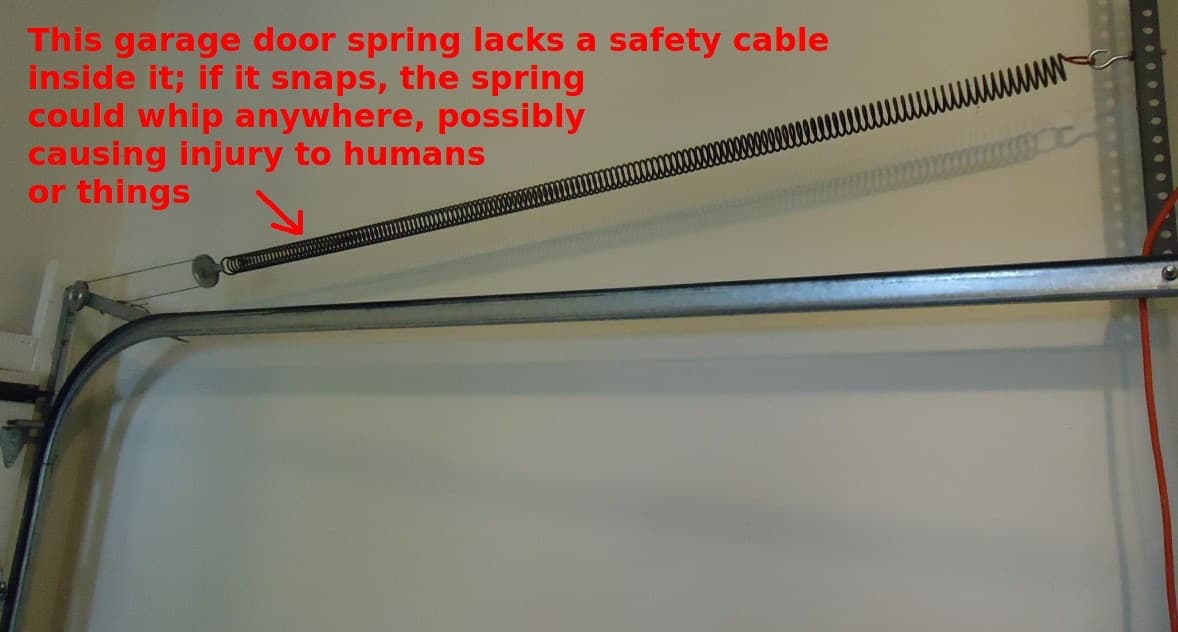
How the two compare
- Where they are: torsion springs are above the door on a shaft; extension springs run along the side tracks.
- How they work: torsion springs twist; extension springs stretch.
- Balance: a torsion setup lifts through drums on a shaft. Extension springs depend on cables and pulleys on both sides staying matched.
- When one breaks: a broken torsion spring usually shows as a visible gap in the coil and a door that will not lift. A broken extension spring may leave the door lopsided or dragging on one side.
- Cost to replace: it varies with the door's weight, the spring size and whether cables or drums need replacing too. Ask for a written quote that lists each part, and ask whether the technician recommends replacing springs as a pair.
The weight is the reason all of this matters. Clopay says some large doors might weigh as much as 500 pounds when the spring tension is removed.[1] The springs are what make that door feel light enough to lift by hand or for a small opener motor.
Signs your springs need attention
You do not need to touch a spring to check on it. The CPSC says a properly operating door is "balanced," meaning it will stay in place when stopped in any partially open position.[2] It also says a severely unbalanced door could unexpectedly crash to the floor, possibly striking someone under the open door.[2] The CPSC recommends inspecting the door and opener every 30 days.[2]
Look for a door that is heavy, jerks or sags to one side, a visible gap in a torsion coil, a stretched or sagging extension spring, frayed cables or a loud bang from the garage. If any of those show up, keep people and vehicles clear and leave the door alone.
When to call a licensed pro
For any work on springs, cables, drums or the brackets at the bottom corners of the door. Clopay says the brackets at the bottom corners of your garage door are under great tension.[1] A technician can tell you which type you have, whether the pair should be replaced together, and whether the cables are worn too.
Virginia has a licensing line to keep in mind. DPOR's consumer guide says that if the work is valued at $1,000 or more, a valid Virginia Contractor's License is required for the license category in which the contractor is to work.[3] The guide also says unlicensed contracting is against the law.[3] Ask any company for its licence number and insurance before work starts.
To go deeper, read how garage door springs work, whether it is safe to replace a spring yourself and what spring replacement costs in Virginia. You can also browse all garage door answers or find garage door repair businesses near you.
If a spring has broken or the door will not stay balanced, describe the job once and local garage door businesses will quote it.
Common questions
- Which type of garage door spring do I have?
- Look above the door. A coil on a metal shaft over the opening is a torsion spring. Long coils running along the side tracks are extension springs. Do not touch either to find out; a look from the floor is enough.
- Which is better, torsion or extension springs?
- Neither is better for every door. The right choice depends on the door's weight and the manufacturer's specification, and a technician should match the springs to the door.
- Can I replace a garage door spring myself?
- Clopay's manual warns that removing a torsion spring assembly without proper training or tools may cause an uncontrolled release of spring forces and serious or fatal injury. Treat extension springs with the same caution and hire a trained technician.
- Should garage door springs be replaced in pairs?
- Often, but not always. Ask the technician whether they recommend replacing both and what that adds to the written quote.
- How do I know if a garage door spring is broken?
- A torsion spring often shows a gap in the coil, and the door feels very heavy or will not lift. A broken extension spring may leave the door lopsided or dragging to one side. Keep clear and call a technician.
Sources
- [1] Installation & Maintenance: Aluminum Full Vision Residential Garage Door Instructions, Clopay. Checked October 27, 2026.
- [2] Non-Reversing Automatic Garage Door Openers Are a Hazard (Pub. 523), U.S. Consumer Product Safety Commission. Checked October 27, 2026.
- [3] What You Should Know Before You Hire a Contractor, Virginia Board for Contractors, DPOR. Checked October 27, 2026.
Want a pro to handle it?
Describe the job once. Licensed local businesses send quotes, and you pay only when you book one.
Get a quote for Garage Doors