What should I ask a junk removal company before booking?
Ask for an all-in written price and what can change it, which items they refuse or surcharge, where the load goes and whether they keep disposal receipts, whether they carry liability insurance, and when payment is due. Where your town requires it, ask about local hauler permits: Fairfax County, for example, requires refuse collectors to hold a Certificate to Operate.
Free to ask. Local shops send quotes, and you pay only when you book one.
By Kasra Taheri, Founder, LoclisPublished
Researched and drafted with AI, then checked claim by claim against the sources listed below before it was published. Prices and rules change; the dates beside each source say when it was last checked.
Step by step
Read when to stop and call a pro, further down this page, before you start.
Step 1: Describe the load the same way to everyone
Send each company the same list of items, rough size, photos and notes on stairs, long carries and parking.
Step 2: Ask how they price
Find out whether they charge by truck volume, by item or by weight, the minimum charge, and how they measure on the day.
Step 3: Ask what costs extra
Get every surcharge in writing, especially refrigerators and freezers, AC units, mattresses, tires and electronics.
Step 4: Ask what they refuse
Confirm which items they will not take, such as paint, chemicals, fuel, propane tanks and batteries, and plan for those separately.
Step 5: Ask where it goes
Ask which landfill, transfer station, recycler or charity the load goes to, and whether they can show a disposal receipt.
Step 6: Ask about permits and insurance
Ask whether they hold any hauler permit your locality requires and whether they carry liability insurance for damage at your home.
Step 7: Get it in writing
Get the price, the date and arrival window, the items included and the payment terms in a written quote before the crew arrives.
Before you book a junk removal company, get five things settled: the full price in writing and what could change it, which items they refuse or charge extra for, where your load goes, whether they hold any permit your locality requires and carry insurance, and when you pay. Most problems with junk removal come from a vague quote or a load that ends up somewhere it should not. A few questions on the phone prevent both.
The price, and what can change it
Ask how they price: by the share of the truck the load fills, by the item, or by weight, and what the minimum charge is. Then ask how they will measure on the day, and what happens if the pile is bigger than described. A good company will price from photos and a list and tell you the range; a company that will only name a price once the truck is in your driveway leaves you little room to say no.
Ask for every surcharge by name. Refrigerators, freezers, dehumidifiers and window AC units, mattresses, tires, TVs and heavy debris such as concrete or dirt are the usual ones. Ask whether stairs, long carries or taking furniture apart cost extra. For what drives these numbers and the public disposal fees behind them, see how much junk removal costs in Virginia.
What they will not take
Every hauler has a refused list, and some of it is set by law. Virginia law makes it unlawful to put a used lead acid battery in mixed municipal solid waste.[5] EPA says lithium-ion batteries and devices containing them should not go in household garbage or recycling bins,[6] because a battery crushed in transport or processing can start a fire.[6] Paint, solvents, fuel, pesticides and propane tanks are usually refused too and belong at your locality's household hazardous waste drop-off; see how to dispose of old paint in Virginia.
For appliances that hold refrigerant, ask how they handle it. EPA says the final disposer of an appliance is responsible for recovering any refrigerant in it,[4] and if someone else recovers it, EPA requires a signed statement with that person's name and address and the date of recovery.[4] A company that takes refrigerators regularly will have an answer ready.
Where your load goes
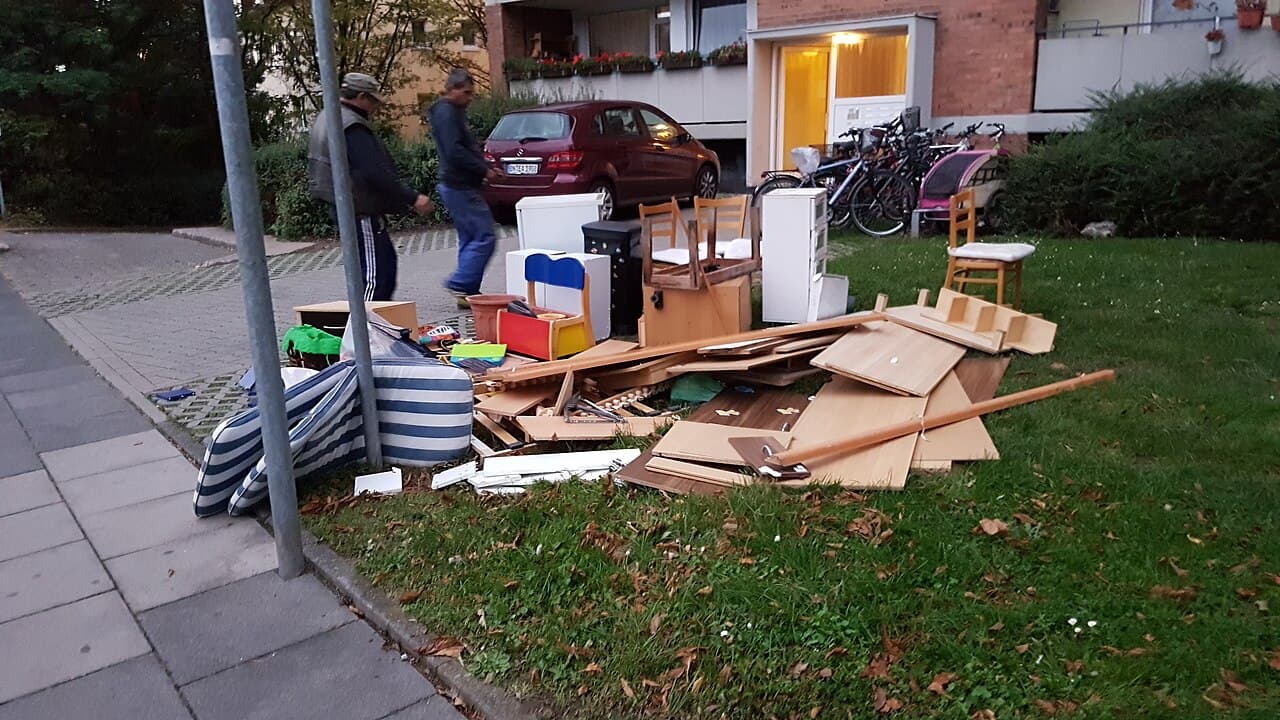
This is the question people skip, and it matters. Virginia law makes it unlawful to dump trash, garbage, refuse or litter on public property, including a highway or right-of-way, or on private property without the written consent of the owner.[1] A conviction is a misdemeanor punishable by up to 12 months in jail and a fine of $500 to $2,500.[1]
A separate statute says it is the duty of all persons to dispose of their solid waste in a legal manner.[2] It adds that, in a civil case, if the waste was in the defendant's possession before it was dumped without the landowner's permission, the court presumes the defendant improperly disposed of it unless the defendant shows otherwise.[2] A court that finds improper disposal must assess a civil penalty of up to $5,000.[2] Boxes and papers with your address on them can lead back to you, so it is worth hiring someone who can tell you where the load goes.
Ask which landfill, transfer station, scrap recycler or charity they use, and whether they can show the disposal ticket. Ask what they donate or recycle, and whether they give donation receipts.
Local permits and insurance
Some Virginia localities regulate who may collect refuse. Fairfax County's code requires refuse collectors serving county residents and businesses to hold a permit called a Certificate to Operate,[3] and contracting with a company that does not have one is a violation of county code subject to civil penalties.[3] The county publishes a list of permitted companies, and says the list is not a recommendation or endorsement.[3] Elsewhere, ask the company and your county or city what applies.
Ask whether the company carries liability insurance, and who pays if the crew scratches a floor, gouges a door frame or damages a car in the driveway. Ask whether the people who come are employees or subcontractors.
Scheduling and payment
Ask for the date and an arrival window, how many people are coming, and whether you need to be home. Ask whether they need the items gathered in one place, and where the truck will park. Ask when payment is due and how; many companies collect when the job is done because the final price depends on the load. Get the price, the items included and the payment terms in writing before the crew arrives.
If something goes wrong
Raise it with the company in writing first, with photos. If that does not resolve it, the Virginia Attorney General's Consumer Protection Section takes complaints against businesses operating in Virginia through an online form,[7] and runs a Consumer Protection Hotline at 1-800-552-9963 from within Virginia.[7] It asks for copies, not originals, of your documents and a statement of the resolution you want.[7] Report items dumped on a roadside or someone's land to your county or city.
Stop and call a pro if
- The load includes chemicals, unlabelled containers or fuel. Ask your locality's household hazardous waste program before anyone hauls it.
- Remodel work is part of the job, such as pulling out cabinets, flooring or a shed. That is a contractor's job, done before the hauler comes.
- A company will not give a price before loading, will not say where the load goes, or asks for full payment up front with nothing in writing. Keep looking.
Booking on Loclis
On Loclis you describe the job once at /jobs/new, businesses quote, and contact details are shared only after you book. A business that needs to see the load first can offer an estimate visit, and a paid visit fee comes off its price. Browse more junk removal and moving answers, see junk removal businesses, or find junk removal and moving businesses around Blacksburg.
Common questions
- Does a junk removal company need a license in Virginia?
- Rules for haulers are set largely by localities. Fairfax County, for example, requires refuse collectors to hold a Certificate to Operate. Ask the company what your county or city requires and whether it holds it.
- Can I get in trouble if a hauler dumps my junk illegally?
- Illegal dumping is a crime under Va. Code § 33.2-802, and in a civil case Va. Code § 10.1-1418.1 presumes the person who had the waste dumped it unless shown otherwise. Hiring a company that can say where the load goes, and keeping your receipt, protects you. For advice on a specific case, talk to a lawyer.
- Should I pay a deposit?
- Many junk removal jobs are paid when the work is done, since the price depends on the load. If a company asks for money up front, get the full price and what the deposit covers in writing first.
- Will a junk removal company take a refrigerator?
- Many will, usually for a surcharge, because the refrigerant has to be recovered before disposal. EPA puts that responsibility on the final disposer. Ask how they handle it.
- Do junk removal companies donate usable items?
- Some do, and some charities pick up furniture themselves. If donation matters to you, ask which charities the company uses and whether it gives you a receipt.
- Where can I complain about a junk removal company in Virginia?
- Start with the company in writing. If that fails, the Virginia Attorney General's Consumer Protection Section takes complaints online and through its hotline at 1-800-552-9963, and your locality handles illegal dumping reports.
Sources
- [1] Va. Code § 33.2-802, Dumping trash; penalty, Code of Virginia, Virginia General Assembly. Checked October 26, 2026.
- [2] Va. Code § 10.1-1418.1, Improper disposal of solid waste; civil penalties, Code of Virginia, Virginia General Assembly. Checked October 26, 2026.
- [3] Permitted Solid Waste Collection Companies, Fairfax County Department of Public Works and Environmental Services. Checked October 26, 2026.
- [4] Appliance Disposal, U.S. Environmental Protection Agency. Checked October 26, 2026.
- [5] Va. Code § 10.1-1425.1, Lead acid batteries; land disposal prohibited; penalty, Code of Virginia, Virginia General Assembly. Checked October 26, 2026.
- [6] Used Lithium-Ion Batteries, U.S. Environmental Protection Agency. Checked October 26, 2026.
- [7] File a Complaint, Office of the Attorney General of Virginia, Consumer Protection Section. Checked October 26, 2026.
Want a pro to handle it?
Describe the job once. Licensed local businesses send quotes, and you pay only when you book one.
Get a quote from a local pro