Why won't the trash company take my bulky items?
Bulky items are usually not part of weekly trash pickup. Most Virginia localities and private haulers collect them separately, on a set schedule or by appointment, with limits on size and lists of refused items such as tires, construction debris, paint, propane tanks and appliances still holding refrigerant. Check who collects your trash, schedule a bulk pickup, or take items to a drop-off site.
Free to ask. Local shops send quotes, and you pay only when you book one.
By Kasra Taheri, Founder, LoclisPublished
Researched and drafted with AI, then checked claim by claim against the sources listed below before it was published. Prices and rules change; the dates beside each source say when it was last checked.
Step by step
Read when to stop and call a pro, further down this page, before you start.
Step 1: Find out who collects your trash
Check whether your county, city, town or a private company collects your trash; your bill, HOA or locality's website will say.
Step 2: Read their bulk item rules
Look up the collector's bulk or special pickup page for the schedule, size limits and the list of accepted items.
Step 3: Schedule the pickup if one is needed
Book the bulk, appliance or special pickup in advance if your collector requires it, and note the confirmed date.
Step 4: Pull out refused items
Remove tires, paint, gas cans, propane tanks, batteries and construction debris from the pile and plan another route for each.
Step 5: Break the pile into allowed sizes
Keep each item and pile within the collector's length and volume limits, and separate piles by type if asked.
Step 6: Set it out at the right time and place
Put items where your household trash goes, on the right day, clear of wires, branches, cars and mailboxes.
Step 7: Call if it is still there
If items are left after the stated pickup window, call your collector or locality's service line before setting them out again.
Step 8: Use a drop-off site or hauler instead
Take the items to your county or city's transfer station or convenience center, or book a junk removal company.
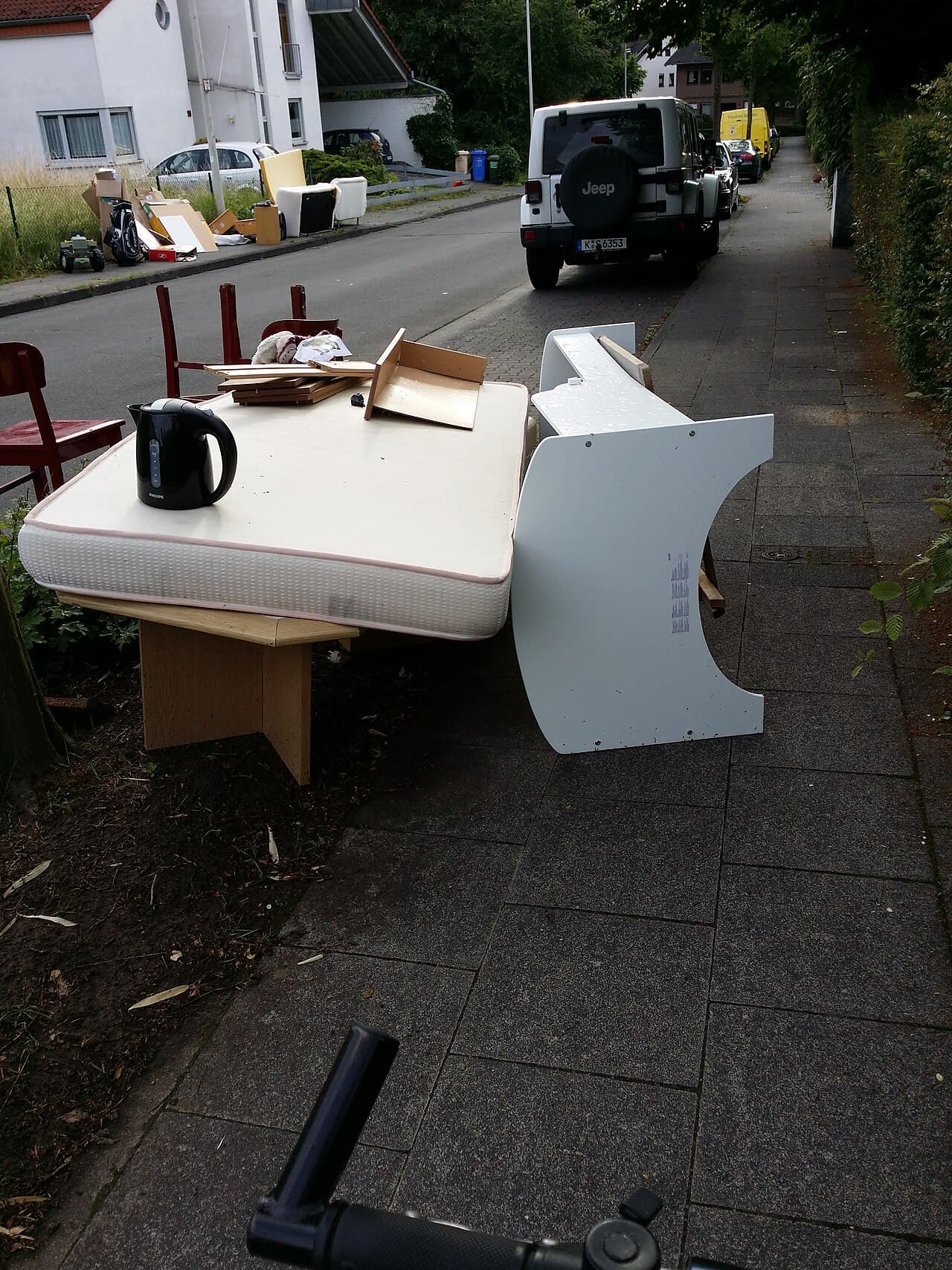
Most trash companies do not take bulky items with the weekly trash. Furniture, mattresses, appliances and large piles go on a separate bulk pickup, usually on a set schedule or by appointment, with limits on size and a list of items they refuse. When a couch or a fridge sits at the curb after trash day, the cause is almost always one of a handful of rules, and each has a fix.
Bulky items are collected separately
EPA notes that managers of solid waste facilities often call durable goods such as furniture, appliances and carpets oversized and bulky,[1] and that these goods are often picked up separately and typically not mixed with other trash at the facility.[1] EPA also says some municipalities require an appointment for bulky item collection, while others require you to haul items to a transfer station or landfill.[2] The weekly truck is set up for bags and carts, not a sofa.
The common reasons, and what to do about each
1. It was not scheduled, or it went out on the wrong week. Many collectors need bulk items booked ahead or set out on a particular week. In Fairfax County, about 10 percent of residents get trash collection from the county and about 90 percent of residents and businesses use private collection companies,[3] and county customers must schedule special collections for bulk items, appliances with refrigerant, brush, electronics and metal in advance.[3] Richmond collects bulk items every other week, on your trash day during your recycling week, and asks you to set them out the night before beside your trash cans.[4] If they are not collected by Saturday of that week, the crew is supposed to return; if they are still there by Saturday of your second recycling week, the city says to call 3-1-1.[4]
2. You called the wrong collector. If an HOA or a private company collects your trash, its rules apply, not the county's. Check your bill or HOA notices before calling.
3. The pile is too big, too long or mixed. Fairfax County limits a special pickup pile to 2 cubic yards, about 6 feet long, 3 feet wide and 3 feet high, charges for larger piles, and requires items to be less than 6 feet long.[3] It asks for piles separated by type, because different trucks collect different materials,[3] and says any item not on its accepted list will not be collected.[3]
4. The pile is in a spot the truck cannot reach. Fairfax County also requires 20 feet of clearance above and on all sides of the pile, and no items under utility wires or tree branches.[3] Piles behind parked cars, against a mailbox or up a long driveway can be skipped.
5. Something in it is on the refused list. Richmond's bulk program refuses construction debris, tires, carpet, auto parts, bricks, drywall, pipes, paint, gas tanks, propane tanks and lawn mowers.[4] Fairfax County's metal pickup excludes cardboard, plastic bags and construction debris.[3]
6. It is an appliance that still holds refrigerant. EPA says municipalities may require the refrigerant to be recovered from appliances before they will accept them for pickup, which can mean hiring a professional such as an appliance repair technician to remove it first.[2] When we checked on October 26, 2026, Richmond charged $50 per appliance for appliance collection,[5] and Fairfax County schedules refrigerators, freezers, dehumidifiers and air conditioners as a separate Freon pickup.[3]
7. It contains batteries, fuel or chemicals. Virginia law makes it unlawful to put a used lead acid battery in mixed municipal solid waste.[7] Gas cans, propane tanks, paint and lithium-ion batteries are refused by most programs and go to a household hazardous waste drop-off; see how to dispose of old paint in Virginia.
8. It was not in an approved container. Bags or boxes of household junk beside the cart can be a container problem rather than a bulk one. Richmond requires household trash to be in a city-issued supercan and says items in other cans or containers will not be collected.[5]
In the New River Valley
The Montgomery Regional Solid Waste Authority says furniture can go to its transfer station any time of year, with tipping fees,[6] and points Blacksburg and Christiansburg residents to their towns for spring and fall pickup events.[6] Check your town's website for the next bulk collection dates before setting anything out.
When the pickup is not worth waiting for
Drop-off is often faster. Richmond residents can take appliances and bulk items to the East Richmond Road Convenience Center or the Southside Transfer Station on North Hopkins Road.[5] Most counties run a transfer station or convenience centers; bring proof of address. For a whole room or garage, or anything too heavy to load yourself, a junk removal company takes it all in one trip; see how much junk removal costs in Virginia and what to ask before booking.
Stop and call a pro if
- The item is too heavy or awkward to move safely, such as a chest freezer, a piano or a hot tub.
- An appliance has to have its refrigerant recovered before your locality will take it. That is a job for a professional such as an appliance repair technician, not something to do yourself.
- The pile includes leaking containers, fuel, unlabelled chemicals or swollen batteries. Ask your locality's household hazardous waste program.
- The debris came from a remodel or demolition. It needs a construction debris route, such as a rented dumpster or a hauler that takes it.
Getting it hauled through Loclis
Browse more junk removal and moving answers, see junk removal businesses, or find junk removal and moving businesses around Blacksburg. To get the items gone without waiting for the next bulk week, describe the job on Loclis and compare quotes.
Common questions
- Why did the trash truck leave my couch at the curb?
- Usually because furniture is collected by a separate bulk pickup, not the weekly trash truck. Many collectors need it scheduled in advance or set out on a particular week, and some limit size or refuse certain items.
- Will the trash company take an old refrigerator?
- Often only through a separate appliance pickup, sometimes for a fee, because the refrigerant has to be recovered. Richmond charged $50 per appliance when we checked in October 2026, and Fairfax County schedules refrigerators as a separate Freon pickup. Some localities require the refrigerant to be removed before pickup.
- Why won't they take my old tires or drywall?
- Many bulk programs refuse them. Richmond's bulk program refuses tires, drywall, bricks and other construction debris, for example. Tires usually go to a transfer station or tire retailer, and remodel debris to a construction debris site, a rented dumpster or a hauler.
- My HOA contracts the trash service. Who do I call?
- Call the collection company named on your HOA's notices, or the HOA itself. Private collectors set their own bulk item rules and fees.
- Can I just leave items at the curb until someone takes them?
- Not for long. Collectors and localities set out times and places, and items left outside those rules can draw a violation notice. If a scheduled pickup is missed, call the collector or your locality.
- What is the fastest way to get rid of bulky items?
- Taking them to your locality's transfer station or convenience center yourself, if you have a truck, or booking a junk removal company, which can take most items in one trip.
Sources
- [1] Durable Goods: Product-Specific Data, U.S. Environmental Protection Agency. Checked October 26, 2026.
- [2] Appliance Disposal, U.S. Environmental Protection Agency. Checked October 26, 2026.
- [3] Special Pickup, Fairfax County Department of Public Works and Environmental Services. Checked October 26, 2026.
- [4] Bulk and Brush, City of Richmond Department of Public Works. Checked October 26, 2026.
- [5] Trash Collection, City of Richmond Department of Public Works. Checked October 26, 2026.
- [6] Disposal Guide, Montgomery Regional Solid Waste Authority. Checked October 26, 2026.
- [7] Va. Code § 10.1-1425.1, Lead acid batteries; land disposal prohibited; penalty, Code of Virginia, Virginia General Assembly. Checked October 26, 2026.
Want a pro to handle it?
Describe the job once. Licensed local businesses send quotes, and you pay only when you book one.
Get a quote from a local pro